01 / Morfologi

Ciri dan struktur

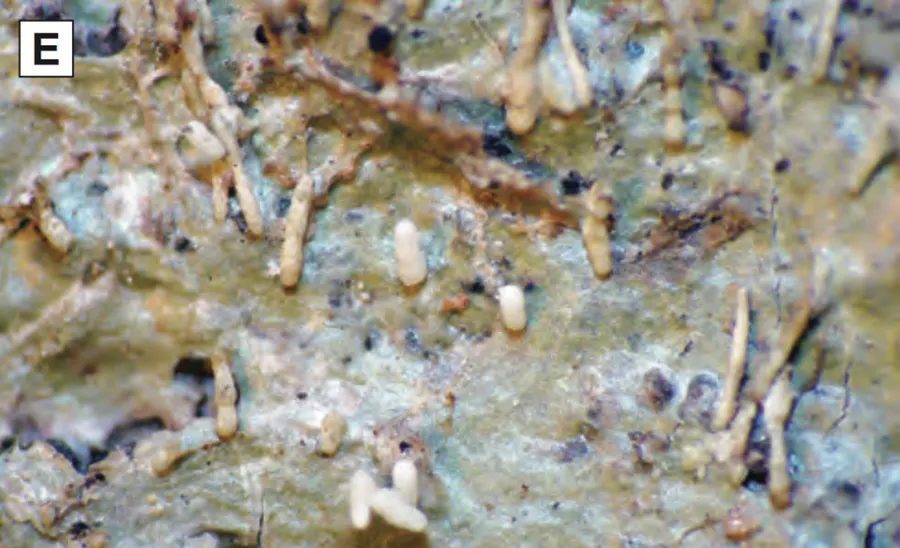
Acanthotrema alboisidiatum can extend to a diameter of up to 5 cm. The thallus, or body, of the lichen is light olive-green, smooth to uneven and shiny. What stands out are the white isidia, short outgrowths on the lichen's surface that, especially when not fully matured, bear a resemblance to insect eggs. These isidia range from 0.2 to 1.0 mm long and 0.1–0.15 mm wide. Despite careful examination, ascomata, the reproductive structures where spores are produced, were not observed in this species. The lichen's photobiont, the component responsible for photosynthesis, is a form of green alga known as Trentepohlia. The cells of Trentepohlia are irregular and grouped together, with a yellowish-green hue. No chemical substances were detected by thin-layer chromatography during the analysis of this species.

Sebagian uraian ditampilkan dalam bahasa sumber; terjemahannya belum tersedia atau belum lolos pemeriksaan.

Rujukan: [1]

Pengukuran mengikuti objek, spesimen atau kultur, dan metode yang disebutkan sumber. Baca uraian asli untuk konteks lengkap.

02 / Kehidupan

Habitat dan peran ekologis

Acanthotrema alboisidiatum was discovered in the shaded understory of Tabonuco forests in El Yunque National Forest, Puerto Rico. It was particularly found towards the base of Dacryodes excelsa trees, suggesting a preference for this type of environment. An additional specimen was examined from Luquillo, Puerto Rico. Tabonuco forests in Puerto Rico have a diverse lichen biota, with 76 corticolous species having been identified from this habitat.

Sebagian uraian ditampilkan dalam bahasa sumber; terjemahannya belum tersedia atau belum lolos pemeriksaan.

Rujukan: [1]

Habitat atau konteks temuan
hutan
Substrat
Informasi belum tersedia pada sumber rilis ini.
Peran atau konteks
Pembentuk liken
Temukan hubungan serupa
03 / Siklus hidup

Reproduksi

Acanthotrema alboisidiatum can extend to a diameter of up to 5 cm. The thallus, or body, of the lichen is light olive-green, smooth to uneven and shiny. What stands out are the white isidia, short outgrowths on the lichen's surface that, especially when not fully matured, bear a resemblance to insect eggs. These isidia range from 0.2 to 1.0 mm long and 0.1–0.15 mm wide. Despite careful examination, ascomata, the reproductive structures where spores are produced, were not observed in this species. The lichen's photobiont, the component responsible for photosynthesis, is a form of green alga known as Trentepohlia. The cells of Trentepohlia are irregular and grouped together, with a yellowish-green hue.

Sebagian uraian ditampilkan dalam bahasa sumber; terjemahannya belum tersedia atau belum lolos pemeriksaan.

Rujukan: [1]

04 / Batas informasi

Catatan identitas dan cakupan

  • Nama diterima mengikuti Catalogue of Life Base2026-09-11; uraian mempertahankan konsep dan nama sumber aslinya.
  • Original geographic, specimen and life-cycle scope retained; source import awaits individual editorial review.
  • Impor dan terjemahan otomatis belum diperiksa editorial per profil. Struktur reproduktif yang disebutkan tidak membuktikan seluruh siklus hidup diketahui.
  • Pengukuran pada uraian mengikuti spesimen, kultur, dan metode sumber; angka tidak diperluas ke semua populasi.

Catatan distribusi dalam narasi mengikuti sumbernya. Dokumentasi spesimen atau foto mengikuti catatan sumber. Bukti wilayah Indonesia dan penilaian konservasi tidak disimpulkan dari gambar.

05 / Dokumentasi

Melihat dengan konteks

Dokumentasi Acanthotrema alboisidiatum dari Wikimedia Commons. The thallus of the corticolous (bark-dwelling) lichen Acanthotrema alboisidiatum , showing the white isidia that contrast with its light olive-green thallus. Identifikasi mengikuti record berkas sumber.

Jenis
Fotografi
Kredit
J.A. Mercado-Díaz
Sumber media
Buka entri sumber

Gambar menunjukkan objek menurut identifikasi sumber, bukan verifikasi independen spesimen oleh Fungi. Tidak ada skala baru yang ditambahkan.

06 / Rujukan

Sumber profil

  1. [1] Acanthotrema alboisidiatum — Wikipedia (en)Bagian sumber: Frozen revision 1159751791
    Tanggal penghimpunan sumber: 2026-10-12
    Teks sumber: CC BY-SA4.0 · Wikipedia contributors
  2. [2] Catalogue of Life Base2026-09-11 — Acanthotrema alboisidiatumBagian sumber: ColDP NameUsage.tsv ID 92GK; accepted species; source 2073
    Tanggal penghimpunan sumber: 2026-10-12
  3. [3] Dokumentasi visual — Acanthotrema alboisidiatumBagian sumber: Individual media record; identification follows the source, not independent determination
    Tanggal penghimpunan sumber: 2026-10-12
    Media sumber: Public domain · J.A. Mercado-Díaz

Adaptasi teks: CC BY-SA 4.0. Wikipedia contributors — Acanthotrema alboisidiatum — Wikipedia (en)

Uraian asli dan riwayat sumber

Riwayat atau halaman sumber

Ringkasan sumber

Acanthotrema alboisidiatum is a species of corticolous (bark-dwelling) crustose lichen in the family Graphidaceae. Described as a new species in 2014, it is primarily distinguished by its striking white isidia that contrast with its light olive-green thallus. The lichen was recognized as a new species despite the absence of and , usually crucial for taxonomic identification. Its DNA sequence data confirms its place in the Acanthotrema genus but distinguishes it from other known members of this genus.

Revisi sumber

Morfologi sumber

Acanthotrema alboisidiatum can extend to a diameter of up to 5 cm. The thallus, or body, of the lichen is light olive-green, smooth to uneven and shiny. What stands out are the white isidia, short outgrowths on the lichen's surface that, especially when not fully matured, bear a resemblance to insect eggs. These isidia range from 0.2 to 1.0 mm long and 0.1–0.15 mm wide. Despite careful examination, ascomata, the reproductive structures where spores are produced, were not observed in this species. The lichen's photobiont, the component responsible for photosynthesis, is a form of green alga known as Trentepohlia. The cells of Trentepohlia are irregular and grouped together, with a yellowish-green hue. No chemical substances were detected by thin-layer chromatography during the analysis of this species.

Revisi sumber

Ekologi sumber

Acanthotrema alboisidiatum was discovered in the shaded understory of Tabonuco forests in El Yunque National Forest, Puerto Rico. It was particularly found towards the base of Dacryodes excelsa trees, suggesting a preference for this type of environment. An additional specimen was examined from Luquillo, Puerto Rico. Tabonuco forests in Puerto Rico have a diverse lichen biota, with 76 corticolous species having been identified from this habitat.

Revisi sumber

Struktur reproduksi sumber

Acanthotrema alboisidiatum can extend to a diameter of up to 5 cm. The thallus, or body, of the lichen is light olive-green, smooth to uneven and shiny. What stands out are the white isidia, short outgrowths on the lichen's surface that, especially when not fully matured, bear a resemblance to insect eggs. These isidia range from 0.2 to 1.0 mm long and 0.1–0.15 mm wide. Despite careful examination, ascomata, the reproductive structures where spores are produced, were not observed in this species. The lichen's photobiont, the component responsible for photosynthesis, is a form of green alga known as Trentepohlia. The cells of Trentepohlia are irregular and grouped together, with a yellowish-green hue.

Revisi sumber

Rujukan halaman ini

Fungi. Acanthotrema alboisidiatum. Rilis data fungi-2026-10-12-expansion-2. https://fungi-atlas.mgadib.chatgpt.site/jamur/acanthotrema-alboisidiatum/.

Status: impor sumber; pemeriksaan editorial per profil belum selesai. Untuk klaim biologis, gunakan rujukan pada bagian terkait dan periksa konteks sumber aslinya.