Ciri dan struktur
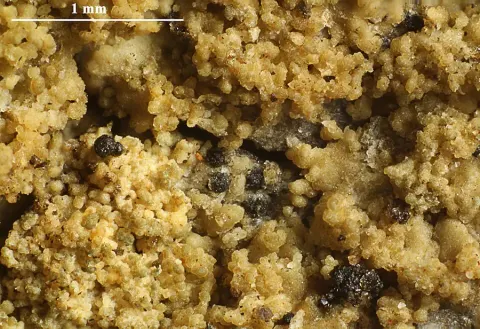
Agonimia flabelliformis has a small, scaly () thallus. Its thallus is distinctive, with fan-shaped () or finely branching, coral-like projections (). The are minute, ranging from 15 to 150 μm wide, and are formed from clusters of roundish green structures called . These goniocysts consist of algal cells surrounded by fungal hyphae that form a clear, jelly-like cortex without the small bumps () found in similar species. The lichen appears bright green when moist and fades to a pale brownish-green when dry. The fruiting bodies of the lichen, known as perithecia, initially appear round but sometimes become slightly pear-shaped as they mature. They measure between 150 and 250 μm in height and 150 to 200 μm in width, and have a dull, pale brown to greyish-brown surface. These perithecia do not possess an , a protective external tissue seen in some lichens. Their openings (ostioles) are pale-coloured and relatively wide, measuring about 30–50 μm across. Internally, the perithecia have a three-layered wall (): an inner clear layer, a dark brown middle layer, and an outer colourless layer. Inside the perithecia, club-shaped asci (structures holding spores) each contain eight spores. The spores themselves are colourless, oblong to ellipsoid in shape, with multiple internal divisions, measuring about 23–35 μm by 11–15 μm. Additionally, simple or segmented —tiny thread-like structures—line the inside of the perithecial openings. The lichen's photosynthetic partner () is a green alga from the group Chlorophyta, consisting of roughly spherical () cells about 8–12 μm in diameter. Pycnidia, another type of reproductive structure, have not been observed in this species.
Habitat dan peran ekologis
The species has so far been recorded from shaded and humid habitats in the Czech Republic, Germany, and Great Britain, growing primarily on mossy bark at tree bases, roots, rocks, and occasionally on soil and decaying plant matter. It frequently associates with the moss Isothecium myosuroides but can also occur independently of mosses. It has also been recorded from Poland, Slovakia, and Lithuania. In addition to Europe, the lichen has also been recorded in eastern North America and the Russian Far East.
- Habitat atau konteks temuan
- Informasi belum tersedia pada sumber rilis ini.
- Substrat
- tanah
- Peran atau konteks
- Pembentuk liken
Reproduksi
Inside the perithecia, club-shaped asci (structures holding spores) each contain eight spores. The spores themselves are colourless, oblong to ellipsoid in shape, with multiple internal divisions, measuring about 23–35 μm by 11–15 μm. Additionally, simple or segmented —tiny thread-like structures—line the inside of the perithecial openings. The lichen's photosynthetic partner () is a green alga from the group Chlorophyta, consisting of roughly spherical () cells about 8–12 μm in diameter. Pycnidia, another type of reproductive structure, have not been observed in this species. No secondary metabolites were detected through standard thin-layer chromatography analysis.
Catatan identitas dan cakupan
- Nama diterima mengikuti Catalogue of Life Base2026-09-11; uraian mempertahankan konsep dan nama sumber aslinya.
- Original geographic, specimen and life-cycle scope retained; source import awaits individual editorial review.
- Impor dan terjemahan otomatis belum diperiksa editorial per profil. Struktur reproduktif yang disebutkan tidak membuktikan seluruh siklus hidup diketahui.
- Pengukuran pada uraian mengikuti spesimen, kultur, dan metode sumber; angka tidak diperluas ke semua populasi.
Catatan distribusi dalam narasi mengikuti sumbernya. Dokumentasi spesimen atau foto mengikuti catatan sumber. Bukti wilayah Indonesia dan penilaian konservasi tidak disimpulkan dari gambar.
Melihat dengan konteks
Ilustrasi skematis garis luar spora Agonimia flabelliformis, berdasarkan uraian sumber; ukuran yang dilaporkan 23–35 × 11–15 µm. Proporsi disederhanakan, bukan salinan satu spesimen. Ornamen permukaan, warna, sekat, dan isi sel tidak direkonstruksi. Varian spora elipsoid, sekitar 23–35 × 11–15 µm. Banyak pembagian internal tidak digambar; ukuran alga pasangan tidak digunakan. Ornamen, warna, sekat, dan isi sel tidak digambar. Skema edukasi, bukan alat identifikasi.
- Jenis
- Ilustrasi skematis
- Kredit
- Fungi, ilustrasi orisinal (2026); fakta morfologi berdasarkan Wikipedia contributors
- Lisensi
- CC BY-SA 4.0
- Sumber media
- Buka entri sumber
Sumber profil
- [1] Agonimia flabelliformis — Wikipedia (en)
- [2] Catalogue of Life Base2026-09-11 — Agonimia flabelliformis
Rujukan halaman ini
Fungi. Agonimia flabelliformis. Rilis data fungi-2026-10-12-expansion-2. https://fungi-atlas.mgadib.chatgpt.site/jamur/agonimia-flabelliformis/.
Status: impor sumber; pemeriksaan editorial per profil belum selesai. Untuk klaim biologis, gunakan rujukan pada bagian terkait dan periksa konteks sumber aslinya.