Ciri dan struktur
Aleurodiscus sichuanensis resembles A. oakesii in having acanthophyses, simple-septate generative hyphae, and gloeocystidia occasionally with protuberances. However, clamped hyphae are rarely present in A. oakesii. Protuberances of acanthophyses of A. oakesii are antler-like, while aculei of acanthophyses in A. sichuanensis are fairly small. Basidiospores of A. sichuanensis are D-shaped or broadly ellipsoid, while those of A. oakesii are ovoid-ellipsoid and slightly smaller (18–27 ×12–14(–17) μm). Aleurodiscus sichuanensis, however, is most closely related to A. alpinus and differs from it by having acanthophyses and simple-septate hyphae. Basidiomes resupinate, effused, adnate, membranaceous-subceraceous, 150–350 μm thick in section. Hymenial surface smooth, Buff or Buff Yellow, occasionally cracked; margin concolorous, determinate. Hyphal system monomitic; hyphae simple-septate. Subiculum uniform, with dense texture, thin or up to 150 μm thick; hyphae interwoven, colorless, richly ramified, tortuous, usually full of small oily drops, 2.5–5.5 μm diam, thin-walled. Hymenial layer with dense texture, 100–200 μm thick; hyphae vertical, colorless, ± straight, 2.5–4.5 μm diam, thin-walled. Crystal masses scattered in subiculum, yellowish. Gloeocystidia numerous, immersed or projecting, yellowish or pale brownish yellow, cylindrical, narrowly clavate or tubular, with oily contents or homogeneous, SA +, basal or median portion occasionally with small aculei, 70–135 × 7–14 μm, with 0.5–1 μm thick walls. Acanthophyses numerous, irregularly cylindrical or narrowly clavate, sometimes subfusiform, colorless, apical parts with numerous aculei, 30–70 × 3–8(–12) μm (aculei excluded), thin-walled.
Habitat dan peran ekologis
On dead branches of Quercus and other angiosperms at high elevations, China, Jul to Oct.
- Habitat atau konteks temuan
- Informasi belum tersedia pada sumber rilis ini.
- Substrat
- kayu
- Peran atau konteks
- Belum dikategorikan pada rilis ini.
Reproduksi
Aleurodiscus sichuanensis resembles A. oakesii in having acanthophyses, simple-septate generative hyphae, and gloeocystidia occasionally with protuberances. However, clamped hyphae are rarely present in A. oakesii. Protuberances of acanthophyses of A. oakesii are antler-like, while aculei of acanthophyses in A. sichuanensis are fairly small. Basidiospores of A. sichuanensis are D-shaped or broadly ellipsoid, while those of A. oakesii are ovoid-ellipsoid and slightly smaller (18–27 ×12–14(–17) μm). Aleurodiscus sichuanensis, however, is most closely related to A. alpinus and differs from it by having acanthophyses and simple-septate hyphae. Basidiomes resupinate, effused, adnate, membranaceous-subceraceous, 150–350 μm thick in section.
Catatan identitas dan cakupan
- Nama diterima mengikuti Catalogue of Life Base2026-09-11; uraian mempertahankan konsep dan nama sumber aslinya.
- Preserve original treatment localities, hosts and substrate scope. Materials examined describe documented specimens, not the full global range.
- Impor dan terjemahan otomatis belum diperiksa editorial per profil. Struktur reproduktif yang disebutkan tidak membuktikan seluruh siklus hidup diketahui.
- Pengukuran pada uraian mengikuti spesimen, kultur, dan metode sumber; angka tidak diperluas ke semua populasi.
Catatan distribusi dalam narasi mengikuti sumbernya. Dokumentasi spesimen atau foto mengikuti catatan sumber. Bukti wilayah Indonesia dan penilaian konservasi tidak disimpulkan dari gambar.
Melihat dengan konteks
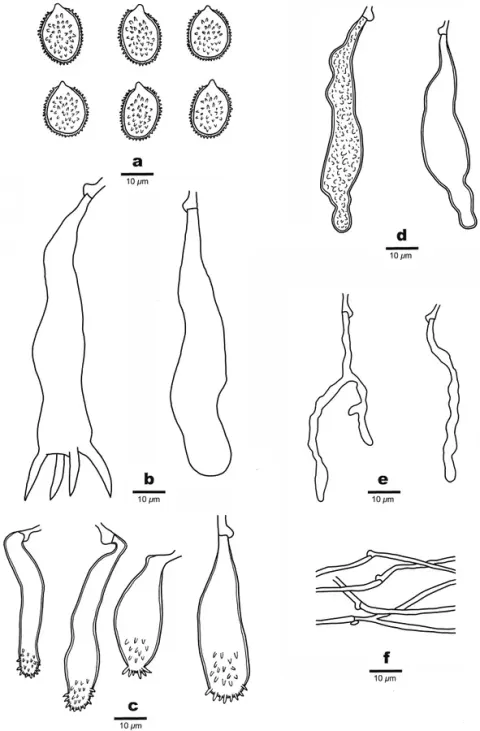
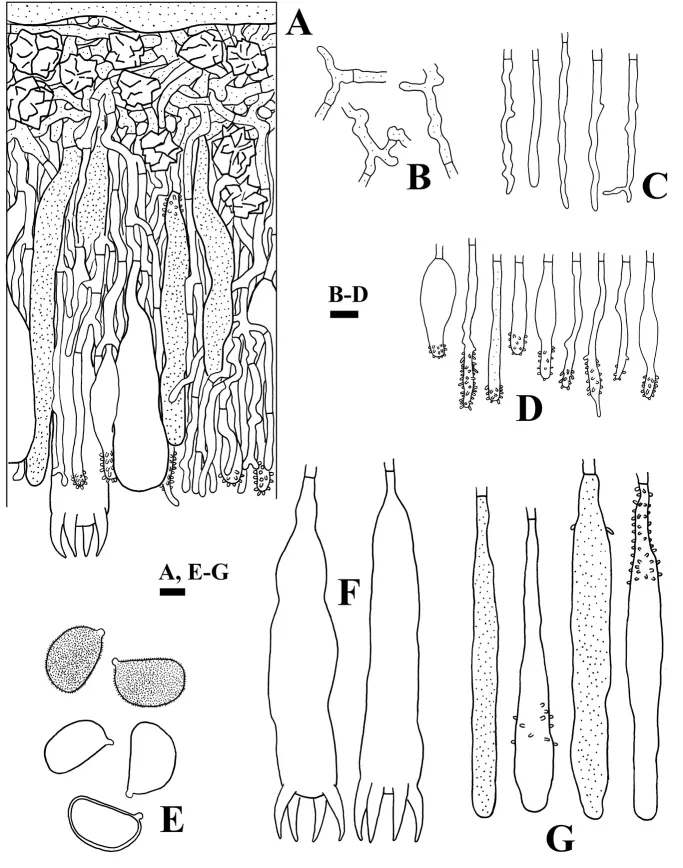
Microscopic structures of Aleurodiscus sichuanensis (holotype, Wu 0010-18) A basidiocarp section B subicular hyphae C hyphidia D acanthophyses E basidiospores (upper: in IKI, lower: in KOH) F basidia G gloeocysitidia. Scale bars: 10 μm.
- Jenis
- Pelat ilmiah
- Kredit
- Sheng-Hua Wu, Chia-Ling Wei, Yu-Ting Lin, Chiung-Chih Chang, Shuang-Hui He
- Lisensi
- CC BY 4.0
- Sumber media
- Buka entri sumber
Dokumentasi tambahan

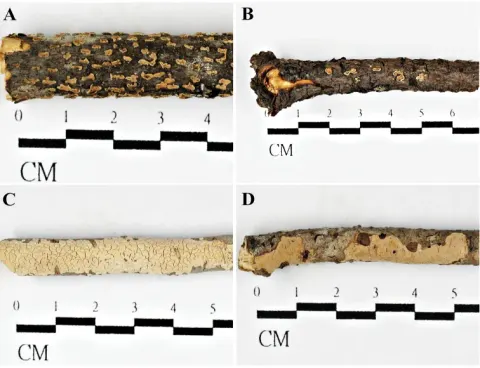
Basidiocarps A Aleurodiscus alpinus (holotype, Wu 1407-55) B A. pinicola (holotype, Wu 1308-54) C A. senticosus (holotype, Wu 1308-54) D A. sichuanensis (holotype, Wu 0010-18).
Kredit dan penggunaan
Sheng-Hua Wu, Chia-Ling Wei, Yu-Ting Lin, Chiung-Chih Chang, Shuang-Hui He
Ukuran dan format gambar disesuaikan tanpa pemotongan, retus, atau penambahan skala. Lisensi sumber dipertahankan.
Sumber profil
- [1] Four new East Asian species of Aleurodiscus with echinulate basidiospores — Aleurodiscus sichuanensis
- [2] Catalogue of Life Base2026-09-11 — Aleurodiscus sichuanensis
- [3] Dokumentasi visual — Aleurodiscus sichuanensis
- [4] Dokumentasi visual — Aleurodiscus sichuanensis
Rujukan halaman ini
Fungi. Aleurodiscus sichuanensis. Rilis data fungi-2026-10-12-expansion-2. https://fungi-atlas.mgadib.chatgpt.site/jamur/aleurodiscus-sichuanensis/.
Status: impor sumber; pemeriksaan editorial per profil belum selesai. Untuk klaim biologis, gunakan rujukan pada bagian terkait dan periksa konteks sumber aslinya.