01 / Morfologi

Ciri dan struktur

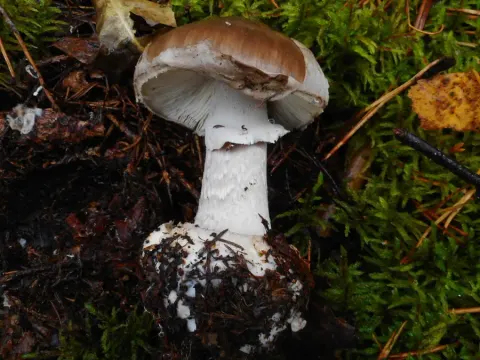
The death cap has a large and imposing epigeous (aboveground) fruiting body (basidiocarp), usually with a pileus (cap) from 5 to 15 cm across (2 to 5.8 inches) across, initially rounded and hemispherical, but flattening with age. The color of the cap can be pale-green, yellowish-green, olive-green, bronze, or (in one form) white; it is often paler toward the margins, which can have darker streaks; it is also often paler after rain. The cap surface is sticky when wet and easily peeled—a troublesome feature, as that is allegedly a feature of edible fungi. The remains of the partial veil are seen as a skirtlike, floppy annulus usually about 1 to 1.5 cm below the cap. The crowded white lamellae (gills) are free. The stipe is white with a scattering of grayish-olive scales and is 8 to 15 cm long and 1 to 2 cm thick, with a swollen, ragged, sac-like white volva (base). Spores: 7-12 x 6-9 μm. Smooth, ellipsoid, amyloid. The smell has been described as initially faint and honey-sweet, but strengthening over time to become overpowering, sickly-sweet and objectionable. Young specimens first emerge from the ground resembling a white egg covered by a universal veil, which then breaks, leaving the volva as a remnant. The spore print is white, a common feature of Amanita. The transparent spores are globular to egg-shaped, measure 8–10 μm (0.3–0.4 mil) long, and stain blue with iodine.

Sebagian uraian ditampilkan dalam bahasa sumber; terjemahannya belum tersedia atau belum lolos pemeriksaan.

Rujukan: [1]

Pengukuran mengikuti objek, spesimen atau kultur, dan metode yang disebutkan sumber. Baca uraian asli untuk konteks lengkap.

02 / Kehidupan

Habitat dan peran ekologis

Cap kematian berasal dari Eropa, di mana ia tersebar luas. It is found from the southern coastal regions of Scandinavia in the north, to Ireland in the west, east to Poland and western Russia, and south throughout the Balkans, in Greece, Italy, Spain, and Portugal in the Mediterranean basin, and in Morocco and Algeria in north Africa. Di Asia Barat, telah dilaporkan dari hutan di Iran utara. Ada catatan dari timur jauh di Asia but ini belum dikonfirmasi sebagai A. phalloides. By the akhir abad ke-19, Charles Horton Peck had melaporkan A. phalloides di Amerika Utara. Di 1918, sampel dari United Timur States were diidentifikasi sebagai spesies yang berbeda meskipun serupa, A. brunnescens, oleh George Francis Atkinson of Cornell University. By the 1970s, it had become clear that A. phalloides does occur in the United States, apparently having been introduced from Europe alongside chestnuts, with populations on the West and East Coasts. Sebuah tinjauan sejarah 2006 menyimpulkan bahwa East Coast populations disertakan secara tidak sengaja, mungkin pada akar tanaman impor yang lain seperti kastan. The origins of the West Coast populations remained unclear, due to scant historical records, Observations of various collections of A. phalloides, from conifers rather than native forests, have led to the hypothesis that the species was introduced to North America multiple times.

Sebagian uraian ditampilkan dalam bahasa sumber; terjemahannya belum tersedia atau belum lolos pemeriksaan.

Rujukan: [1]

Habitat atau konteks temuan
hutan
Substrat
Informasi belum tersedia pada sumber rilis ini.
Peran atau konteks
Belum dikategorikan pada rilis ini.
Temukan hubungan serupa
03 / Siklus hidup

Reproduksi

The death cap has a large and imposing epigeous (aboveground) fruiting body (basidiocarp), usually with a pileus (cap) from 5 to 15 cm across (2 to 5.8 inches) across, initially rounded and hemispherical, but flattening with age. The color of the cap can be pale-green, yellowish-green, olive-green, bronze, or (in one form) white; it is often paler toward the margins, which can have darker streaks; it is also often paler after rain. The cap surface is sticky when wet and easily peeled—a troublesome feature, as that is allegedly a feature of edible fungi. The remains of the partial veil are seen as a skirtlike, floppy annulus usually about 1 to 1.5 cm below the cap. The crowded white lamellae (gills) are free.

Sebagian uraian ditampilkan dalam bahasa sumber; terjemahannya belum tersedia atau belum lolos pemeriksaan.

Rujukan: [1]

Sinonim menurut acuan taksonomi rilis: Agaricus phalloides; Amanita phalloides f. citrina; Amanita phalloides var. alba; Amanita phalloides var. euphalloides; Amanita phalloides var. larroquei; Amanita phalloides var. moravecii; Amanita phalloides var. pulla; Amanita phalloides var. striatula; Amanita viridis; Amanitina phalloides; Venenarius phalloides
04 / Batas informasi

Catatan identitas dan cakupan

  • Nama diterima mengikuti Catalogue of Life Base2026-09-11; uraian mempertahankan konsep dan nama sumber aslinya.
  • Original geographic, specimen and life-cycle scope retained; source import awaits individual editorial review.
  • Impor dan terjemahan otomatis belum diperiksa editorial per profil. Struktur reproduktif yang disebutkan tidak membuktikan seluruh siklus hidup diketahui.
  • Pengukuran pada uraian mengikuti spesimen, kultur, dan metode sumber; angka tidak diperluas ke semua populasi.

Catatan distribusi dalam narasi mengikuti sumbernya. Dokumentasi spesimen atau foto mengikuti catatan sumber. Bukti wilayah Indonesia dan penilaian konservasi tidak disimpulkan dari gambar.

05 / Dokumentasi

Melihat dengan konteks

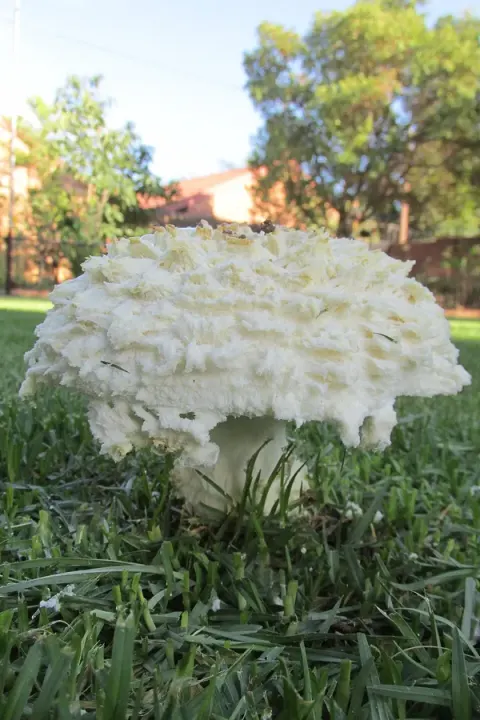
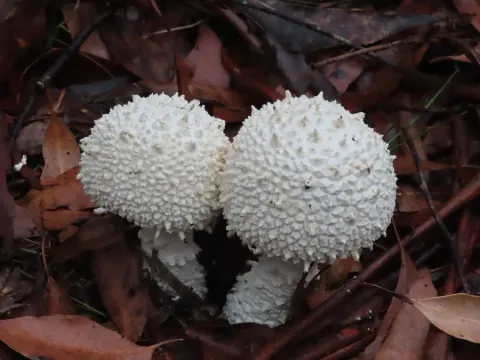
Dokumentasi Amanita phalloides menurut asosiasi foto pada record takson iNaturalist. Kredit: Davide Puddu. Identitas mengikuti sumber; bukan penentuan spesimen independen.

Jenis
Fotografi
Kredit
(c) Davide Puddu, bazı hakları saklıdır (CC BY), yükleyen: Davide Puddu
Lisensi
CC BY 4.0
Sumber media
Buka entri sumber

Gambar menunjukkan objek menurut identifikasi sumber, bukan verifikasi independen spesimen oleh Fungi. Tidak ada skala baru yang ditambahkan.

06 / Rujukan

Sumber profil

  1. [1] Amanita phalloides — Wikipedia (en)Bagian sumber: Frozen revision 1372135256
    Tanggal penghimpunan sumber: 2026-10-12
    Teks sumber: CC BY-SA4.0 · Wikipedia contributors
  2. [2] Catalogue of Life Base2026-09-11 — Amanita phalloidesBagian sumber: ColDP NameUsage.tsv ID 65ZB2; accepted species; source 2073
    Tanggal penghimpunan sumber: 2026-10-12
  3. [3] Dokumentasi visual — Amanita phalloidesBagian sumber: Individual media record; identification follows the source, not independent determination
    Tanggal penghimpunan sumber: 2026-10-12
    Media sumber: CC BY 4.0 · (c) Davide Puddu, bazı hakları saklıdır (CC BY), yükleyen: Davide Puddu

Adaptasi teks: CC BY-SA 4.0. Wikipedia contributors — Amanita phalloides — Wikipedia (en)

Uraian asli dan riwayat sumber

Riwayat atau halaman sumber

Ringkasan sumber

Amanita phalloides ( ), commonly known as the death cap, is a deadly poisonous basidiomycete fungus and mushroom, one of many in the genus Amanita. Originating in Europe but later introduced to other parts of the world since the late twentieth century, A. phalloides forms ectomycorrhizae with various broadleaved trees. In some cases, the death cap has been introduced to new regions with the cultivation of non-native species of oak, chestnut, and pine. The large fruiting bodies appear in summer and autumn; the caps are generally greenish in colour with a white stipe and gills.

Revisi sumber

Morfologi sumber

The death cap has a large and imposing epigeous (aboveground) fruiting body (basidiocarp), usually with a pileus (cap) from 5 to 15 cm across (2 to 5.8 inches) across, initially rounded and hemispherical, but flattening with age. The color of the cap can be pale-green, yellowish-green, olive-green, bronze, or (in one form) white; it is often paler toward the margins, which can have darker streaks; it is also often paler after rain. The cap surface is sticky when wet and easily peeled—a troublesome feature, as that is allegedly a feature of edible fungi. The remains of the partial veil are seen as a skirtlike, floppy annulus usually about 1 to 1.5 cm below the cap. The crowded white lamellae (gills) are free. The stipe is white with a scattering of grayish-olive scales and is 8 to 15 cm long and 1 to 2 cm thick, with a swollen, ragged, sac-like white volva (base). Spores: 7-12 x 6-9 μm. Smooth, ellipsoid, amyloid. The smell has been described as initially faint and honey-sweet, but strengthening over time to become overpowering, sickly-sweet and objectionable. Young specimens first emerge from the ground resembling a white egg covered by a universal veil, which then breaks, leaving the volva as a remnant. The spore print is white, a common feature of Amanita. The transparent spores are globular to egg-shaped, measure 8–10 μm (0.3–0.4 mil) long, and stain blue with iodine.

Revisi sumber

Ekologi sumber

The death cap is native to Europe, where it is widespread. It is found from the southern coastal regions of Scandinavia in the north, to Ireland in the west, east to Poland and western Russia, and south throughout the Balkans, in Greece, Italy, Spain, and Portugal in the Mediterranean basin, and in Morocco and Algeria in north Africa. In west Asia, it has been reported from forests of northern Iran. There are records from further east in Asia but these have yet to be confirmed as A. phalloides. By the end of the 19th century, Charles Horton Peck had reported A. phalloides in North America. In 1918, samples from the eastern United States were identified as being a distinct though similar species, A. brunnescens, by George Francis Atkinson of Cornell University. By the 1970s, it had become clear that A. phalloides does occur in the United States, apparently having been introduced from Europe alongside chestnuts, with populations on the West and East Coasts. A 2006 historical review concluded the East Coast populations were inadvertently introduced, likely on the roots of other purposely imported plants such as chestnuts. The origins of the West Coast populations remained unclear, due to scant historical records, Observations of various collections of A. phalloides, from conifers rather than native forests, have led to the hypothesis that the species was introduced to North America multiple times.

Revisi sumber

Struktur reproduksi sumber

The death cap has a large and imposing epigeous (aboveground) fruiting body (basidiocarp), usually with a pileus (cap) from 5 to 15 cm across (2 to 5.8 inches) across, initially rounded and hemispherical, but flattening with age. The color of the cap can be pale-green, yellowish-green, olive-green, bronze, or (in one form) white; it is often paler toward the margins, which can have darker streaks; it is also often paler after rain. The cap surface is sticky when wet and easily peeled—a troublesome feature, as that is allegedly a feature of edible fungi. The remains of the partial veil are seen as a skirtlike, floppy annulus usually about 1 to 1.5 cm below the cap. The crowded white lamellae (gills) are free.

Revisi sumber

Rujukan halaman ini

Fungi. Amanita phalloides. Rilis data fungi-2026-10-12-expansion-2. https://fungi-atlas.mgadib.chatgpt.site/jamur/amanita-phalloides/.

Status: impor sumber; pemeriksaan editorial per profil belum selesai. Untuk klaim biologis, gunakan rujukan pada bagian terkait dan periksa konteks sumber aslinya.