Ciri dan struktur
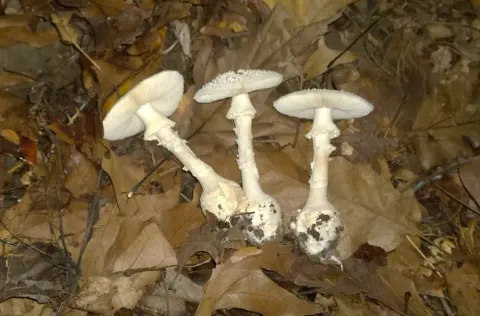
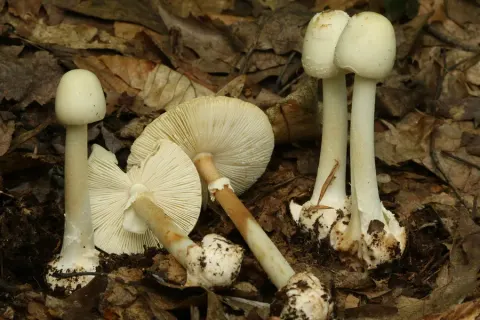
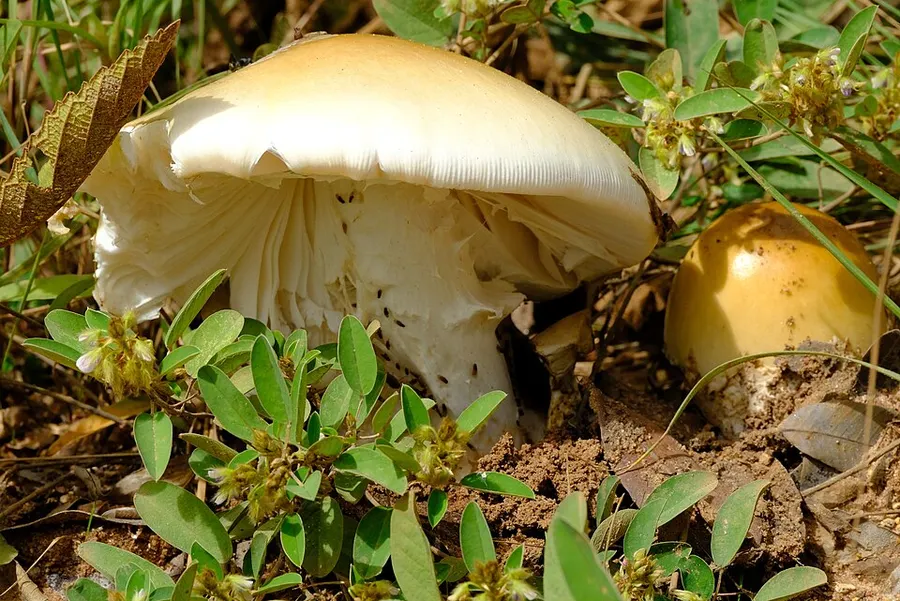
The cap attains a diameter of 10 to 20 cm. It is initially spherical to egg-shaped and uniformly olivaceous brown in color, but later becomes flattened and uniformly white from the center. The sticky cap surface is smooth and shiny, and does not retain any fragments of the partial veil; the cap margin has fine radial grooves. Gills are free from attachment to the stem, white, and up to 1.5 cm broad (measuring from the top to the bottom of the gill). Crowded closely together, they are interspersed with three tiers of lamellulae (short gills that do not extend fully from the cap margin to the stem). The gill edges are finely notched and have a woolly appearance. The stem is 10 to 15 cm long by 1.5 to 2 cm thick, cylindrical, stout, and hollow. Its surface is whitish, fibrillose, and ringed. An ample membrane-like ring is finely grooved and attached to the upper part of the stem. At the base of the stem lies a broad sac-like volva, which has dimensions of 5 to 10 cm by 3 to 5 cm. Initially black-brown in color, the outer layer of the volva eventually breaks up into large warts. The soft cap flesh is up to 1.5 cm thick in the center, white, and does not change color when cut. The spores are 9–13 by 8–10.5 μm, roughly spherical to broadly egg-shaped, hyaline (translucent), inamyloid, thin-walled, and usually contain a single oil drop.
Habitat dan peran ekologis
Like all Amanita species, A. zambiana is mycorrhizal. It typically associates with trees in the genus Brachystegia. Fruit bodies are often found in small groups at the side of gravel roads. Its distribution includes Zimbabwe, Zambia, Malawi, and southern Tanzania. In Zambia, it is known locally as tente in the Bemba language, or ndelema in Kaonde, Tumbuka and Nyanja. It is also known as the Christmas mushroom, as it is most abundant around December and early January. A popular edible, it contributes significantly to Zimbabwean household food security when it is in season. It is widely marketed at roadside stalls and markets, but only the cap is sold. Occasionally, the mushroom is dried for storage, but only after first boiling it and draining the water. According to a 2002 publication, the average price paid to mushroom harvesters in Zambia was about US$3 per kg.
- Habitat atau konteks temuan
- Informasi belum tersedia pada sumber rilis ini.
- Substrat
- Informasi belum tersedia pada sumber rilis ini.
- Peran atau konteks
- Mitra tumbuhan
Reproduksi
The stem is 10 to 15 cm long by 1.5 to 2 cm thick, cylindrical, stout, and hollow. Its surface is whitish, fibrillose, and ringed. An ample membrane-like ring is finely grooved and attached to the upper part of the stem. At the base of the stem lies a broad sac-like volva, which has dimensions of 5 to 10 cm by 3 to 5 cm. Initially black-brown in color, the outer layer of the volva eventually breaks up into large warts. The soft cap flesh is up to 1.5 cm thick in the center, white, and does not change color when cut. The spores are 9–13 by 8–10.5 μm, roughly spherical to broadly egg-shaped, hyaline (translucent), inamyloid, thin-walled, and usually contain a single oil drop.
Catatan identitas dan cakupan
- Nama diterima mengikuti Catalogue of Life Base2026-09-11; uraian mempertahankan konsep dan nama sumber aslinya.
- Original geographic, specimen and life-cycle scope retained; source import awaits individual editorial review.
- Impor dan terjemahan otomatis belum diperiksa editorial per profil. Struktur reproduktif yang disebutkan tidak membuktikan seluruh siklus hidup diketahui.
- Pengukuran pada uraian mengikuti spesimen, kultur, dan metode sumber; angka tidak diperluas ke semua populasi.
Catatan distribusi dalam narasi mengikuti sumbernya. Dokumentasi spesimen atau foto mengikuti catatan sumber. Bukti wilayah Indonesia dan penilaian konservasi tidak disimpulkan dari gambar.
Melihat dengan konteks
Dokumentasi Amanita zambiana dari Wikimedia Commons. Tente ( Amanita zambiana ), in Mpika, Muchinga, Zambia Identifikasi mengikuti record berkas sumber.
- Jenis
- Fotografi
- Kredit
- Nick Helme
- Lisensi
- CC BY-SA 4.0
- Sumber media
- Buka entri sumber
Sumber profil
- [1] Amanita zambiana — Wikipedia (en)
- [2] Catalogue of Life Base2026-09-11 — Amanita zambiana
- [3] Dokumentasi visual — Amanita zambiana
Rujukan halaman ini
Fungi. Amanita zambiana. Rilis data fungi-2026-10-12-expansion-2. https://fungi-atlas.mgadib.chatgpt.site/jamur/amanita-zambiana/.
Status: impor sumber; pemeriksaan editorial per profil belum selesai. Untuk klaim biologis, gunakan rujukan pada bagian terkait dan periksa konteks sumber aslinya.