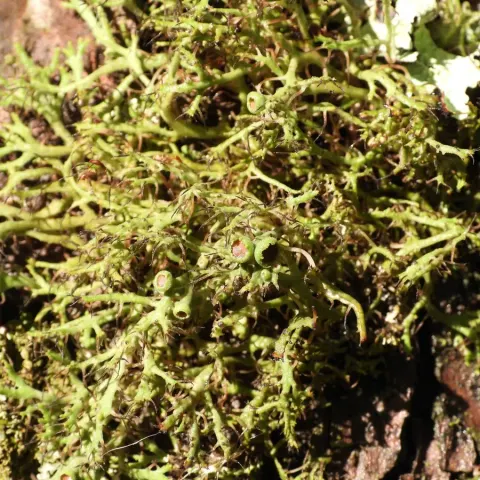
01 / Morfologi

Ciri dan struktur

The lichen forms small to mid-sized rosettes, usually 1.5–7.0 cm across, that sit loosely on the rock. The are short to moderately elongated (roughly 0.7–1.8 mm long and 0.5–1.2 mm wide), somewhat arched, and end in tightly inrolled, scalloped tips. The upper surface is pale to brownish gray and generally lacks the sugar-dust coating (); when present, the pruina is faint and mostly limited to the lobe tips. Coarse bristles are common near the growing tips, and the upper bears minute, single-celled bumps that look like tiny hairs under a microscope. The lower surface is pale, with a thin cortex only near the center of the thallus and becoming whitish and without a cortex toward the lobe tips. The species does not produce soredia (powdery propagules). Fruiting bodies (apothecia) are usually abundant and often crowd together near the center of the rosette. They are round, about 0.5–1.5 (less often up to 2.0) mm in diameter, with a disk that is mostly free of pruina; a rim of thallus tissue () persists around the edge. The sexual spores (ascospores) are typically slightly bent and measure about 23–35(–42) × 12–17 μm (average length per specimen around 29 μm). Tiny flask-shaped structures (pycnidia) are immersed in the thallus and release asexual spores (conidia) that are rod- to short-ellipsoid shaped, about 4.5–6.2(–7.1) × 1.3–2.3 μm. Standard spot tests on the thallus are negative; thin-layer chromatography commonly detects variolaric acid, and weak K+ or KC+ (yellow) reactions may be seen where that compound is concentrated.

Sebagian uraian ditampilkan dalam bahasa sumber; terjemahannya belum tersedia atau belum lolos pemeriksaan.

Rujukan: [1]

Pengukuran mengikuti objek, spesimen atau kultur, dan metode yang disebutkan sumber. Baca uraian asli untuk konteks lengkap.

02 / Kehidupan

Habitat dan peran ekologis

Anaptychia nevadensis grows on siliceous rock (rhyolite, andesite, basalt, granite, quartzite), occasionally overgrowing moss. It favors sheltered microsites – especially crevices and steep, north-facing faces – within open outcrops, typically at about 1550 – 2100 m, with an observed range about 1375 – 2300 m. The species is restricted to the north-western Great Basin of the U.S.A., with confirmed records in Nevada, adjacent northeastern California (Warner Mountains) and southeastern Oregon (Steens Mountain). It often occurs near, but is readily separable from, the sorediate A. elbursiana. The authors note that its range coincides with areas having relatively more winter-weighted precipitation and hypothesize intolerance of summer monsoonal thunderstorms.

Sebagian uraian ditampilkan dalam bahasa sumber; terjemahannya belum tersedia atau belum lolos pemeriksaan.

Rujukan: [1]

Habitat atau konteks temuan
Informasi belum tersedia pada sumber rilis ini.
Substrat
Informasi belum tersedia pada sumber rilis ini.
Peran atau konteks
Pembentuk liken
Temukan hubungan serupa
03 / Siklus hidup

Reproduksi

The lichen forms small to mid-sized rosettes, usually 1.5–7.0 cm across, that sit loosely on the rock. The are short to moderately elongated (roughly 0.7–1.8 mm long and 0.5–1.2 mm wide), somewhat arched, and end in tightly inrolled, scalloped tips. The upper surface is pale to brownish gray and generally lacks the sugar-dust coating (); when present, the pruina is faint and mostly limited to the lobe tips. Coarse bristles are common near the growing tips, and the upper bears minute, single-celled bumps that look like tiny hairs under a microscope. The lower surface is pale, with a thin cortex only near the center of the thallus and becoming whitish and without a cortex toward the lobe tips.

Sebagian uraian ditampilkan dalam bahasa sumber; terjemahannya belum tersedia atau belum lolos pemeriksaan.

Rujukan: [1]

04 / Batas informasi

Catatan identitas dan cakupan

  • Nama diterima mengikuti Catalogue of Life Base2026-09-11; uraian mempertahankan konsep dan nama sumber aslinya.
  • Original geographic, specimen and life-cycle scope retained; source import awaits individual editorial review.
  • Impor dan terjemahan otomatis belum diperiksa editorial per profil. Struktur reproduktif yang disebutkan tidak membuktikan seluruh siklus hidup diketahui.
  • Pengukuran pada uraian mengikuti spesimen, kultur, dan metode sumber; angka tidak diperluas ke semua populasi.

Catatan distribusi dalam narasi mengikuti sumbernya. Dokumentasi spesimen atau foto mengikuti catatan sumber. Bukti wilayah Indonesia dan penilaian konservasi tidak disimpulkan dari gambar.

05 / Dokumentasi

Melihat dengan konteks

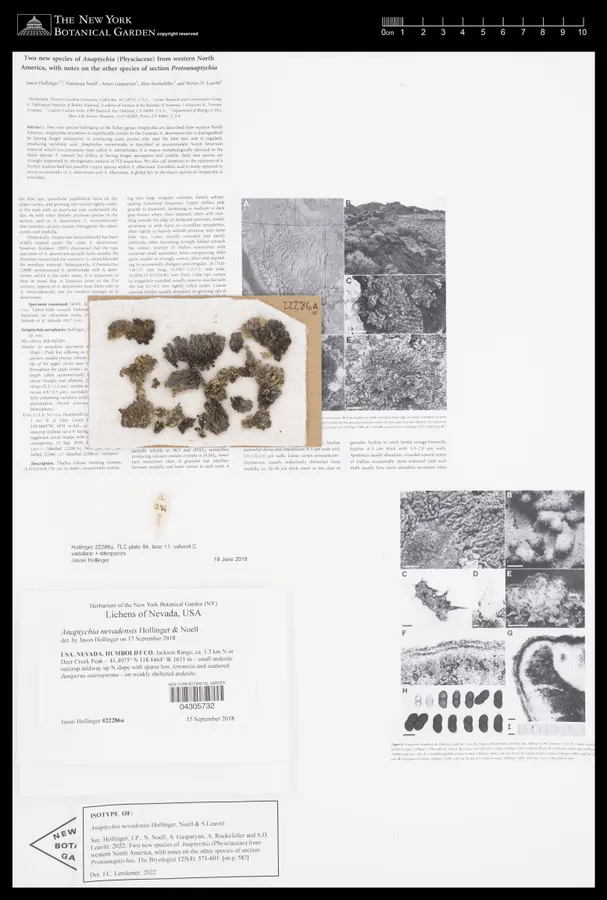
Voucher herbarium Anaptychia nevadensis (04305732), The New York Botanical Garden. Identifikasi mengikuti record spesimen sumber. Foto bahan, kemasan, atau label herbarium sebagaimana tersedia pada record institusi; bukan foto lapangan atau penentuan spesimen independen.

Jenis
Voucher herbarium
Kredit
The New York Botanical Garden
Lisensi
CC BY 4.0
Sumber media
Buka entri sumber

Gambar menunjukkan objek menurut identifikasi sumber, bukan verifikasi independen spesimen oleh Fungi. Tidak ada skala baru yang ditambahkan.

06 / Rujukan

Sumber profil

  1. [1] Anaptychia nevadensis — Wikipedia (en)Bagian sumber: Frozen revision 1308442179
    Tanggal penghimpunan sumber: 2026-10-12
    Teks sumber: CC BY-SA4.0 · Wikipedia contributors
  2. [2] Catalogue of Life Base2026-09-11 — Anaptychia nevadensisBagian sumber: ColDP NameUsage.tsv ID B32K2; accepted species; source 2073
    Tanggal penghimpunan sumber: 2026-10-12
  3. [3] Dokumentasi visual — Anaptychia nevadensisBagian sumber: Individual media record; identification follows the source, not independent determination
    Tanggal penghimpunan sumber: 2026-10-12
    Media sumber: CC BY 4.0 · The New York Botanical Garden

Adaptasi teks: CC BY-SA 4.0. Wikipedia contributors — Anaptychia nevadensis — Wikipedia (en)

Uraian asli dan riwayat sumber

Riwayat atau halaman sumber

Ringkasan sumber

Anaptychia nevadensis is a species of foliose lichen in the family Physciaceae. It was described in 2022 from the north-western Great Basin of the western United States. It is an abundantly fertile, soredia-lacking member of section Protoanaptychia and differs from the Eurasian A. desertorum in having only scant whitish (typically restricted to the lobe tips), longer ascospores on average, and frequent production of variolaric acid.

Revisi sumber

Morfologi sumber

The lichen forms small to mid-sized rosettes, usually 1.5–7.0 cm across, that sit loosely on the rock. The are short to moderately elongated (roughly 0.7–1.8 mm long and 0.5–1.2 mm wide), somewhat arched, and end in tightly inrolled, scalloped tips. The upper surface is pale to brownish gray and generally lacks the sugar-dust coating (); when present, the pruina is faint and mostly limited to the lobe tips. Coarse bristles are common near the growing tips, and the upper bears minute, single-celled bumps that look like tiny hairs under a microscope. The lower surface is pale, with a thin cortex only near the center of the thallus and becoming whitish and without a cortex toward the lobe tips. The species does not produce soredia (powdery propagules). Fruiting bodies (apothecia) are usually abundant and often crowd together near the center of the rosette. They are round, about 0.5–1.5 (less often up to 2.0) mm in diameter, with a disk that is mostly free of pruina; a rim of thallus tissue () persists around the edge. The sexual spores (ascospores) are typically slightly bent and measure about 23–35(–42) × 12–17 μm (average length per specimen around 29 μm). Tiny flask-shaped structures (pycnidia) are immersed in the thallus and release asexual spores (conidia) that are rod- to short-ellipsoid shaped, about 4.5–6.2(–7.1) × 1.3–2.3 μm. Standard spot tests on the thallus are negative; thin-layer chromatography commonly detects variolaric acid, and weak K+ or KC+ (yellow) reactions may be seen where that compound is concentrated.

Revisi sumber

Ekologi sumber

Anaptychia nevadensis grows on siliceous rock (rhyolite, andesite, basalt, granite, quartzite), occasionally overgrowing moss. It favors sheltered microsites – especially crevices and steep, north-facing faces – within open outcrops, typically at about 1550 – 2100 m, with an observed range about 1375 – 2300 m. The species is restricted to the north-western Great Basin of the U.S.A., with confirmed records in Nevada, adjacent northeastern California (Warner Mountains) and southeastern Oregon (Steens Mountain). It often occurs near, but is readily separable from, the sorediate A. elbursiana. The authors note that its range coincides with areas having relatively more winter-weighted precipitation and hypothesize intolerance of summer monsoonal thunderstorms.

Revisi sumber

Struktur reproduksi sumber

The lichen forms small to mid-sized rosettes, usually 1.5–7.0 cm across, that sit loosely on the rock. The are short to moderately elongated (roughly 0.7–1.8 mm long and 0.5–1.2 mm wide), somewhat arched, and end in tightly inrolled, scalloped tips. The upper surface is pale to brownish gray and generally lacks the sugar-dust coating (); when present, the pruina is faint and mostly limited to the lobe tips. Coarse bristles are common near the growing tips, and the upper bears minute, single-celled bumps that look like tiny hairs under a microscope. The lower surface is pale, with a thin cortex only near the center of the thallus and becoming whitish and without a cortex toward the lobe tips.

Revisi sumber

Rujukan halaman ini

Fungi. Anaptychia nevadensis. Rilis data fungi-2026-10-12-expansion-2. https://fungi-atlas.mgadib.chatgpt.site/jamur/anaptychia-nevadensis/.

Status: impor sumber; pemeriksaan editorial per profil belum selesai. Untuk klaim biologis, gunakan rujukan pada bagian terkait dan periksa konteks sumber aslinya.