Ciri dan struktur
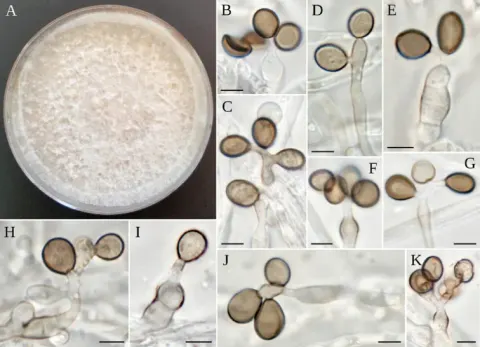
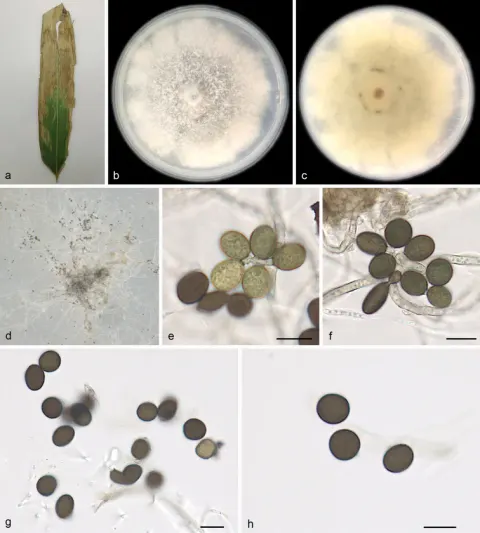
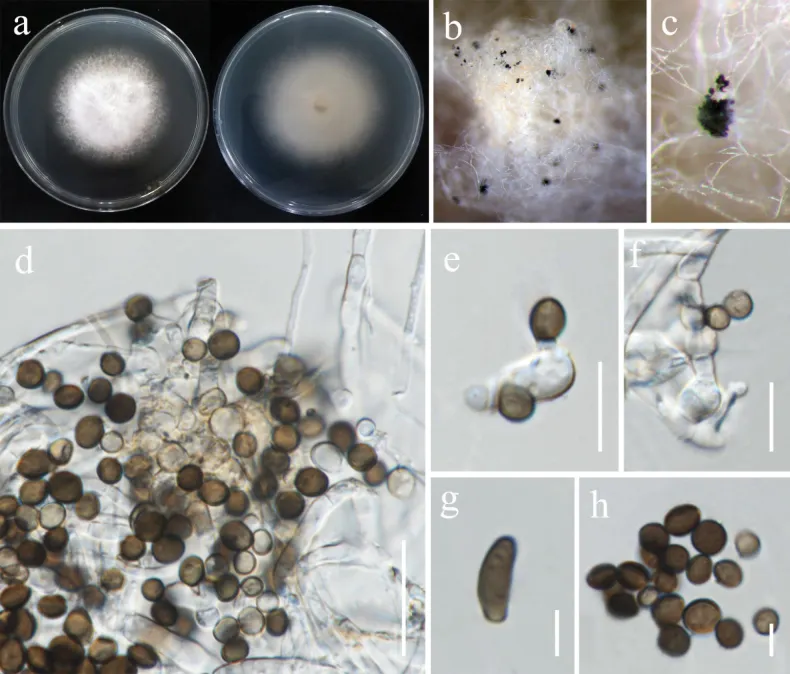
Endophytic from healthy panicle of Oryza sativa. Sexual morph: not observed. Asexual morph: Conidiophores 2.5–4 μm wide, basauxic, cylindrical, septate, straight or flexuous, sometimes reduced to conidiogenous cells, hyaline. Conidiogenous cells 7–21.5 × 4.5–6 μm (x̄ = 13 × 5 µm, n = 10), cylindrical to subcylindrical, lageniform or ampulliform, pale brown to hyaline. Conidia 5–7 × 4–5.5 μm (x̄ = 6.5 × 5 µm, n = 25), globose to subglobose, lenticular to side view with a pale longitudinal germ slit, thick-walled, brown to dark brown. Colonies on PDA reaching 46–48 mm in diameter after 7 days at 28 °C, white, becoming pale orange with age, circular, floccose to cottony; reverse dull white.
Habitat dan peran ekologis
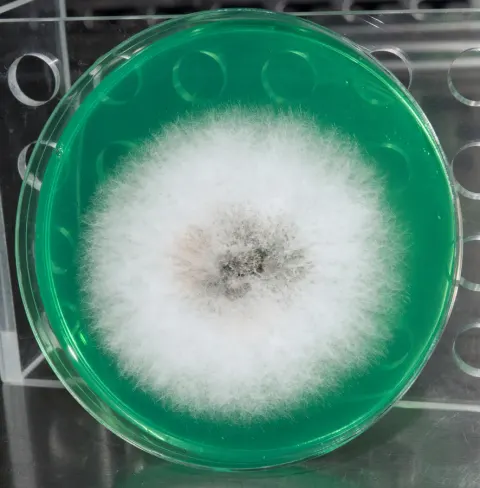
Colonies on PDA reaching 46–48 mm in diameter after 7 days at 28 °C, white, becoming pale orange with age, circular, floccose to cottony; reverse dull white. Based on the morphological and molecular data, the isolate MFLUCC 24-0511 was identified as a representative of Apiospora mukdahanensis with 100% ML and 1.00 PP bootstrap support (Fig. 2). Apiospora mukdahanensis was described by Monkai et al. (2022) and isolated from dead leaves of bamboo in Mukdahan Province, Thailand. Morphologically, our strain closely resembles the type strain MFLUCC 22-0056. However, our observations revealed the presence of sterile cells, which were not reported in their collection (Monkai et al. 2022). This study describes this species as a new host record from rice.
- Habitat atau konteks temuan
- kultur yang didokumentasikan
- Substrat
- Informasi belum tersedia pada sumber rilis ini.
- Peran atau konteks
- Belum dikategorikan pada rilis ini.
Reproduksi
Endophytic from healthy panicle of Oryza sativa. Sexual morph: not observed. Asexual morph: Conidiophores 2.5–4 μm wide, basauxic, cylindrical, septate, straight or flexuous, sometimes reduced to conidiogenous cells, hyaline. Conidiogenous cells 7–21.5 × 4.5–6 μm (x̄ = 13 × 5 µm, n = 10), cylindrical to subcylindrical, lageniform or ampulliform, pale brown to hyaline. Conidia 5–7 × 4–5.5 μm (x̄ = 6.5 × 5 µm, n = 25), globose to subglobose, lenticular to side view with a pale longitudinal germ slit, thick-walled, brown to dark brown.
Catatan identitas dan cakupan
- Nama diterima mengikuti Catalogue of Life Base2026-09-11; uraian mempertahankan konsep dan nama sumber aslinya.
- Preserve original treatment localities, hosts and substrate scope. Materials examined describe documented specimens, not the full global range.
- Impor dan terjemahan otomatis belum diperiksa editorial per profil. Struktur reproduktif yang disebutkan tidak membuktikan seluruh siklus hidup diketahui.
- Pengukuran pada uraian mengikuti spesimen, kultur, dan metode sumber; angka tidak diperluas ke semua populasi.
Catatan distribusi dalam narasi mengikuti sumbernya. Dokumentasi spesimen atau foto mengikuti catatan sumber. Bukti wilayah Indonesia dan penilaian konservasi tidak disimpulkan dari gambar.
Melihat dengan konteks
Apiospora mukdahanensis (MFLUCC 24-0511, new host record). a. Front and reverse of the colony on PDA; b, c. Conidiomata formed on PDA; d. Conidiophores, conidiogenous cells, and conidia; e, f. Conidiogenous cells g. Sterile cell; h. Conidia. Scale bars: 20 μm (d);10 μm (e–f); 5 μm (g–h).
- Jenis
- Pelat ilmiah
- Kredit
- Sahar Absalan, Alireza Armand, Ruvishika S. Jayawardena, Nakarin Suwannarach, Jutamart Monkai, Nootjarin Jungkhun, Saisamorn Lumyong, Kevin D. Hyde
- Lisensi
- CC BY 4.0
- Sumber media
- Buka entri sumber
Sumber profil
- [1] Endophytic xylariaceous fungi from rice in northern Thailand: discovery of novel species and new host records — Apiospora mukdahanensis
- [2] Catalogue of Life Base2026-09-11 — Apiospora mukdahanensis
- [3] Dokumentasi visual — Apiospora mukdahanensis
Rujukan halaman ini
Fungi. Apiospora mukdahanensis. Rilis data fungi-2026-10-12-expansion-2. https://fungi-atlas.mgadib.chatgpt.site/jamur/apiospora-mukdahanensis/.
Status: impor sumber; pemeriksaan editorial per profil belum selesai. Untuk klaim biologis, gunakan rujukan pada bagian terkait dan periksa konteks sumber aslinya.