01 / Morfologi

Ciri dan struktur

Characterised within the genus by having small, hyaline and muriform ascospores. Thallus crustose, corticate, thick, green to yellow-green, smooth to uneven, with cortex 40–125 μm thick, medulla 20–75 μm thick, prothallus black. Algae trentepohlioid, cells 18–65 μm wide. Ascomata perithecia, pyriform, black, 0.45–0.60 mm diam., erupent to prominent, fused into a pseudostroma, not covered by thallus. Ascoma wall carbonised, up to ca. 145 μm thick. Ostiole apical, black, not shared, with a white annulus surrounding the ostiolar region. Pseudostroma forming raised black lines, irregular in shape or forming a partial network on the thallus. Hamathecium hyaline, not inspersed with droplets or granules, consisting of branched and anastomosing paraphyses, 1.5–2.5 µm thick. Asci clavate to cylindrical, 150–200 × 32–50 µm. Ascospores 8 per ascus, hyaline, muriform with 6–9 transverse and 1–2 longitudinal septa per tier near centre of spore in optical section, narrowly ellipsoid, 35–50 × 13–15.5 μm. Pycnidia not observed.

Sebagian uraian ditampilkan dalam bahasa sumber; terjemahannya belum tersedia atau belum lolos pemeriksaan.

Rujukan: [1]

Pengukuran mengikuti objek, spesimen atau kultur, dan metode yang disebutkan sumber. Baca uraian asli untuk konteks lengkap.

02 / Kehidupan

Habitat dan peran ekologis

The new species was found in north-eastern Thailand, growing in a dry evergreen forest on tree bark. It is only known from the type locality.

Sebagian uraian ditampilkan dalam bahasa sumber; terjemahannya belum tersedia atau belum lolos pemeriksaan.

Rujukan: [1]

Habitat atau konteks temuan
hutan
Substrat
Informasi belum tersedia pada sumber rilis ini.
Peran atau konteks
Pembentuk liken
Temukan hubungan serupa
03 / Siklus hidup

Reproduksi

Characterised within the genus by having small, hyaline and muriform ascospores. Thallus crustose, corticate, thick, green to yellow-green, smooth to uneven, with cortex 40–125 μm thick, medulla 20–75 μm thick, prothallus black. Algae trentepohlioid, cells 18–65 μm wide. Ascomata perithecia, pyriform, black, 0.45–0.60 mm diam., erupent to prominent, fused into a pseudostroma, not covered by thallus. Ascoma wall carbonised, up to ca. 145 μm thick. Ostiole apical, black, not shared, with a white annulus surrounding the ostiolar region. Pseudostroma forming raised black lines, irregular in shape or forming a partial network on the thallus. Hamathecium hyaline, not inspersed with droplets or granules, consisting of branched and anastomosing paraphyses, 1.5–2.5 µm thick.

Sebagian uraian ditampilkan dalam bahasa sumber; terjemahannya belum tersedia atau belum lolos pemeriksaan.

Rujukan: [1]

04 / Batas informasi

Catatan identitas dan cakupan

  • Nama diterima mengikuti Catalogue of Life Base2026-09-11; uraian mempertahankan konsep dan nama sumber aslinya.
  • Preserve original treatment localities, hosts and substrate scope. Materials examined describe documented specimens, not the full global range.
  • Impor dan terjemahan otomatis belum diperiksa editorial per profil. Struktur reproduktif yang disebutkan tidak membuktikan seluruh siklus hidup diketahui.
  • Pengukuran pada uraian mengikuti spesimen, kultur, dan metode sumber; angka tidak diperluas ke semua populasi.

Catatan distribusi dalam narasi mengikuti sumbernya. Dokumentasi spesimen atau foto mengikuti catatan sumber. Bukti wilayah Indonesia dan penilaian konservasi tidak disimpulkan dari gambar.

05 / Dokumentasi

Melihat dengan konteks

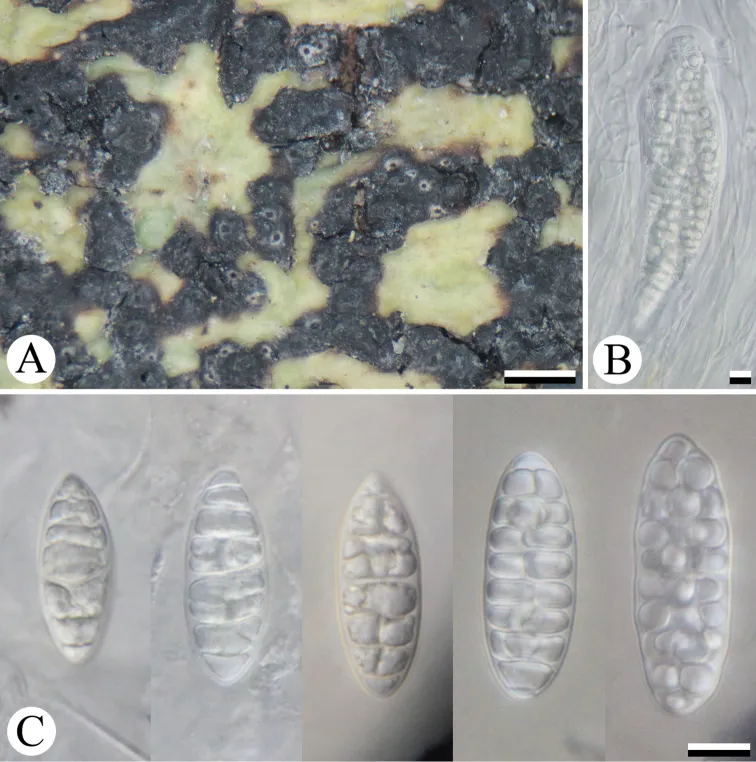
Morphological characters of Architrypethelium murisporum (holotype): A thallus and pseudostromata with ascomata B ascus with ascospores and C ascospores. Scale bars: 1 mm (A); 10 μm (B–C).

Jenis
Pelat ilmiah
Kredit
Theerapat Luangsuphabool, H. Thorsten Lumbsch, Jittra Piapukiew, Ek Sangvichien
Lisensi
CC BY 4.0
Sumber media
Buka entri sumber

Gambar menunjukkan objek menurut identifikasi sumber, bukan verifikasi independen spesimen oleh Fungi. Tidak ada skala baru yang ditambahkan.

06 / Rujukan

Sumber profil

  1. [1] Architrypethelium murisporum (Ascomycota, Trypetheliaceae), a remarkable new lichen species from Thailand challenging ascospore septation as an indicator of phylogenetic relationships — Architrypethelium murisporumBagian sumber: PMC5958175_section_7
    Tanggal penghimpunan sumber: 2026-10-12
    Teks sumber: CC BY 4.0 · Luangsuphabool, Theerapat & Lumbsch, H. Thorsten
  2. [2] Catalogue of Life Base2026-09-11 — Architrypethelium murisporumBagian sumber: ColDP NameUsage.tsv ID 5VQ7Z; accepted species; source 2073
    Tanggal penghimpunan sumber: 2026-10-12
  3. [3] Dokumentasi visual — Architrypethelium murisporumBagian sumber: Individual media record; identification follows the source, not independent determination
    Tanggal penghimpunan sumber: 2026-10-12
    Media sumber: CC BY 4.0 · Theerapat Luangsuphabool, H. Thorsten Lumbsch, Jittra Piapukiew, Ek Sangvichien

Adaptasi teks: CC BY 4.0. Luangsuphabool, Theerapat & Lumbsch, H. Thorsten — Architrypethelium murisporum (Ascomycota, Trypetheliaceae), a remarkable new lichen species from Thailand challenging ascospore septation as an indicator of phylogenetic relationships — Architrypethelium murisporum

Uraian asli dan riwayat sumber

Riwayat atau halaman sumber

Ringkasan sumber

Characterised within the genus by having small, hyaline and muriform ascospores. Thallus crustose, corticate, thick, green to yellow-green, smooth to uneven, with cortex 40–125 μm thick, medulla 20–75 μm thick, prothallus black. Algae trentepohlioid, cells 18–65 μm wide. Ascomata perithecia, pyriform, black, 0.45–0.60 mm diam., erupent to prominent, fused into a pseudostroma, not covered by thallus. Ascoma wall carbonised, up to ca. 145 μm thick. Ostiole apical, black, not shared, with a white annulus surrounding the ostiolar region.

Revisi sumber

Morfologi sumber

Characterised within the genus by having small, hyaline and muriform ascospores. Thallus crustose, corticate, thick, green to yellow-green, smooth to uneven, with cortex 40–125 μm thick, medulla 20–75 μm thick, prothallus black. Algae trentepohlioid, cells 18–65 μm wide. Ascomata perithecia, pyriform, black, 0.45–0.60 mm diam., erupent to prominent, fused into a pseudostroma, not covered by thallus. Ascoma wall carbonised, up to ca. 145 μm thick. Ostiole apical, black, not shared, with a white annulus surrounding the ostiolar region. Pseudostroma forming raised black lines, irregular in shape or forming a partial network on the thallus. Hamathecium hyaline, not inspersed with droplets or granules, consisting of branched and anastomosing paraphyses, 1.5–2.5 µm thick. Asci clavate to cylindrical, 150–200 × 32–50 µm. Ascospores 8 per ascus, hyaline, muriform with 6–9 transverse and 1–2 longitudinal septa per tier near centre of spore in optical section, narrowly ellipsoid, 35–50 × 13–15.5 μm. Pycnidia not observed.

Revisi sumber

Ekologi sumber

The new species was found in north-eastern Thailand, growing in a dry evergreen forest on tree bark. It is only known from the type locality.

Revisi sumber

Struktur reproduksi sumber

Characterised within the genus by having small, hyaline and muriform ascospores. Thallus crustose, corticate, thick, green to yellow-green, smooth to uneven, with cortex 40–125 μm thick, medulla 20–75 μm thick, prothallus black. Algae trentepohlioid, cells 18–65 μm wide. Ascomata perithecia, pyriform, black, 0.45–0.60 mm diam., erupent to prominent, fused into a pseudostroma, not covered by thallus. Ascoma wall carbonised, up to ca. 145 μm thick. Ostiole apical, black, not shared, with a white annulus surrounding the ostiolar region. Pseudostroma forming raised black lines, irregular in shape or forming a partial network on the thallus. Hamathecium hyaline, not inspersed with droplets or granules, consisting of branched and anastomosing paraphyses, 1.5–2.5 µm thick.

Revisi sumber

Rujukan halaman ini

Fungi. Architrypethelium murisporum. Rilis data fungi-2026-10-12-expansion-2. https://fungi-atlas.mgadib.chatgpt.site/jamur/architrypethelium-murisporum/.

Status: impor sumber; pemeriksaan editorial per profil belum selesai. Untuk klaim biologis, gunakan rujukan pada bagian terkait dan periksa konteks sumber aslinya.