Ciri dan struktur
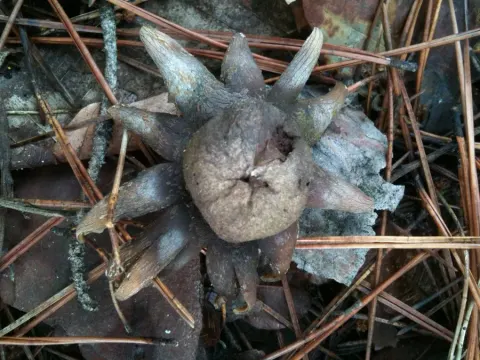
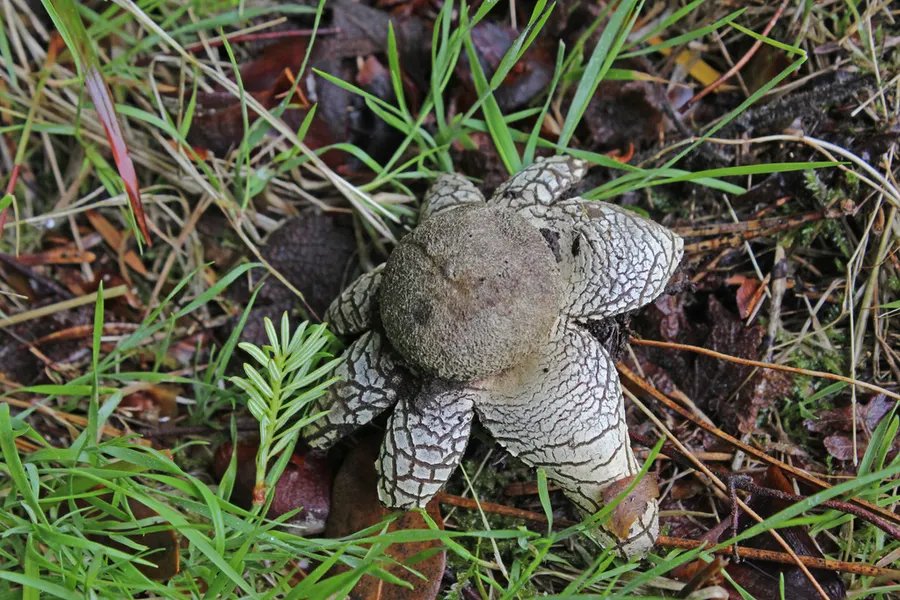
Young specimens of A. hygrometricus have roughly spherical fruit bodies that typically start their development partially embedded in the substrate. A smooth whitish mycelial layer covers the fruit body, and may be partially encrusted with debris. As the fruit body matures, the mycelial layer tears away, and the outer tissue layer, the exoperidium, breaks open in a star-shaped (stellate) pattern to form 4–20 irregular "rays". This simultaneously pushes the fruit body above ground to reveal a round spore case enclosed in a thin papery endoperidium. The rays open and close in response to levels of moisture in the environment, opening up in high humidity, and closing when the air is dry. This is possible because the exoperidium is made of several different layers of tissue; the innermost, fibrous layer is hygroscopic, and curls or uncurls the entire ray as it loses or gains moisture from its surroundings. This adaptation enables the fruit body to disperse spores at times of optimum moisture, and reduce evaporation during dry periods. Further, dry fruit bodies with the rays curled up may be readily blown about by the wind, allowing them to scatter spores from the pore as they roll. The fruit body is 1–8 cm in diameter from tip to tip when expanded. The exoperidium is thick, and the rays are typically areolate (divided into small areas by cracks and crevices) on the upper surface, and are dark grey to black. The spore case is sessile (lacking a stalk), light gray to tan color and 1 to 3 cm broad with a felt-like or scurfy (coated with loose scaly crust) surface; the top of the spore case is opened by an irregular slit, tear or pore.
Habitat dan peran ekologis
Astraeus hygrometricus adalah jamur ektomikoriza dan tumbuh bersama dengan berbagai spesies pohon. Asosiasi mutualis antara akar pohon dan mycelium jamur membantu pohon mengekstrak nutrisi (terutama fosfor) dari bumi; sebagai gantinya, jamur menerima karbohidrat dari fotosintesis. Di Amerika Utara, asosiasi dengan ek dan pinus adalah biasa, sementara di India, telah dicatat untuk tumbuh secara umum dengan chir pinus (Pinus roxburghii) dan sal (Shorea robusta). Bintang bumi palsu ditemukan di tanah di ladang terbuka, seringkali tersebar atau bergrup, terutama di tanah berpasir atau berlumut yang kekurangan nutrisi. Hal ini juga dilaporkan tumbuh di batuan, lebih memilih substrat asam seperti slate dan granit, sementara menghindari substrat kaya kalsium. Di Nepal, mayat buah telah dikumpulkan di ketinggian 3000 m. Fruit bodies biasanya muncul pada musim gugur, meskipun tubuh buah kering tetap dan dapat bertahan hingga beberapa tahun. Gelatinipulvinella astraeicola adalah jamur leotiaceous dengan sedikit, gelatin, pulvinate (bentuk bantal) apothecia, diketahui tumbuh hanya di permukaan dalam sinar mati Astraeus species, termasuk A. hygrometricus. Genus ini memiliki distribusi kosmopolitan kecuali di wilayah iklim tempuh Arktik, Alpine dan dingin; ini umum di wilayah iklim tempuh dan tropis di dunia.
- Habitat atau konteks temuan
- Informasi belum tersedia pada sumber rilis ini.
- Substrat
- tanah
- Peran atau konteks
- Mitra tumbuhan
Reproduksi
Young specimens of A. hygrometricus have roughly spherical fruit bodies that typically start their development partially embedded in the substrate. A smooth whitish mycelial layer covers the fruit body, and may be partially encrusted with debris. As the fruit body matures, the mycelial layer tears away, and the outer tissue layer, the exoperidium, breaks open in a star-shaped (stellate) pattern to form 4–20 irregular "rays". This simultaneously pushes the fruit body above ground to reveal a round spore case enclosed in a thin papery endoperidium. The rays open and close in response to levels of moisture in the environment, opening up in high humidity, and closing when the air is dry. This is possible because the exoperidium is made of several different layers of tissue; the innermost, fibrous layer is hygroscopic, and curls or uncurls the entire ray as it loses or gains moisture from its surroundings.
Catatan identitas dan cakupan
- Nama diterima mengikuti Catalogue of Life Base2026-09-11; uraian mempertahankan konsep dan nama sumber aslinya.
- Original geographic, specimen and life-cycle scope retained; source import awaits individual editorial review.
- Impor dan terjemahan otomatis belum diperiksa editorial per profil. Struktur reproduktif yang disebutkan tidak membuktikan seluruh siklus hidup diketahui.
- Pengukuran pada uraian mengikuti spesimen, kultur, dan metode sumber; angka tidak diperluas ke semua populasi.
Catatan distribusi dalam narasi mengikuti sumbernya. Dokumentasi spesimen atau foto mengikuti catatan sumber. Bukti wilayah Indonesia dan penilaian konservasi tidak disimpulkan dari gambar.
Melihat dengan konteks
Dokumentasi Astraeus hygrometricus menurut asosiasi foto pada record takson iNaturalist. Kredit: Davide Puddu. Identitas mengikuti sumber; bukan penentuan spesimen independen.
- Jenis
- Fotografi
- Kredit
- (c) Davide Puddu, some rights reserved (CC BY), uploaded by Davide Puddu
- Lisensi
- CC BY 4.0
- Sumber media
- Buka entri sumber
Dokumentasi tambahan
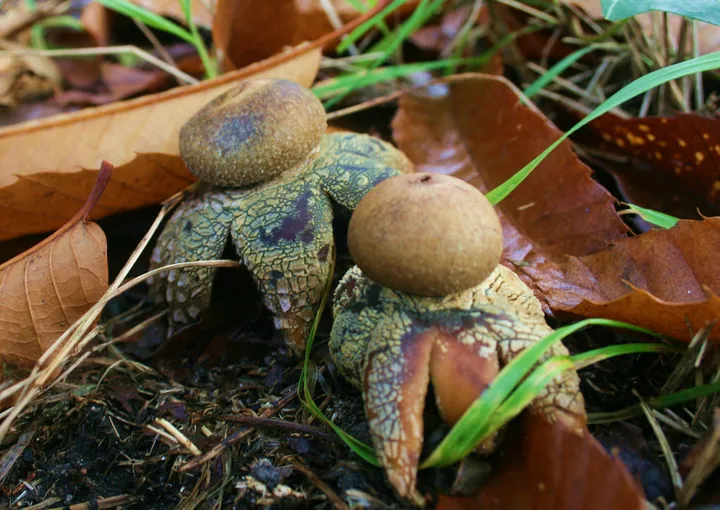
Foto yang diasosiasikan dengan Astraeus hygrometricus pada iNaturalist. Identifikasi mengikuti sumber; bukan penentuan spesimen independen.
Kredit dan penggunaan
(c) Óscar (fotosderianxo/xindilo), some rights reserved (CC BY-SA)
Ukuran dan format gambar disesuaikan tanpa pemotongan, retus, atau penambahan skala. Lisensi sumber dipertahankan.
Sumber profil
- [1] Astraeus hygrometricus — Wikipedia (en)
- [2] Catalogue of Life Base2026-09-11 — Astraeus hygrometricus
- [3] Dokumentasi visual — Astraeus hygrometricus
- [4] Dokumentasi visual — Astraeus hygrometricus
Rujukan halaman ini
Fungi. Astraeus hygrometricus. Rilis data fungi-2026-10-12-expansion-2. https://fungi-atlas.mgadib.chatgpt.site/jamur/astraeus-hygrometricus/.
Status: impor sumber; pemeriksaan editorial per profil belum selesai. Untuk klaim biologis, gunakan rujukan pada bagian terkait dan periksa konteks sumber aslinya.