01 / Morfologi

Ciri dan struktur

The convex cap measures 30 – 80 mm in diameter. Slightly sticky when wet, the cap surface is shiny and smooth. Sometimes, the surface has flattened filaments (formed from aggregated hyphae) and may develop cracks. The thin and easily detached cap cuticle is initially reddish brown to dark brown, later becoming cinnamon brown. The cap margin is curved inward when young, but becomes bent downward when mature. The white to very pale yellow cap flesh does not change color when exposed to air, and has a pleasant odor and mild taste. The tubes comprising the hymenophore on the underside of the cap measure 3 – 8 mm long and are pale yellow initially before developing a greenish tinge with age. The pore surface does not stain when it is bruised. The pores are roughly spherical or polyhedral at first, becoming angular to pentagonal in age, and almost gill-like near the attachment to the stem. Pores are about 1–2 mm in diameter. The stem is solid (i.e., not hollow) 3 – 5 cm long, 10 – 15 mm thick in the upper part, expanding to 2 – 2.5 cm at the bulbous base. It has pseudorrhiza (cord-like structures resembling a plant root) that are 0.5 – 1.5 cm long. The stem surface is dry and smooth except for a powdery region near the apex. The top of the stem is yellow, but it gradually becomes reddish approaching the bulbous base. The stem tissue is pale yellow, although tunnels dug by insect larvae are reddish brown. A drop of dilute ammonia (as a 12% NH4OH solution) placed on the cap surface immediately turns dark red. If placed on the bulbous part of the stem base of a dried specimen, it will turn dark for roughly 15 seconds before starting to fade.

Sebagian uraian ditampilkan dalam bahasa sumber; terjemahannya belum tersedia atau belum lolos pemeriksaan.

Rujukan: [1]

Pengukuran mengikuti objek, spesimen atau kultur, dan metode yang disebutkan sumber. Baca uraian asli untuk konteks lengkap.

02 / Kehidupan

Habitat dan peran ekologis

The fruit bodies of Boletus abruptibulbus grow singly or in groups in sand. The species is known only from the Gulf Coast of the Florida Panhandle, where fruiting occurs on older dunes, particularly in areas where the habit changes from coastal scrub to oak-pine woods. This latter habitat is characterized by the presence of the tree species Sand Live Oak (Quercus geminata), Myrtle Oak (Q. myrtifolia), and Sand Pine (Pinus clausa). Fruiting occurs from December to March. Boletus abruptibulbus is one of only three North American Boletaceae species in coastal dunes; the others are Leccinum arenicola, found in New Brunswick, Canada, and Phylloporus arenicola, described from Oregon.

Sebagian uraian ditampilkan dalam bahasa sumber; terjemahannya belum tersedia atau belum lolos pemeriksaan.

Rujukan: [1]

Habitat atau konteks temuan
Informasi belum tersedia pada sumber rilis ini.
Substrat
Informasi belum tersedia pada sumber rilis ini.
Peran atau konteks
Belum dikategorikan pada rilis ini.
Temukan hubungan serupa
03 / Siklus hidup

Reproduksi

The spores are smooth, spindle-shaped, and measure 13.5–19.8 by 5.0–7.2 μm—rather large for a member of the Boletaceae. Grayish-yellow or greenish yellow when mounted in a dilute potassium hydroxide, dextrinoid (yellowish- or reddish-brown) when stained with Melzer's reagent. The basidia (spore-bearing cells in the hymenium) are club-shaped, hyaline (translucent), four-spored, and measure 28.8–42.3 by 7.2–11.7 μm. The hymenium contains basidioles (immature or aborted basidia), which are club-shaped and measure 20.7–35.1 by 7.2–9.0 μm. Pleurocystidia (cystidia on the surface of the tubes) range in shape from somewhat spindle-shaped to cylindrical, and are hyaline, smooth, and thin-walled, with dimensions of 41.4–61.2 by 7.2–10.8 μm.

Sebagian uraian ditampilkan dalam bahasa sumber; terjemahannya belum tersedia atau belum lolos pemeriksaan.

Rujukan: [1]

Sinonim menurut acuan taksonomi rilis: Boletus abruptibulbus
04 / Batas informasi

Catatan identitas dan cakupan

  • Nama diterima mengikuti Catalogue of Life Base2026-09-11; uraian mempertahankan konsep dan nama sumber aslinya.
  • Original geographic, specimen and life-cycle scope retained; source import awaits individual editorial review.
  • Impor dan terjemahan otomatis belum diperiksa editorial per profil. Struktur reproduktif yang disebutkan tidak membuktikan seluruh siklus hidup diketahui.
  • Pengukuran pada uraian mengikuti spesimen, kultur, dan metode sumber; angka tidak diperluas ke semua populasi.

Catatan distribusi dalam narasi mengikuti sumbernya. Dokumentasi spesimen atau foto mengikuti catatan sumber. Bukti wilayah Indonesia dan penilaian konservasi tidak disimpulkan dari gambar.

05 / Dokumentasi

Melihat dengan konteks

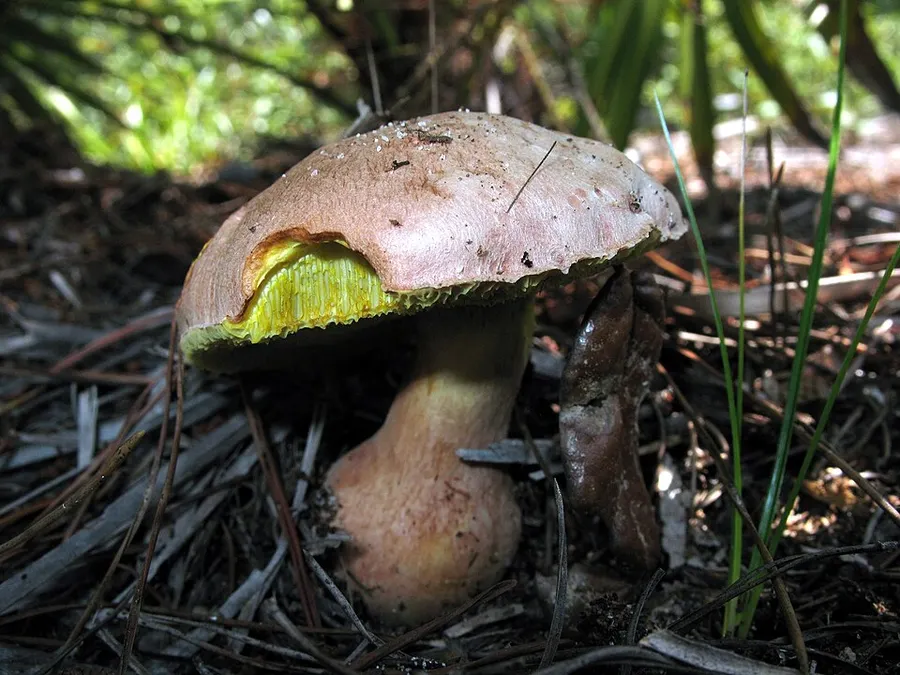
Dokumentasi Boletus abruptibulbus dari Wikimedia Commons. A fruit body of the bolete fungus Boletus abruptibulbus . Photographed in Sopchoppy, Florida, USA. Identifikasi mengikuti record berkas sumber.

Jenis
Fotografi
Kredit
Richard Kneal (bloodworm)
Sumber media
Buka entri sumber

Gambar menunjukkan objek menurut identifikasi sumber, bukan verifikasi independen spesimen oleh Fungi. Tidak ada skala baru yang ditambahkan.

06 / Rujukan

Sumber profil

  1. [1] Boletus abruptibulbus — Wikipedia (en)Bagian sumber: Frozen revision 1304847378
    Tanggal penghimpunan sumber: 2026-10-12
    Teks sumber: CC BY-SA4.0 · Wikipedia contributors
  2. [2] Catalogue of Life Base2026-09-11 — Aureoboletus abruptibulbusBagian sumber: ColDP NameUsage.tsv ID JTFX; accepted species; source 2073
    Tanggal penghimpunan sumber: 2026-10-12
  3. [3] Dokumentasi visual — Boletus abruptibulbusBagian sumber: Individual media record; identification follows the source, not independent determination
    Tanggal penghimpunan sumber: 2026-10-12
    Media sumber: CC BY-SA 3.0 · Richard Kneal (bloodworm)

Adaptasi teks: CC BY-SA 4.0. Wikipedia contributors — Boletus abruptibulbus — Wikipedia (en)

Uraian asli dan riwayat sumber

Riwayat atau halaman sumber

Ringkasan sumber

Boletus abruptibulbus is a species of bolete mushroom belonging to the Boletaceae family. Described as new to science in 2009, it is found only on the Gulf Coast of the Florida Panhandle, where it grows on the ground in coastal sand dunes, one of only three North American boletes known to favor this habitat. The fruit bodies have convex brownish caps up to 8 cm in diameter, supported by solid yellowish to reddish stems measuring 3 – 5 cm long by 10 – 15 mm thick. The pores on the underside of the cap measure about 1–2 mm in diameter and are initially pale yellow before developing a greenish tinge with age.

Revisi sumber

Morfologi sumber

The convex cap measures 30 – 80 mm in diameter. Slightly sticky when wet, the cap surface is shiny and smooth. Sometimes, the surface has flattened filaments (formed from aggregated hyphae) and may develop cracks. The thin and easily detached cap cuticle is initially reddish brown to dark brown, later becoming cinnamon brown. The cap margin is curved inward when young, but becomes bent downward when mature. The white to very pale yellow cap flesh does not change color when exposed to air, and has a pleasant odor and mild taste. The tubes comprising the hymenophore on the underside of the cap measure 3 – 8 mm long and are pale yellow initially before developing a greenish tinge with age. The pore surface does not stain when it is bruised. The pores are roughly spherical or polyhedral at first, becoming angular to pentagonal in age, and almost gill-like near the attachment to the stem. Pores are about 1–2 mm in diameter. The stem is solid (i.e., not hollow) 3 – 5 cm long, 10 – 15 mm thick in the upper part, expanding to 2 – 2.5 cm at the bulbous base. It has pseudorrhiza (cord-like structures resembling a plant root) that are 0.5 – 1.5 cm long. The stem surface is dry and smooth except for a powdery region near the apex. The top of the stem is yellow, but it gradually becomes reddish approaching the bulbous base. The stem tissue is pale yellow, although tunnels dug by insect larvae are reddish brown. A drop of dilute ammonia (as a 12% NH4OH solution) placed on the cap surface immediately turns dark red. If placed on the bulbous part of the stem base of a dried specimen, it will turn dark for roughly 15 seconds before starting to fade.

Revisi sumber

Ekologi sumber

The fruit bodies of Boletus abruptibulbus grow singly or in groups in sand. The species is known only from the Gulf Coast of the Florida Panhandle, where fruiting occurs on older dunes, particularly in areas where the habit changes from coastal scrub to oak-pine woods. This latter habitat is characterized by the presence of the tree species Sand Live Oak (Quercus geminata), Myrtle Oak (Q. myrtifolia), and Sand Pine (Pinus clausa). Fruiting occurs from December to March. Boletus abruptibulbus is one of only three North American Boletaceae species in coastal dunes; the others are Leccinum arenicola, found in New Brunswick, Canada, and Phylloporus arenicola, described from Oregon.

Revisi sumber

Struktur reproduksi sumber

The spores are smooth, spindle-shaped, and measure 13.5–19.8 by 5.0–7.2 μm—rather large for a member of the Boletaceae. Grayish-yellow or greenish yellow when mounted in a dilute potassium hydroxide, dextrinoid (yellowish- or reddish-brown) when stained with Melzer's reagent. The basidia (spore-bearing cells in the hymenium) are club-shaped, hyaline (translucent), four-spored, and measure 28.8–42.3 by 7.2–11.7 μm. The hymenium contains basidioles (immature or aborted basidia), which are club-shaped and measure 20.7–35.1 by 7.2–9.0 μm. Pleurocystidia (cystidia on the surface of the tubes) range in shape from somewhat spindle-shaped to cylindrical, and are hyaline, smooth, and thin-walled, with dimensions of 41.4–61.2 by 7.2–10.8 μm.

Revisi sumber

Rujukan halaman ini

Fungi. Aureoboletus abruptibulbus. Rilis data fungi-2026-10-12-expansion-2. https://fungi-atlas.mgadib.chatgpt.site/jamur/aureoboletus-abruptibulbus/.

Status: impor sumber; pemeriksaan editorial per profil belum selesai. Untuk klaim biologis, gunakan rujukan pada bagian terkait dan periksa konteks sumber aslinya.