Ciri dan struktur
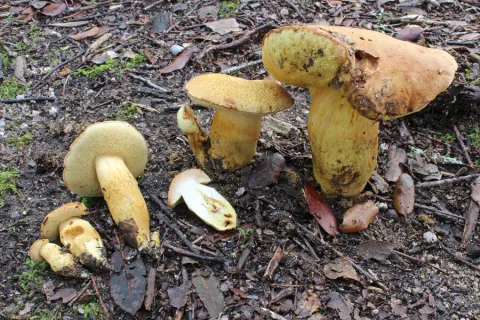
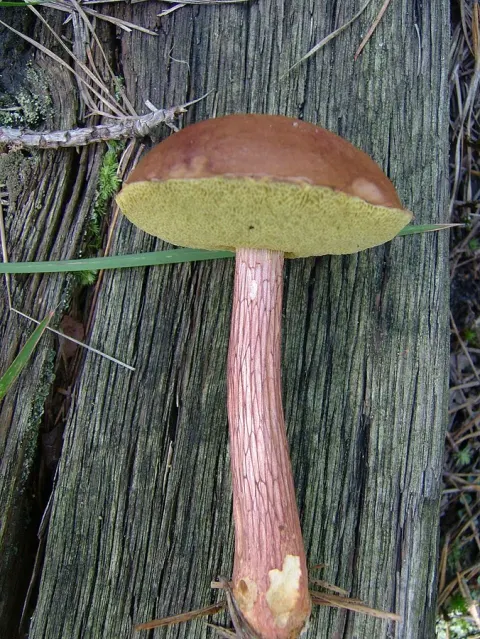
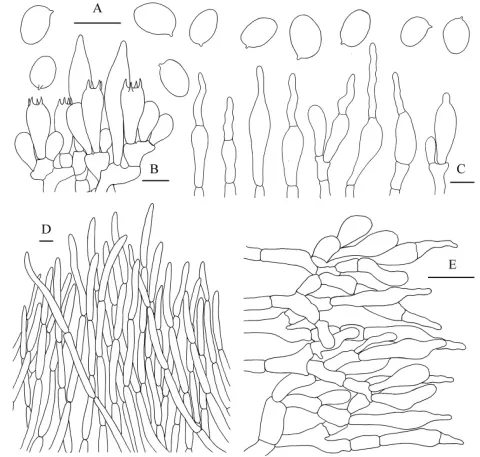
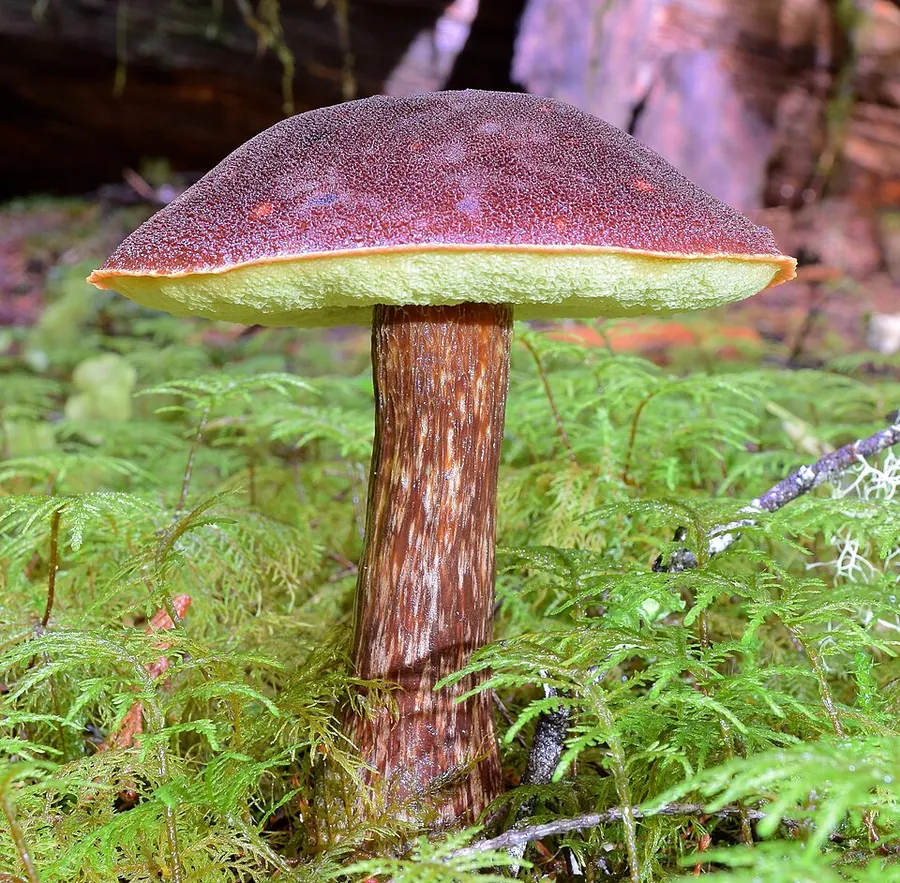
The caps of the fruit bodies are up to 15 cm in diameter, red or brownish-red in color, initially convex but flattening out as they develop. The flesh is firm but watery, thick, and either not changing color or becoming deeper yellow with bruising. usually thickest at the base and tapering upward, up to 4 cm thick below and 0.5 to 1 cm at the apex. It typically starts out with a bulbous shape but becomes more equal in width throughout as it matures. The surface is dry, often roughened and pitted, and with a network of grooves or ridges (striations) or reticulations near the top of the stem. It is about the same color as the cap, but will bruise to a darker reddish-brown near the base. The stem is solid (that is, not hollow), and its flesh pale purplish at the top, but yellowish below. Mycelium at the base of the stem is also yellow. Collected in deposit, the spores are olive-brown. Viewed with a microscope, the spores are spindle-shaped to roughly elliptical, with smooth, thick walls, and have dimensions of 18–22 by 7–9 μm. Overholts' 1940 publication on the species reported spore dimensions of 20–26 by 8–9 μm. The basidia (spore-bearing cells) are club-shaped, hyaline (translucent), 4-spored, and 31–36 by 7–11 μm. Cystidia (sterile cells on the face of a gill) are thin-walled, and measure 60–90 by 10–18 μm. There are no clamp connections present in the hyphae.
Habitat dan peran ekologis
The fruit bodies grow solitarily, scattered, or sometimes in small groups on the ground or on well-decayed conifer logs, especially of western and mountain hemlock, but occasionally also Douglas-fir and western red cedar. Jamur ini sangat diduga membentuk hubungan mikoriza dengan hemlock, meskipun upaya standar untuk menumbuhkan B. mirabilis mikorisa dalam budaya laboratorium telah gagal. Although fruit bodies are sometimes found growing on logs with advanced brown cubical rot—a trait suggestive of cellulose-decomposing saprobic fungi—the rotten wood harboring the fungi typically contains abundant conifer roots. Hal ini telah disarankan bahwa B. mirabilis telah secara khusus beradaptasi dengan ceruk ini untuk mengurangi persaingan nutrisi dengan jamur mikoriza lainnya, dan lebih lanjut, bahwa ketidakmampuan untuk menanam mikorrizae di laboratorium menggunakan teknik standar mungkin karena karakteristik fisik atau kimia tertentu dari kayu dengan kutub cokelat diperlukan untuk pertumbuhan jamur. Aureoboletus mirabilis, yang biasanya muncul dari akhir musim panas hingga musim gugur, didistribusikan di hutan hemlock Pantai Pasifik Ranges from Utara California to Alaska, Cascade Range, serta di hutan pedalaman seperti di Manitoba.
- Habitat atau konteks temuan
- hutan; kultur yang didokumentasikan
- Substrat
- kayu; tanah
- Peran atau konteks
- Pengurai; Mitra tumbuhan
Reproduksi
Collected in deposit, the spores are olive-brown. Viewed with a microscope, the spores are spindle-shaped to roughly elliptical, with smooth, thick walls, and have dimensions of 18–22 by 7–9 μm. Overholts' 1940 publication on the species reported spore dimensions of 20–26 by 8–9 μm. The basidia (spore-bearing cells) are club-shaped, hyaline (translucent), 4-spored, and 31–36 by 7–11 μm. Cystidia (sterile cells on the face of a gill) are thin-walled, and measure 60–90 by 10–18 μm. There are no clamp connections present in the hyphae.
Catatan identitas dan cakupan
- Nama diterima mengikuti Catalogue of Life Base2026-09-11; uraian mempertahankan konsep dan nama sumber aslinya.
- Original geographic, specimen and life-cycle scope retained; source import awaits individual editorial review.
- Impor dan terjemahan otomatis belum diperiksa editorial per profil. Struktur reproduktif yang disebutkan tidak membuktikan seluruh siklus hidup diketahui.
- Pengukuran pada uraian mengikuti spesimen, kultur, dan metode sumber; angka tidak diperluas ke semua populasi.
Catatan distribusi dalam narasi mengikuti sumbernya. Dokumentasi spesimen atau foto mengikuti catatan sumber. Bukti wilayah Indonesia dan penilaian konservasi tidak disimpulkan dari gambar.
Melihat dengan konteks
Dokumentasi Aureoboletus mirabilis dari Wikimedia Commons. For more information about this, see the observation page at Mushroom Observer. Identifikasi mengikuti record berkas sumber.
- Jenis
- Fotografi
- Kredit
- This image was created by user RTehan at Mushroom Observer , a source for mycological images. You can contact this user here .
- Lisensi
- CC BY-SA 3.0
- Sumber media
- Buka entri sumber
Sumber profil
- [1] Aureoboletus mirabilis — Wikipedia (en)
- [2] Catalogue of Life Base2026-09-11 — Aureoboletus mirabilis
- [3] Dokumentasi visual — Aureoboletus mirabilis
Rujukan halaman ini
Fungi. Aureoboletus mirabilis. Rilis data fungi-2026-10-12-expansion-2. https://fungi-atlas.mgadib.chatgpt.site/jamur/aureoboletus-mirabilis/.
Status: impor sumber; pemeriksaan editorial per profil belum selesai. Untuk klaim biologis, gunakan rujukan pada bagian terkait dan periksa konteks sumber aslinya.