Ciri dan struktur
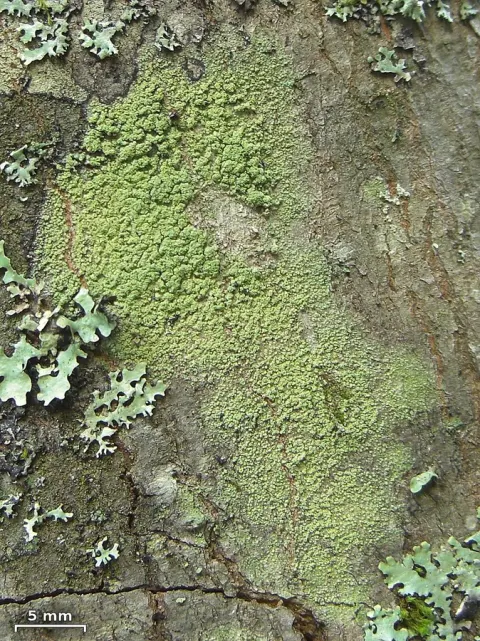
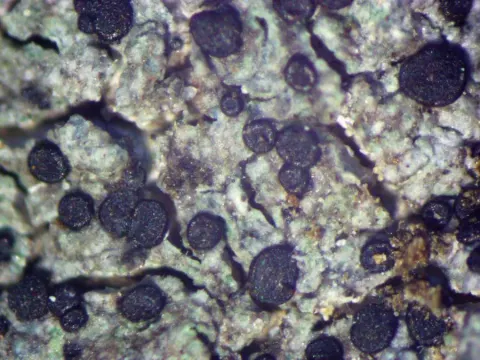
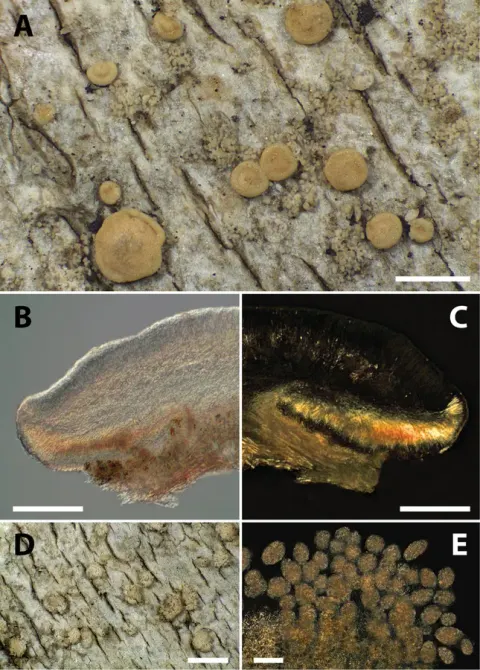
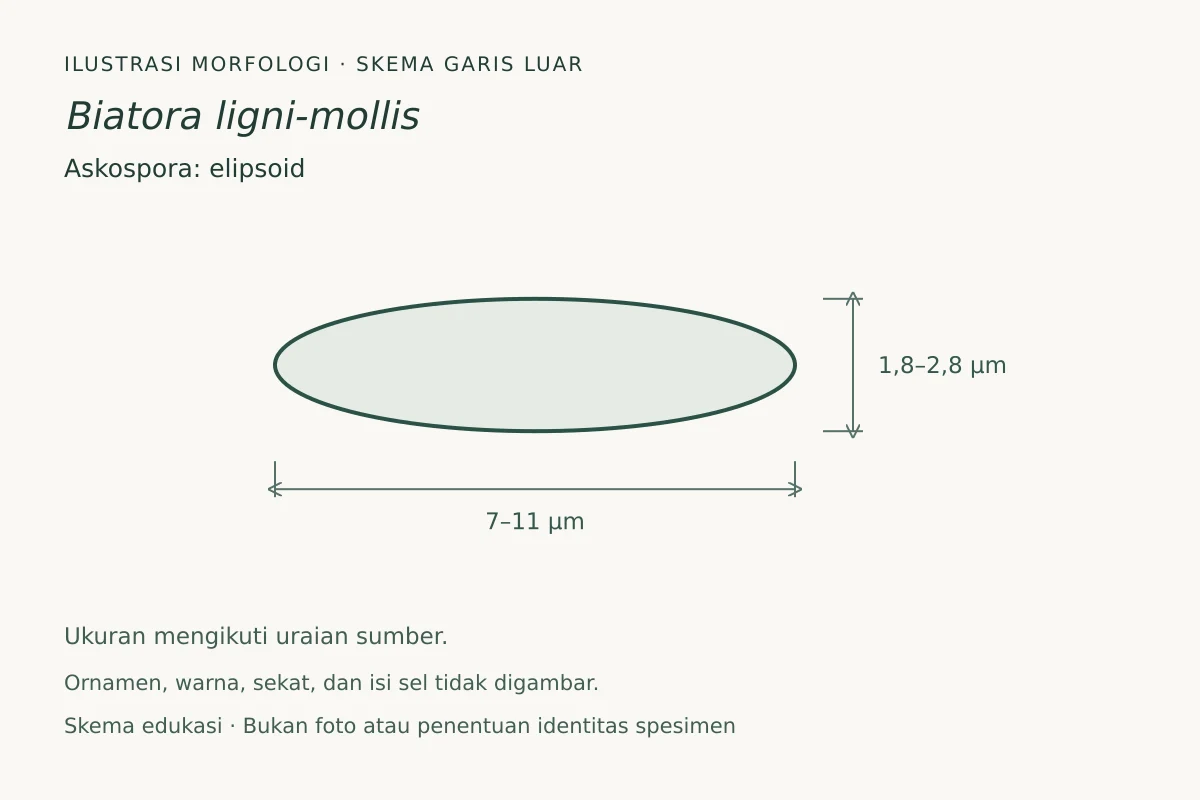
Biatora ligni-mollis develops a thin, crust-forming thallus that is mostly immersed in, or barely lifts above, the surface of decaying conifer wood. Where the thallus is visible it appears white to pale cream and breaks into tiny cracked or granular , together covering patches up to about 13 × 2.5 cm. Each surface granule is corticate, with the only 10–25 μm thick, and encloses a layer of short-celled fungal filaments that weave around the green, rounded cells (3.5–13 μm across). The crust produces no soredia or isidia, and no is evident. Under long-wave ultraviolet light the thallus glows brilliant white—a reaction caused by lobaric acid, a compound rarely recorded in Biatora—while standard spot-tests are otherwise negative. Reproductive structures are conspicuous. Reddish-brown apothecia may reach densities of 170 per square centimetre, each 0.3–0.9 mm across with a usually undulating, persistent margin and a flat to strongly convex . The gelatinised —35–75 μm thick—contains masses of colourless crystals that dissolve in potassium hydroxide solution. Within a 105–215 μm-tall hymenium, Micarea-type asci hold eight narrowly ellipsoid ascospores that are 7–11 × 1.8–2.8 μm and remain simple or at most one-septate at maturity. Flask-shaped pycnidia, 0.07–0.12 mm wide, are abundant and generate colourless, ellipsoid to rod-shaped conidia measuring about 4.2 × 1.0 μm. European material matches the Canadian type in most respects but shows some minor differences: apothecia are usually darker orange-brown and never as crowded, the ascospores are commonly one- to three-septate, and chemical analyses detect both lobaric and roccellic acids (North-American thalli contain lobaric acid alone).
Habitat dan peran ekologis
All verified North-American records derive from the humid inland temperate rainforests of south-eastern and central British Columbia. In that region the lichen colonises the soft, punky wood of long-dead western redcedar (Thuja plicata) and western hemlock (Tsuga heterophylla) snags within ancient cedar–hemlock stands that have retained closed canopies for many centuries, typically between about 650 and 820 m elevation. Subsequent work showed that B. ligni-mollis is also rare but widespread in Western Europe, with confirmed collections from Belgium, France, Germany, Poland and Scotland. There it inhabits the bark or exposed lignum of veteran deciduous and conifer hosts—most frequently oaks, yews, firs and spruces—within long-continuity woodlands or along their margins rather than being restricted to undisturbed inland rainforest sites. This trans-Atlantic distribution mirrors the disjunct ranges documented for several other lichen species and is most plausibly explained by long-distance dispersal rather than recent anthropogenic introduction.
- Habitat atau konteks temuan
- Informasi belum tersedia pada sumber rilis ini.
- Substrat
- Informasi belum tersedia pada sumber rilis ini.
- Peran atau konteks
- Pembentuk liken
Reproduksi
Biatora ligni-mollis develops a thin, crust-forming thallus that is mostly immersed in, or barely lifts above, the surface of decaying conifer wood. Where the thallus is visible it appears white to pale cream and breaks into tiny cracked or granular , together covering patches up to about 13 × 2.5 cm. Each surface granule is corticate, with the only 10–25 μm thick, and encloses a layer of short-celled fungal filaments that weave around the green, rounded cells (3.5–13 μm across). The crust produces no soredia or isidia, and no is evident. Under long-wave ultraviolet light the thallus glows brilliant white—a reaction caused by lobaric acid, a compound rarely recorded in Biatora—while standard spot-tests are otherwise negative.
Catatan identitas dan cakupan
- Nama diterima mengikuti Catalogue of Life Base2026-09-11; uraian mempertahankan konsep dan nama sumber aslinya.
- Original geographic, specimen and life-cycle scope retained; source import awaits individual editorial review.
- Impor dan terjemahan otomatis belum diperiksa editorial per profil. Struktur reproduktif yang disebutkan tidak membuktikan seluruh siklus hidup diketahui.
- Pengukuran pada uraian mengikuti spesimen, kultur, dan metode sumber; angka tidak diperluas ke semua populasi.
Catatan distribusi dalam narasi mengikuti sumbernya. Dokumentasi spesimen atau foto mengikuti catatan sumber. Bukti wilayah Indonesia dan penilaian konservasi tidak disimpulkan dari gambar.
Melihat dengan konteks
Ilustrasi skematis garis luar askospora Biatora ligni-mollis, berdasarkan uraian sumber; ukuran yang dilaporkan 7–11 × 1,8–2,8 µm. Proporsi disederhanakan, bukan salinan satu spesimen. Ornamen permukaan, warna, sekat, dan isi sel tidak direkonstruksi. Askospora elipsoid sempit, 7–11 × 1,8–2,8 µm. Sekat yang bervariasi pada bahan Amerika Utara dan Eropa tidak digambar. Ornamen, warna, sekat, dan isi sel tidak digambar. Skema edukasi, bukan alat identifikasi.
- Jenis
- Ilustrasi skematis
- Kredit
- Fungi, ilustrasi orisinal (2026); fakta morfologi berdasarkan Wikipedia contributors
- Lisensi
- CC BY-SA 4.0
- Sumber media
- Buka entri sumber
Sumber profil
- [1] Biatora ligni-mollis — Wikipedia (en)
- [2] Catalogue of Life Base2026-09-11 — Biatora ligni-mollis
Rujukan halaman ini
Fungi. Biatora ligni-mollis. Rilis data fungi-2026-10-12-expansion-2. https://fungi-atlas.mgadib.chatgpt.site/jamur/biatora-ligni-mollis/.
Status: impor sumber; pemeriksaan editorial per profil belum selesai. Untuk klaim biologis, gunakan rujukan pada bagian terkait dan periksa konteks sumber aslinya.