01 / Morfologi

Ciri dan struktur

Botryosphaeria salicicola is characterised by oval to broadly fusiform ascospores (25.2 × 10.8; L/W = 2.3 vs. 22.7× 7.8 µm, L/W = 2.9) and cylindrical to clavate asci (65–170 × 20–30 µm), with moderate growth rate. Saprobic on dead branches of Salix. Teleomorph: Ascomata superficial, becoming erumpent at maturity, aggregated, thick-walled, wall composed of dark brown, thick-walled textura angularis, becoming thinner-walled and hyaline towards the inner layers, 160 µm diam. Hamathecium comprising hyaline, septate, branched, 2–3.5 µm wide filamentous pseudoparaphyses. Asci 65–170 × 20–30 µm, 8-spored, bitunicate, cylindrical, to clavate, stipitate. Ascospores 22–26 × 9.0–13 µm (average = 25.2 × 10.8 µm, n = 20, L/W = 2.3), irregularly biseriate in the ascus, hyaline, guttulate, smooth with granular contents, aseptate, oval to broadly fusiform, widest in the middle or upper third of the ascospore, tapering to the obtuse base and apex. Anamorph: Not observed. Ascospores germinate on PDA within 24 hours at room temperature (25 °C). Colonies with white fluffy mycelium on PDA (90 mm), after 7 days becomes grey-black at the bottom of centre, olivaceous-grey at the bottom of edge, white mycelium, raised, fluffy, dense filamentous.

Sebagian uraian ditampilkan dalam bahasa sumber; terjemahannya belum tersedia atau belum lolos pemeriksaan.

Rujukan: [1]

Pengukuran mengikuti objek, spesimen atau kultur, dan metode yang disebutkan sumber. Baca uraian asli untuk konteks lengkap.

02 / Kehidupan

Habitat dan peran ekologis

Saprobic on dead branches of Salix. Teleomorph: Ascomata superficial, becoming erumpent at maturity, aggregated, thick-walled, wall composed of dark brown, thick-walled textura angularis, becoming thinner-walled and hyaline towards the inner layers, 160 µm diam. Hamathecium comprising hyaline, septate, branched, 2–3.5 µm wide filamentous pseudoparaphyses. Asci 65–170 × 20–30 µm, 8-spored, bitunicate, cylindrical, to clavate, stipitate. Ascospores 22–26 × 9.0–13 µm (average = 25.2 × 10.8 µm, n = 20, L/W = 2.3), irregularly biseriate in the ascus, hyaline, guttulate, smooth with granular contents, aseptate, oval to broadly fusiform, widest in the middle or upper third of the ascospore, tapering to the obtuse base and apex. Anamorph: Not observed. Ascospores germinate on PDA within 24 hours at room temperature (25 °C). Colonies with white fluffy mycelium on PDA (90 mm), after 7 days becomes grey-black at the bottom of centre, olivaceous-grey at the bottom of edge, white mycelium, raised, fluffy, dense filamentous.

Sebagian uraian ditampilkan dalam bahasa sumber; terjemahannya belum tersedia atau belum lolos pemeriksaan.

Rujukan: [1]

Habitat atau konteks temuan
kultur yang didokumentasikan
Substrat
kayu
Peran atau konteks
Pengurai
Temukan hubungan serupa
03 / Siklus hidup

Reproduksi

Botryosphaeria salicicola is characterised by oval to broadly fusiform ascospores (25.2 × 10.8; L/W = 2.3 vs. 22.7× 7.8 µm, L/W = 2.9) and cylindrical to clavate asci (65–170 × 20–30 µm), with moderate growth rate. Saprobic on dead branches of Salix. Teleomorph: Ascomata superficial, becoming erumpent at maturity, aggregated, thick-walled, wall composed of dark brown, thick-walled textura angularis, becoming thinner-walled and hyaline towards the inner layers, 160 µm diam. Hamathecium comprising hyaline, septate, branched, 2–3.5 µm wide filamentous pseudoparaphyses. Asci 65–170 × 20–30 µm, 8-spored, bitunicate, cylindrical, to clavate, stipitate. Ascospores 22–26 × 9.0–13 µm (average = 25.2 × 10.8 µm, n = 20, L/W = 2.3), irregularly biseriate in the ascus, hyaline, guttulate, smooth with granular contents, aseptate, oval to broadly fusiform, widest in the middle or upper third of the ascospore, tapering to the obtuse base and apex.

Sebagian uraian ditampilkan dalam bahasa sumber; terjemahannya belum tersedia atau belum lolos pemeriksaan.

Rujukan: [1]

04 / Batas informasi

Catatan identitas dan cakupan

  • Nama diterima mengikuti Catalogue of Life Base2026-09-11; uraian mempertahankan konsep dan nama sumber aslinya.
  • Preserve original treatment localities, hosts and substrate scope. Materials examined describe documented specimens, not the full global range.
  • Impor dan terjemahan otomatis belum diperiksa editorial per profil. Struktur reproduktif yang disebutkan tidak membuktikan seluruh siklus hidup diketahui.
  • Pengukuran pada uraian mengikuti spesimen, kultur, dan metode sumber; angka tidak diperluas ke semua populasi.

Catatan distribusi dalam narasi mengikuti sumbernya. Dokumentasi spesimen atau foto mengikuti catatan sumber. Bukti wilayah Indonesia dan penilaian konservasi tidak disimpulkan dari gambar.

05 / Dokumentasi

Melihat dengan konteks

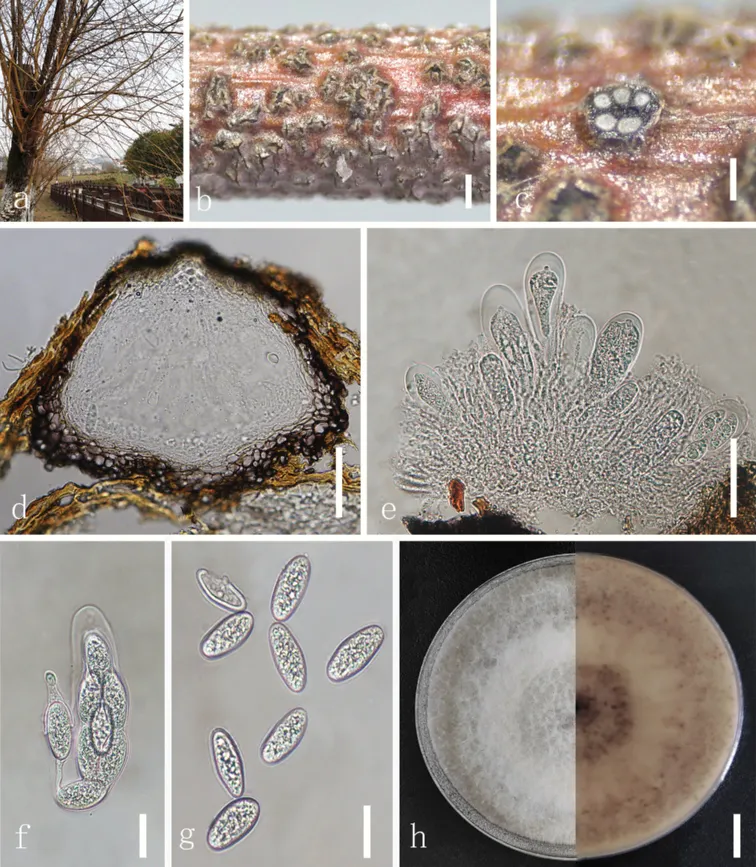
Botryosphaeria salicicola (GUCC 21230, holotype) a–c ascomata on natural substrate d section through ascomata f mature asci g ascospores h colony on PDA (left: above, right: reverse). Scale bars: 400 µm (b); 200 µm (c); 50 µm (d); 40 µm (e); 20 µm (f, g); 15 mm (h).

Jenis
Pelat ilmiah
Kredit
Jing-E Sun, Chao-Rong Meng, Alan J. L. Phillips, Yong Wang
Lisensi
CC BY 4.0
Sumber media
Buka entri sumber

Gambar menunjukkan objek menurut identifikasi sumber, bukan verifikasi independen spesimen oleh Fungi. Tidak ada skala baru yang ditambahkan.

06 / Rujukan

Sumber profil

  1. [1] Two new Botryosphaeria (Botryosphaeriales, Botryosphaeriaceae) species in China — Botryosphaeria salicicolaBagian sumber: PMC9836432_section_7
    Tanggal penghimpunan sumber: 2026-10-12
    Teks sumber: CC BY 4.0 · Sun JE, Meng CR, Phillips AJL, Wang Y.
  2. [2] Catalogue of Life Base2026-09-11 — Botryosphaeria salicicolaBagian sumber: ColDP NameUsage.tsv ID B2WZT; accepted species; source 2073
    Tanggal penghimpunan sumber: 2026-10-12
  3. [3] Dokumentasi visual — Botryosphaeria salicicolaBagian sumber: Individual media record; identification follows the source, not independent determination
    Tanggal penghimpunan sumber: 2026-10-12
    Media sumber: CC BY 4.0 · Jing-E Sun, Chao-Rong Meng, Alan J. L. Phillips, Yong Wang

Adaptasi teks: CC BY 4.0. Sun JE, Meng CR, Phillips AJL, Wang Y. — Two new Botryosphaeria (Botryosphaeriales, Botryosphaeriaceae) species in China — Botryosphaeria salicicola

Uraian asli dan riwayat sumber

Riwayat atau halaman sumber

Ringkasan sumber

Botryosphaeria salicicola is characterised by oval to broadly fusiform ascospores (25.2 × 10.8; L/W = 2.3 vs. 22.7× 7.8 µm, L/W = 2.9) and cylindrical to clavate asci (65–170 × 20–30 µm), with moderate growth rate. Saprobic on dead branches of Salix. Teleomorph: Ascomata superficial, becoming erumpent at maturity, aggregated, thick-walled, wall composed of dark brown, thick-walled textura angularis, becoming thinner-walled and hyaline towards the inner layers, 160 µm diam. Hamathecium comprising hyaline, septate, branched, 2–3.5 µm wide filamentous pseudoparaphyses.

Revisi sumber

Morfologi sumber

Botryosphaeria salicicola is characterised by oval to broadly fusiform ascospores (25.2 × 10.8; L/W = 2.3 vs. 22.7× 7.8 µm, L/W = 2.9) and cylindrical to clavate asci (65–170 × 20–30 µm), with moderate growth rate. Saprobic on dead branches of Salix. Teleomorph: Ascomata superficial, becoming erumpent at maturity, aggregated, thick-walled, wall composed of dark brown, thick-walled textura angularis, becoming thinner-walled and hyaline towards the inner layers, 160 µm diam. Hamathecium comprising hyaline, septate, branched, 2–3.5 µm wide filamentous pseudoparaphyses. Asci 65–170 × 20–30 µm, 8-spored, bitunicate, cylindrical, to clavate, stipitate. Ascospores 22–26 × 9.0–13 µm (average = 25.2 × 10.8 µm, n = 20, L/W = 2.3), irregularly biseriate in the ascus, hyaline, guttulate, smooth with granular contents, aseptate, oval to broadly fusiform, widest in the middle or upper third of the ascospore, tapering to the obtuse base and apex. Anamorph: Not observed. Ascospores germinate on PDA within 24 hours at room temperature (25 °C). Colonies with white fluffy mycelium on PDA (90 mm), after 7 days becomes grey-black at the bottom of centre, olivaceous-grey at the bottom of edge, white mycelium, raised, fluffy, dense filamentous.

Revisi sumber

Ekologi sumber

Saprobic on dead branches of Salix. Teleomorph: Ascomata superficial, becoming erumpent at maturity, aggregated, thick-walled, wall composed of dark brown, thick-walled textura angularis, becoming thinner-walled and hyaline towards the inner layers, 160 µm diam. Hamathecium comprising hyaline, septate, branched, 2–3.5 µm wide filamentous pseudoparaphyses. Asci 65–170 × 20–30 µm, 8-spored, bitunicate, cylindrical, to clavate, stipitate. Ascospores 22–26 × 9.0–13 µm (average = 25.2 × 10.8 µm, n = 20, L/W = 2.3), irregularly biseriate in the ascus, hyaline, guttulate, smooth with granular contents, aseptate, oval to broadly fusiform, widest in the middle or upper third of the ascospore, tapering to the obtuse base and apex. Anamorph: Not observed. Ascospores germinate on PDA within 24 hours at room temperature (25 °C). Colonies with white fluffy mycelium on PDA (90 mm), after 7 days becomes grey-black at the bottom of centre, olivaceous-grey at the bottom of edge, white mycelium, raised, fluffy, dense filamentous.

Revisi sumber

Struktur reproduksi sumber

Botryosphaeria salicicola is characterised by oval to broadly fusiform ascospores (25.2 × 10.8; L/W = 2.3 vs. 22.7× 7.8 µm, L/W = 2.9) and cylindrical to clavate asci (65–170 × 20–30 µm), with moderate growth rate. Saprobic on dead branches of Salix. Teleomorph: Ascomata superficial, becoming erumpent at maturity, aggregated, thick-walled, wall composed of dark brown, thick-walled textura angularis, becoming thinner-walled and hyaline towards the inner layers, 160 µm diam. Hamathecium comprising hyaline, septate, branched, 2–3.5 µm wide filamentous pseudoparaphyses. Asci 65–170 × 20–30 µm, 8-spored, bitunicate, cylindrical, to clavate, stipitate. Ascospores 22–26 × 9.0–13 µm (average = 25.2 × 10.8 µm, n = 20, L/W = 2.3), irregularly biseriate in the ascus, hyaline, guttulate, smooth with granular contents, aseptate, oval to broadly fusiform, widest in the middle or upper third of the ascospore, tapering to the obtuse base and apex.

Revisi sumber

Rujukan halaman ini

Fungi. Botryosphaeria salicicola. Rilis data fungi-2026-10-12-expansion-2. https://fungi-atlas.mgadib.chatgpt.site/jamur/botryosphaeria-salicicola/.

Status: impor sumber; pemeriksaan editorial per profil belum selesai. Untuk klaim biologis, gunakan rujukan pada bagian terkait dan periksa konteks sumber aslinya.