Ciri dan struktur
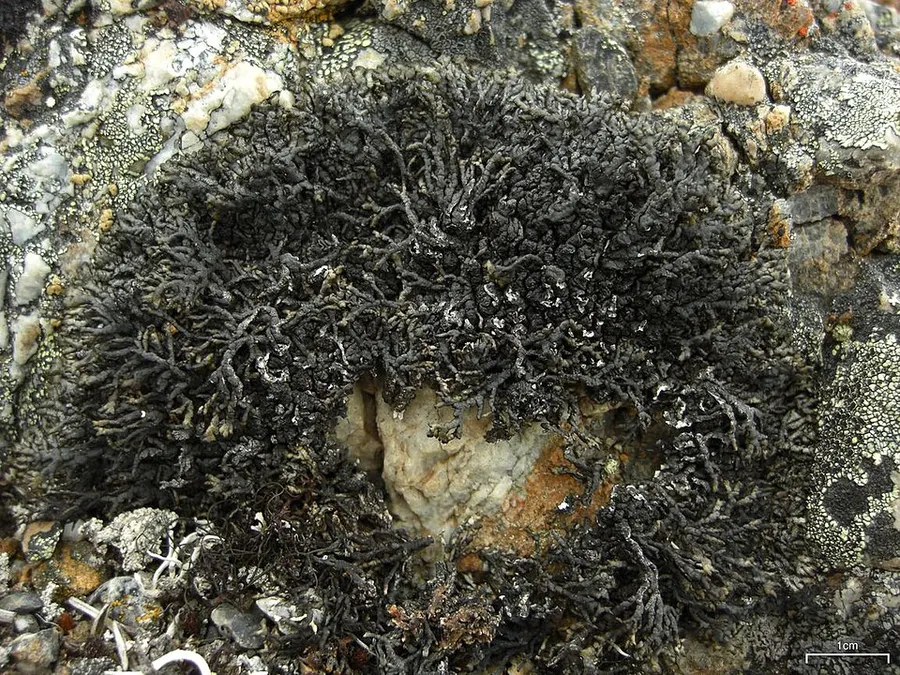
Brodoa oroarctica is a foliose lichen, meaning it has a leaf-like form, though it can also appear somewhat shrubby (). The lichen forms thalli that can grow up to 6 cm across, irregularly spreading and loosely attached to rock surfaces. Its most characteristic feature is its stiff, narrow , which measure between 0.5 and 1 millimetre (mm) in width. These lobes are cylindrical and appear inflated, though they are actually solid throughout, and can be either touching each other, separate, or loosely overlapping as they spread in an irregular pattern across the rock surface rather than forming a circular pattern. The lobes are constricted at regular intervals, creating a form that resembles a string of sausages, alluding to the species' common name. The upper surface can range in colour from pale grey to ash grey, brown, or almost black, and is distinctly , with discontinuous patches of cortex interspersed with black cracks and lines. The colour varies depending on the amount of sunlight exposure the lichen receives. The upper surface features a characteristic pattern of pale spots. The lower surface is black, becoming brown towards the lobe tips. The internal structure includes a white medulla throughout, and its upper surface layer (cortex) is composed of a tissue type called covered by a thin polysaccharide-like layer. The lower surface has a different structure, with a distinctive arrangement and lacks the polysaccharide-like covering. The lichen lacks rhizines. While the species does not produce specialised vegetative structures like soredia or isidia, and lacks holes in its surface, it can occasionally develop regeneration .
Habitat dan peran ekologis
Brodoa oroarctica is an Arctic–alpine species with a circumpolar distribution. Its main range extends throughout Arctic regions, including Iceland, Fennoscandia, Svalbard, northern Russia (from the Polar Urals to Severnaya Zemlya), northern Canada, Greenland, and Alaska. In Greenland, it occurs in Johannes V. Jensen Land, which is the northernmost arctic land area. In North America, it extends southward along the Rocky Mountains. The species has also been documented in high-elevation sites in the Altai Mountains of northwestern China and, notably, in northern Greece above 1750 m. It is saxicolous, growing on rock surfaces in exposed Arctic and alpine environments, and sometimes overgrowing neighbouring mosses. It grows on exposed siliceous rock, although it was recorded growing on basaltic rock in Iceland. The species commonly grows alongside other Arctic–alpine lichens including Alectoria pubescens, Cetraria hepatizon, Parmelia omphalodes, and various Umbilicaria species. This association indicates its preference for habitats with low snow cover during winter. The species is notable for having several disjunct populations in eastern North America, where it is relatively scarce compared to western mountains.
- Habitat atau konteks temuan
- Informasi belum tersedia pada sumber rilis ini.
- Substrat
- Informasi belum tersedia pada sumber rilis ini.
- Peran atau konteks
- Pembentuk liken
Reproduksi
While the species does not produce specialised vegetative structures like soredia or isidia, and lacks holes in its surface, it can occasionally develop regeneration . Unlike some similar species that frequently produce apothecia (fruiting bodies), B. oroarctica rarely develops these features. When present, the apothecia are situated on the surface of the thallus (), reaching up to 5 mm in diameter, with dark brown and narrow, even margins. The spores are more or less spherical to broadly ellipsoid, measuring 8–10 by 12 μm, with eight spores per ascus. The species also produces small asexual reproductive structures called pycnidia, which are black and embedded in the upper surface of the lichen.
Catatan identitas dan cakupan
- Nama diterima mengikuti Catalogue of Life Base2026-09-11; uraian mempertahankan konsep dan nama sumber aslinya.
- Original geographic, specimen and life-cycle scope retained; source import awaits individual editorial review.
- Impor dan terjemahan otomatis belum diperiksa editorial per profil. Struktur reproduktif yang disebutkan tidak membuktikan seluruh siklus hidup diketahui.
- Pengukuran pada uraian mengikuti spesimen, kultur, dan metode sumber; angka tidak diperluas ke semua populasi.
Catatan distribusi dalam narasi mengikuti sumbernya. Dokumentasi spesimen atau foto mengikuti catatan sumber. Bukti wilayah Indonesia dan penilaian konservasi tidak disimpulkan dari gambar.
Melihat dengan konteks
Dokumentasi Brodoa oroarctica dari Wikimedia Commons. Brodoa oroarctica (Krog) Goward 20090624.100b Mount Stearns, Willmore Wilderness, Alberta (I'm not positive that this is different from 20090624.100a yet, Allantoparmelia alpicola .) Identifikasi mengikuti record berkas sumber.
- Jenis
- Fotografi
- Kredit
- Jason Hollinger
- Lisensi
- CC BY 2.0
- Sumber media
- Buka entri sumber
Sumber profil
- [1] Brodoa oroarctica — Wikipedia (en)
- [2] Catalogue of Life Base2026-09-11 — Brodoa oroarctica
- [3] Dokumentasi visual — Brodoa oroarctica
Rujukan halaman ini
Fungi. Brodoa oroarctica. Rilis data fungi-2026-10-12-expansion-2. https://fungi-atlas.mgadib.chatgpt.site/jamur/brodoa-oroarctica/.
Status: impor sumber; pemeriksaan editorial per profil belum selesai. Untuk klaim biologis, gunakan rujukan pada bagian terkait dan periksa konteks sumber aslinya.