Ciri dan struktur
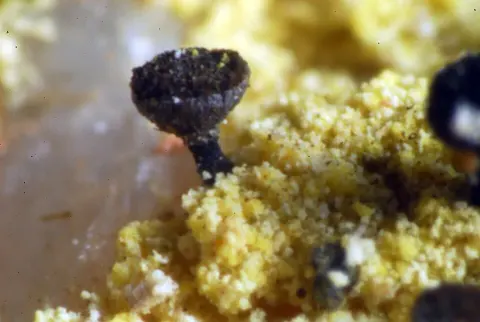
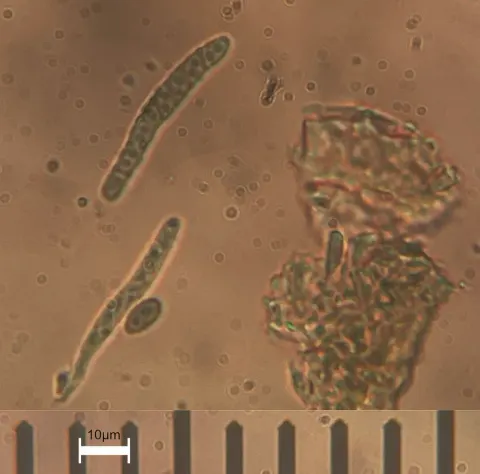
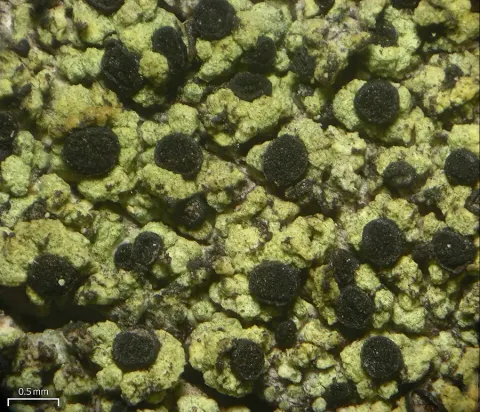
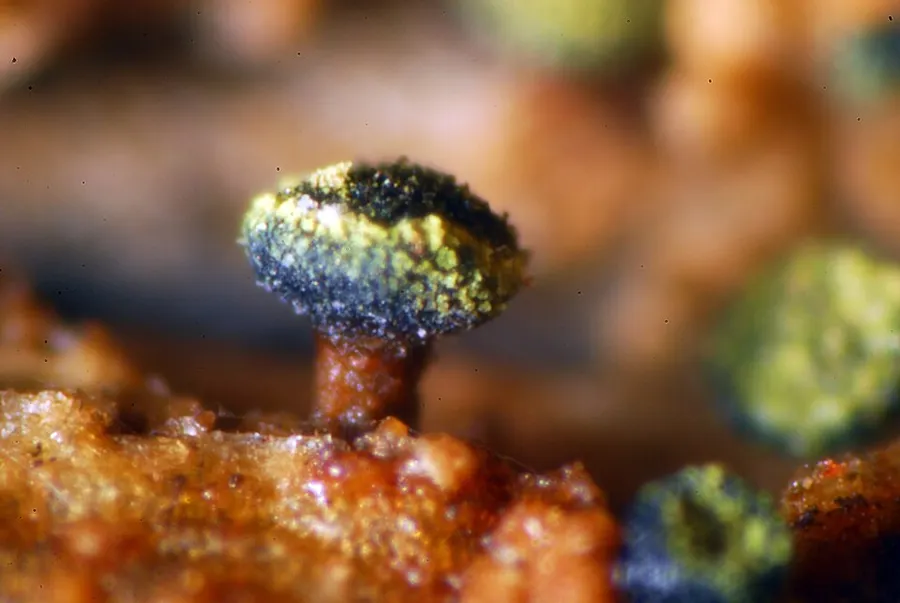
The thallus (the main body of the lichen) of Calicium adspersum is grey and granular in texture. It produces black, pin-like apothecia (fruiting bodies) about 0.6–1 mm tall, typically standing three to five times higher than the width of their stalk. The apothecial head is broadly lens-shaped (about 0.3–0.6 mm across), with a yellowish (a powdery surface coating) on the head and along the margin of the (the rim of the fruiting body). The stalk is slender, about 0.1–0.3 mm in diameter. The lichenized fungus associates with a green-algal in the genus Trebouxia. Under the microscope, the apothecial stalk is surrounded by a thin, colourless sheath that turns faintly blue in iodine (I+). Microscopically, the asci are club- to cylinder-shaped. The ascospores measure about 13–16 × 5.5–6.5 μm and have spiral (helically arranged) ridges on their surface. In standard spot tests, the thallus reacts K+ (yellow turning red) and Pd+ (yellow-red), consistent with the presence of norstictic acid, while the yellow pruina contains vulpinic acid. The species also produces asexual spores (conidia) in pycnidia. Vobis reported the conidia as colourless, single-celled and thin-walled, about 2.0–2.2 × 1.2 μm. In laboratory culture on bark-extract agar, the conidia swelled within about a week and later formed germ tubes. After several weeks to months they developed branched hyphae and small mycelial mats, and colonies derived from groups of conidia were maintained for more than a year. These experiments show that the conidia can germinate and produce mycelium under favourable conditions, and may therefore contribute to dispersal of the fungal partner ().
Habitat dan peran ekologis
Calicium adspersum has an antitropical distribution, and is widespread in temperate areas of both hemispheres. In the United Kingdom, where it is rare, it grows on dry, old oak bark. In Switzerland, it has been recorded on oak in the Swiss Plateau and on conifers at high elevations (upper montane and subalpine zones) in the northern Prealps. In Tasmania, Calicium adspersum subsp. australe is considered rather uncommon (or easily overlooked) and occurs on dead wood, usually on standing trees, in sclerophyll forest and rainforest. In north-western European Russia, Calicium adspersum has been confirmed from Leningrad Region on Picea bark (the first verified regional record, after an earlier unvouchered 1837 report from "St. Petersburg"), and it is otherwise reported from Karelia and widely across Fennoscandia and the Baltic states, where it is associated with southern taiga forests. In North America, it was known from only 11 verified collections in 1999. In North America, confirmed records are associated with cool, humid forests under maritime influence, where the lichen grows on the aged bark of old conifers, usually on rain-sheltered parts of the lower trunk such as bark crevices, the dry side of leaning trunks, or the undersides of limbs.
- Habitat atau konteks temuan
- hutan
- Substrat
- kayu
- Peran atau konteks
- Pembentuk liken
Reproduksi
Under the microscope, the apothecial stalk is surrounded by a thin, colourless sheath that turns faintly blue in iodine (I+). Microscopically, the asci are club- to cylinder-shaped. The ascospores measure about 13–16 × 5.5–6.5 μm and have spiral (helically arranged) ridges on their surface. In standard spot tests, the thallus reacts K+ (yellow turning red) and Pd+ (yellow-red), consistent with the presence of norstictic acid, while the yellow pruina contains vulpinic acid. The species also produces asexual spores (conidia) in pycnidia. Vobis reported the conidia as colourless, single-celled and thin-walled, about 2.0–2.2 × 1.2 μm. In laboratory culture on bark-extract agar, the conidia swelled within about a week and later formed germ tubes.
Catatan identitas dan cakupan
- Nama diterima mengikuti Catalogue of Life Base2026-09-11; uraian mempertahankan konsep dan nama sumber aslinya.
- Original geographic, specimen and life-cycle scope retained; source import awaits individual editorial review.
- Impor dan terjemahan otomatis belum diperiksa editorial per profil. Struktur reproduktif yang disebutkan tidak membuktikan seluruh siklus hidup diketahui.
- Pengukuran pada uraian mengikuti spesimen, kultur, dan metode sumber; angka tidak diperluas ke semua populasi.
Catatan distribusi dalam narasi mengikuti sumbernya. Dokumentasi spesimen atau foto mengikuti catatan sumber. Bukti wilayah Indonesia dan penilaian konservasi tidak disimpulkan dari gambar.
Melihat dengan konteks
Dokumentasi Calicium adspersum dari Wikimedia Commons. The pin lichen Calicium adspersum ; photographed in Italy Identifikasi mengikuti record berkas sumber.
- Jenis
- Fotografi
- Kredit
- Domenico Puntillo
- Lisensi
- CC BY-SA 4.0
- Sumber media
- Buka entri sumber
Sumber profil
- [1] Calicium adspersum — Wikipedia (en)
- [2] Catalogue of Life Base2026-09-11 — Calicium adspersum
- [3] Dokumentasi visual — Calicium adspersum
Rujukan halaman ini
Fungi. Calicium adspersum. Rilis data fungi-2026-10-12-expansion-2. https://fungi-atlas.mgadib.chatgpt.site/jamur/calicium-adspersum/.
Status: impor sumber; pemeriksaan editorial per profil belum selesai. Untuk klaim biologis, gunakan rujukan pada bagian terkait dan periksa konteks sumber aslinya.