Ciri dan struktur
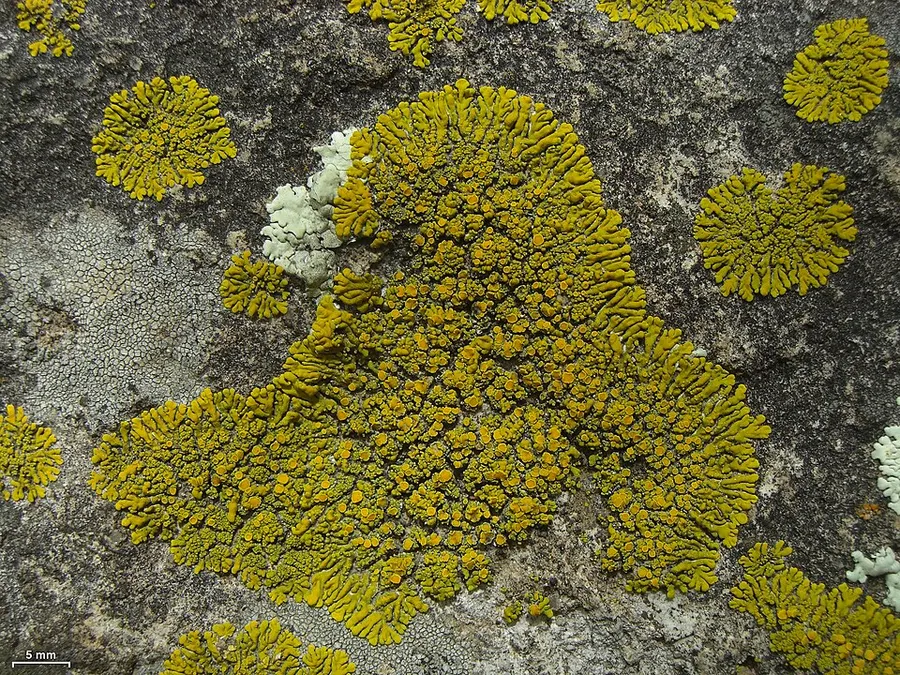
The species forms small, closely appressed rosettes (a placodioid thallus, with flat spreading from a center and hugging the rock). Compared with Candelina mexicana, Poelt noted that the thallus is usually much smaller; marginal lobes are up to about 2 mm long and 0.2–0.5(–1) mm wide, strongly flattened and tightly attached; the surface often has a more reddish-yellow cast and reacts K+ (red) in spot tests. The medulla (the inner, cottony tissue) is entirely white and lacks the yellow needles seen in C. mexicana. Apothecia are about 0.3–0.5 mm across, rather narrowly attached, with flat and to notched margins. The ascospores are narrowly ellipsoid, and measure 11–15 × 3.3–4.5 μm. The cortex conforms to the Candelina type: a thin layer capped by a dense, closely cemented band of yellow pigment , lacking the "peppered pigment hoods" and flaking hyaline coating that characterise Placomaronea; the medulla is white rather than hollow. Thin-layer chromatography (TLC) shows pulvinic acid derivatives with several chemotypes; most tested specimens of C. submexicana react K+ (red) on the thallus (a few are only weakly K±), consistent with pulvinic series compounds detected on TLC.
Habitat dan peran ekologis
The species is confirmed from Mexico, the southwestern United States (Arizona, New Mexico) and Peru (Department of Ica), based on examined herbarium material. It grows on exposed, non-calcareous rock in sunny, open sites, typically on horizontal to gently sloping faces in warm, dry regions, and the Peruvian gatherings are likewise from open, rocky habitats.
- Habitat atau konteks temuan
- Informasi belum tersedia pada sumber rilis ini.
- Substrat
- Informasi belum tersedia pada sumber rilis ini.
- Peran atau konteks
- Pembentuk liken
Reproduksi
The species forms small, closely appressed rosettes (a placodioid thallus, with flat spreading from a center and hugging the rock). Compared with Candelina mexicana, Poelt noted that the thallus is usually much smaller; marginal lobes are up to about 2 mm long and 0.2–0.5(–1) mm wide, strongly flattened and tightly attached; the surface often has a more reddish-yellow cast and reacts K+ (red) in spot tests. The medulla (the inner, cottony tissue) is entirely white and lacks the yellow needles seen in C. mexicana. Apothecia are about 0.3–0.5 mm across, rather narrowly attached, with flat and to notched margins. The ascospores are narrowly ellipsoid, and measure 11–15 × 3.3–4.5 μm.
Catatan identitas dan cakupan
- Nama diterima mengikuti Catalogue of Life Base2026-09-11; uraian mempertahankan konsep dan nama sumber aslinya.
- Original geographic, specimen and life-cycle scope retained; source import awaits individual editorial review.
- Impor dan terjemahan otomatis belum diperiksa editorial per profil. Struktur reproduktif yang disebutkan tidak membuktikan seluruh siklus hidup diketahui.
- Pengukuran pada uraian mengikuti spesimen, kultur, dan metode sumber; angka tidak diperluas ke semua populasi.
Catatan distribusi dalam narasi mengikuti sumbernya. Dokumentasi spesimen atau foto mengikuti catatan sumber. Bukti wilayah Indonesia dan penilaian konservasi tidak disimpulkan dari gambar.
Melihat dengan konteks
Dokumentasi Candelina submexicana dari Wikimedia Commons. Chiricahua Mountains, Arizona, 14 May 2015. Identifikasi mengikuti record berkas sumber.
- Jenis
- Fotografi
- Kredit
- Jason Hollinger
- Lisensi
- CC BY 2.0
- Sumber media
- Buka entri sumber
Sumber profil
- [1] Candelina submexicana — Wikipedia (en)
- [2] Catalogue of Life Base2026-09-11 — Candelina submexicana
- [3] Dokumentasi visual — Candelina submexicana
Rujukan halaman ini
Fungi. Candelina submexicana. Rilis data fungi-2026-10-12-expansion-2. https://fungi-atlas.mgadib.chatgpt.site/jamur/candelina-submexicana/.
Status: impor sumber; pemeriksaan editorial per profil belum selesai. Untuk klaim biologis, gunakan rujukan pada bagian terkait dan periksa konteks sumber aslinya.