Ciri dan struktur
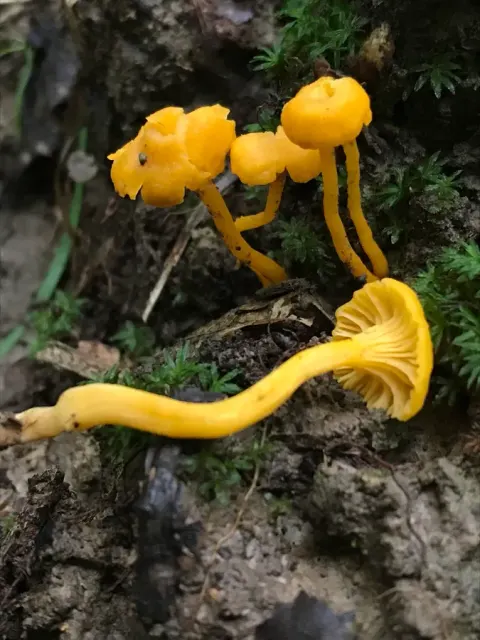
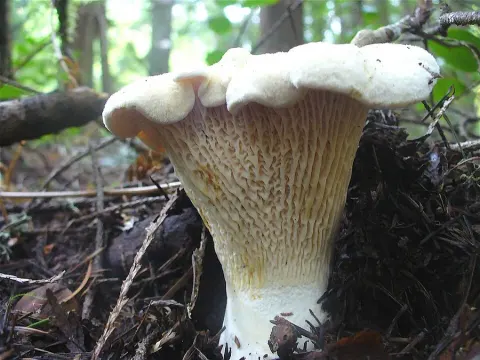
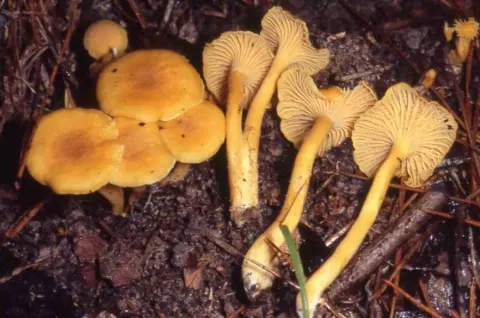
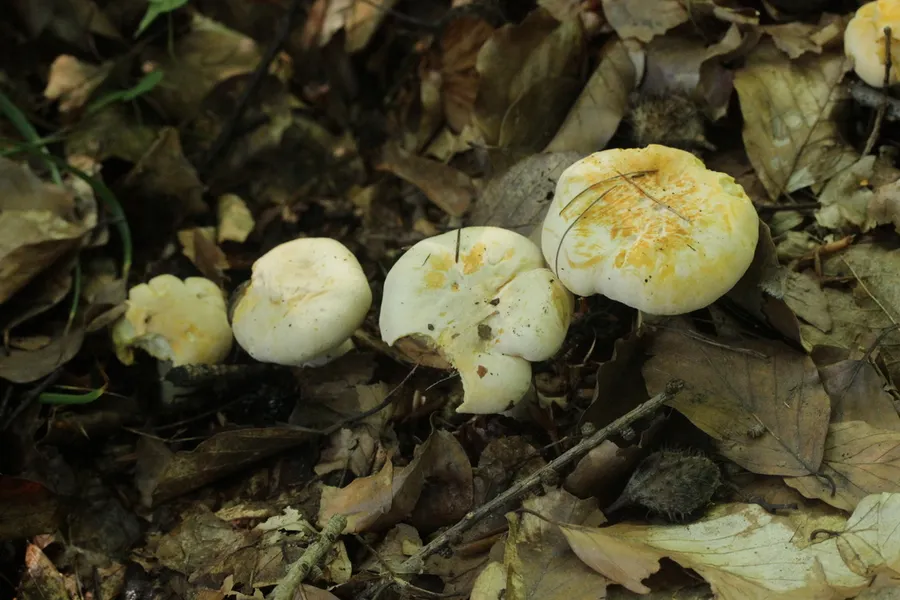
The cap of Cantharellus subpruinosus ranges from 20 to 70 mm in diameter. Initially convex, it flattens out with age and may become slightly depressed at the centre. The surface of the cap is smooth and has a silky to velvety texture, initially covered by a distinctive white powdery coating known as pruina, which makes young specimens appear almost white. As the fungus matures, the cap transitions to a vibrant orange hue, often becoming marked with ochre stains when bruised or handled. Its edge is distinctly wavy to lobed and retains remnants of the pruina even at maturity, gradually turning a rust-like shade. The underside features pronounced, decurrent folds (ridges that run down the stipe), which share the same general colouration as the cap and similarly stain yellow to orangey-ochre when touched. The stipe measures 20 to 70 mm tall and 10 to 30 mm thick, sometimes broadening slightly towards the top. Initially solid, the stipe gradually develops a hollow area towards its base, and its shape can vary from somewhat spindle-like to cylindrical-clavate (club-shaped). Typically, the stipe is slightly paler than or the same colour as the cap and likewise stains ochre upon handling. Internally, the flesh of the stem is whitish, contrasting with the orange flesh beneath the cap's outer layer. The fungus has a mild taste and emits a pleasant, fruity aroma reminiscent of apricots. Microscopically, the spores of C. subpruinosus are elliptical, occasionally kidney-shaped when viewed from the side, smooth, and transparent (hyaline), measuring roughly 7.5–8.5 by 4–5 μm. The basidia—the spore-producing cells—are elongated and club-shaped, typically bearing five to six spores each.
Habitat dan peran ekologis
Cantharellus subpruinosus grows in mossy, forested habitats, typically within mixed woodlands dominated by broad-leaved trees and spruce (Picea species). It can be found growing singly or in clusters on the forest floor. At the time of its original description, its known geographical distribution was known to be centred in Europe, specifically described from the Haute-Savoie region in France. Its preferred habitat includes shaded, humid environments with abundant leaf litter, providing optimal conditions for its growth and development. A report of unusual fungal species found in Cyprus included a population of Cantharellus that were suggested to be C. subpruinosus.
- Habitat atau konteks temuan
- hutan
- Substrat
- Informasi belum tersedia pada sumber rilis ini.
- Peran atau konteks
- Belum dikategorikan pada rilis ini.
Reproduksi
Internally, the flesh of the stem is whitish, contrasting with the orange flesh beneath the cap's outer layer. The fungus has a mild taste and emits a pleasant, fruity aroma reminiscent of apricots. Microscopically, the spores of C. subpruinosus are elliptical, occasionally kidney-shaped when viewed from the side, smooth, and transparent (hyaline), measuring roughly 7.5–8.5 by 4–5 μm. The basidia—the spore-producing cells—are elongated and club-shaped, typically bearing five to six spores each.
Catatan identitas dan cakupan
- Nama diterima mengikuti Catalogue of Life Base2026-09-11; uraian mempertahankan konsep dan nama sumber aslinya.
- Original geographic, specimen and life-cycle scope retained; source import awaits individual editorial review.
- Impor dan terjemahan otomatis belum diperiksa editorial per profil. Struktur reproduktif yang disebutkan tidak membuktikan seluruh siklus hidup diketahui.
- Pengukuran pada uraian mengikuti spesimen, kultur, dan metode sumber; angka tidak diperluas ke semua populasi.
Catatan distribusi dalam narasi mengikuti sumbernya. Dokumentasi spesimen atau foto mengikuti catatan sumber. Bukti wilayah Indonesia dan penilaian konservasi tidak disimpulkan dari gambar.
Melihat dengan konteks
Dokumentasi Cantharellus pallens menurut asosiasi foto pada record takson iNaturalist. Kredit: Björn Sothmann. Identitas mengikuti sumber; bukan penentuan spesimen independen.
- Jenis
- Fotografi
- Kredit
- (c) Björn Sothmann, some rights reserved (CC BY-SA), uploaded by Björn Sothmann
- Lisensi
- CC BY-SA 4.0
- Sumber media
- Buka entri sumber
Dokumentasi tambahan

Foto yang diasosiasikan dengan Cantharellus pallens pada iNaturalist. Identifikasi mengikuti sumber; bukan penentuan spesimen independen.
Kredit dan penggunaan
(c) Davide Puddu, some rights reserved (CC BY), uploaded by Davide Puddu
Ukuran dan format gambar disesuaikan tanpa pemotongan, retus, atau penambahan skala. Lisensi sumber dipertahankan.
Sumber profil
- [1] Cantharellus subpruinosus — Wikipedia (en)
- [2] Catalogue of Life Base2026-09-11 — Cantharellus pallens
- [3] Dokumentasi visual — Cantharellus pallens
- [4] Dokumentasi visual — Cantharellus pallens
Rujukan halaman ini
Fungi. Cantharellus pallens. Rilis data fungi-2026-10-12-expansion-2. https://fungi-atlas.mgadib.chatgpt.site/jamur/cantharellus-pallens/.
Status: impor sumber; pemeriksaan editorial per profil belum selesai. Untuk klaim biologis, gunakan rujukan pada bagian terkait dan periksa konteks sumber aslinya.