Ciri dan struktur
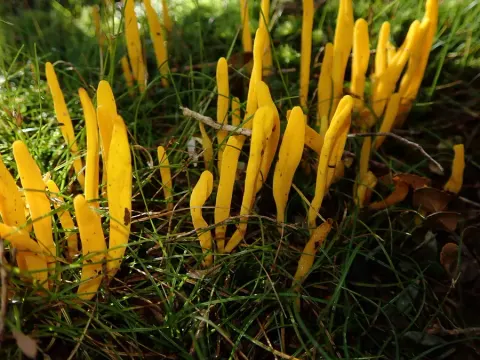
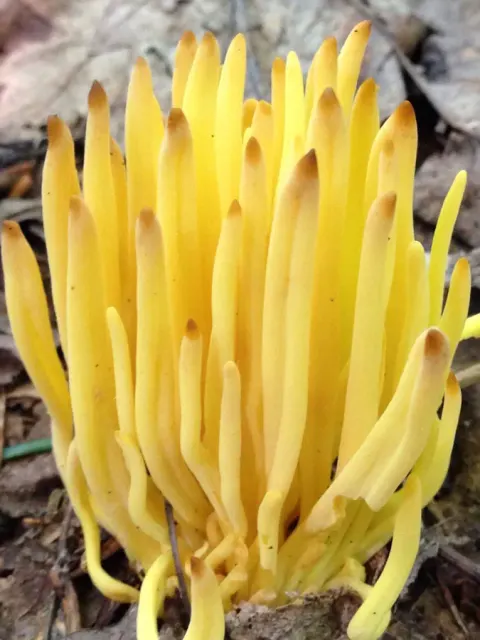
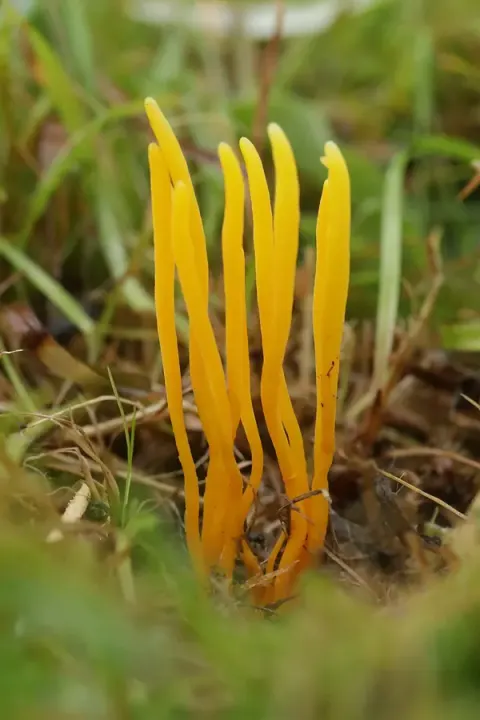
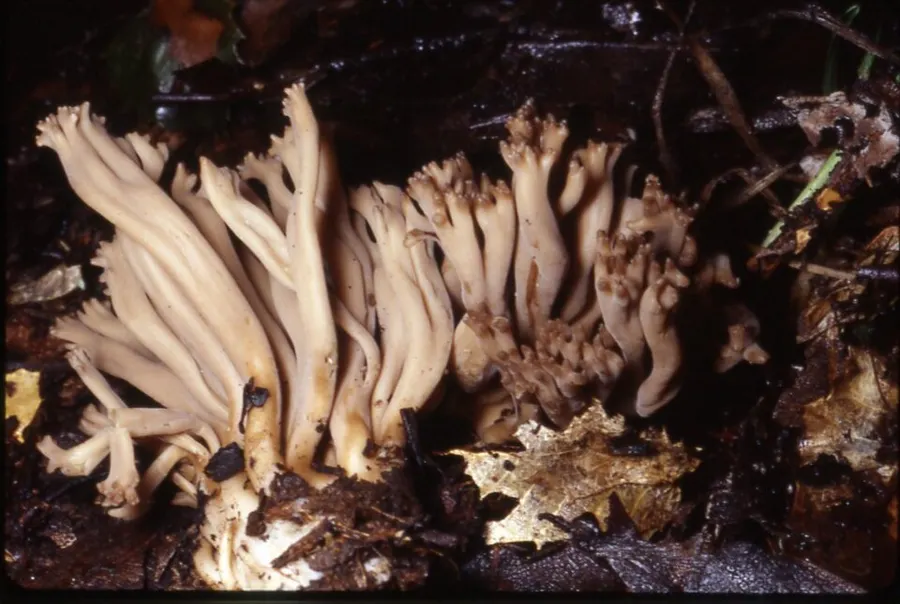
The multiply branched fruit bodies grow to heights of 2 – 4.5 cm. The branches are initially white before darkening to pale brown and umber, usually with darker tips. The stipe is short, white, and shaggy with long hairs. Branches are 1 – 2.5 mm wide, and clustered and erect below, branching first polychotomously (multiply branched), and then irregularly dichotomously (divided in two branches). The flesh, initially white before becoming brown in age, is firm and hard. It has no distinctive taste, and a "pleasant" smell. The spores are roughly spherical to pip-shaped, smooth, contain a single oil droplet, and measure 4–6.7 by 3–6 μm. The basidia (spore-bearing cells) are quite long, measuring 70–95 by 8–9 μm before tapering to a narrow base about 2.5 μm wide. They are four-spored, with the spores attached to sterigmata that are 8–10 μm long.
Habitat dan peran ekologis
The fruit bodies of Clavulinopsis umbrinella grow in grass. In Europe, it is uncommon, having been reported from Great Britain, which Napier acquired in 1986. During the First World War the property served as a military hospital and was used to treat shell-shocked officers. The poets Wilfred Owen and Siegfried Sassoon met when they were treated there in 1917. Ecologist Abbie Patterson made the discovery on a lawn at the campus and has come up with a "quirky theory" that soldiers' boots may have picked up spores in the mud of the Flanders Fields. As evidence, Patterson offers a photograph of soldiers and nurses lined up on the same spot that he made his discovery. (Patterson has discovered several other rare species in the grounds, an outcome he attributes to the absence of weedkillers.)
- Habitat atau konteks temuan
- Informasi belum tersedia pada sumber rilis ini.
- Substrat
- Informasi belum tersedia pada sumber rilis ini.
- Peran atau konteks
- Belum dikategorikan pada rilis ini.
Reproduksi
The spores are roughly spherical to pip-shaped, smooth, contain a single oil droplet, and measure 4–6.7 by 3–6 μm. The basidia (spore-bearing cells) are quite long, measuring 70–95 by 8–9 μm before tapering to a narrow base about 2.5 μm wide. They are four-spored, with the spores attached to sterigmata that are 8–10 μm long.
Catatan identitas dan cakupan
- Nama diterima mengikuti Catalogue of Life Base2026-09-11; uraian mempertahankan konsep dan nama sumber aslinya.
- Original geographic, specimen and life-cycle scope retained; source import awaits individual editorial review.
- Impor dan terjemahan otomatis belum diperiksa editorial per profil. Struktur reproduktif yang disebutkan tidak membuktikan seluruh siklus hidup diketahui.
- Pengukuran pada uraian mengikuti spesimen, kultur, dan metode sumber; angka tidak diperluas ke semua populasi.
Catatan distribusi dalam narasi mengikuti sumbernya. Dokumentasi spesimen atau foto mengikuti catatan sumber. Bukti wilayah Indonesia dan penilaian konservasi tidak disimpulkan dari gambar.
Melihat dengan konteks
Dokumentasi Clavulinopsis umbrinella dari Wikimedia Commons. For more information about this, see the observation page at Mushroom Observer. Identifikasi mengikuti record berkas sumber.
- Jenis
- Fotografi
- Kredit
- This image was created by user Ron Pastorino (Ronpast) at Mushroom Observer , a source for mycological images. You can contact this user here .
- Lisensi
- CC BY-SA 3.0
- Sumber media
- Buka entri sumber
Sumber profil
- [1] Clavulinopsis umbrinella — Wikipedia (en)
- [2] Catalogue of Life Base2026-09-11 — Clavulinopsis umbrinella
- [3] Dokumentasi visual — Clavulinopsis umbrinella
Rujukan halaman ini
Fungi. Clavulinopsis umbrinella. Rilis data fungi-2026-10-12-expansion-2. https://fungi-atlas.mgadib.chatgpt.site/jamur/clavulinopsis-umbrinella/.
Status: impor sumber; pemeriksaan editorial per profil belum selesai. Untuk klaim biologis, gunakan rujukan pada bagian terkait dan periksa konteks sumber aslinya.