Ciri dan struktur
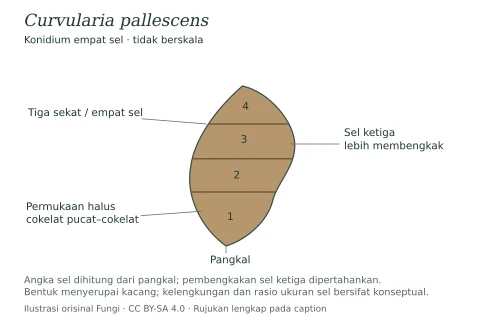
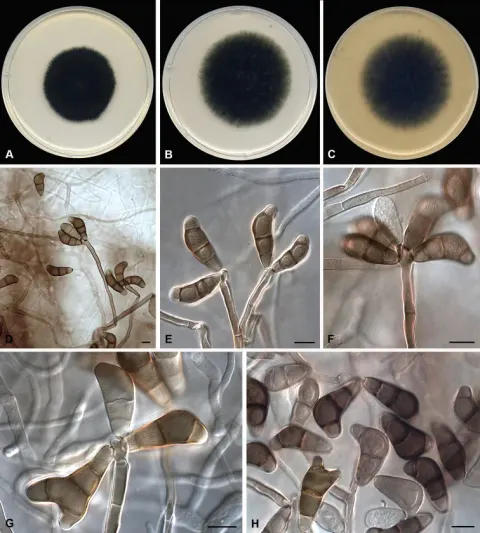
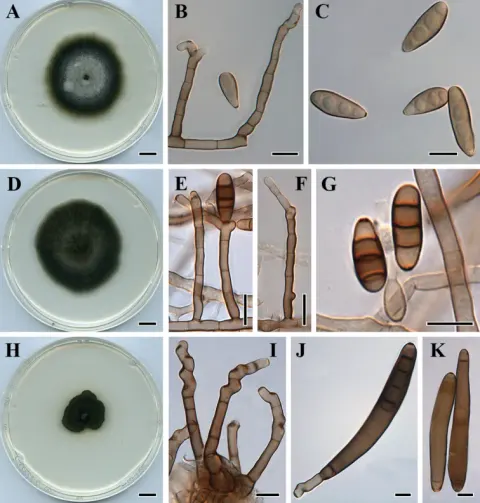
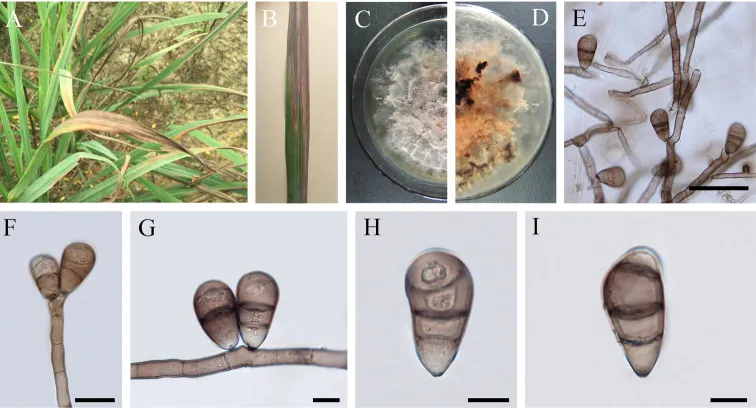
Pathogenic on Cymbopogon citratus. Fungus initially producing white to grey lesions with dark borders on all parts of the shoot, later enlarging and coalescing over entire leaf. Colonies on PDA irregularly circular, with mycelial growth rate = 1.0 cm/day, vegetative hyphae septate, branched, subhyaline to brown, smooth to verruculose, 2–3 µm, anastomosing. Aerial mycelium dense, felted, initially pale grey, becoming darkened and greyish-green at maturity, producing black extracellular pigments. On MEA, the colony morphology similar to PDA, with growth rate = 1.35 cm/day. Sexual morph: Undetermined. Asexual morph: Hyphomycetous. Conidiophores macronematous, arising singly, simple or branched, flexuous, 8–10 septate, geniculate, pale brown to dark brown, paler towards apex, 120–200 × 2–3 µm (av. = 170 × 2.5 µm, n = 30). Conidiogenous cells polytretic, sympodial, terminal, sometimes intercalary, cicatrised, with thickened and darkened conidiogenous loci up to 1.0–1.2 µm diam., smooth. Mature conidia 3 to rarely 4 septa, acropleurogenous, obovoid, usually straight to curved at the slightly wider, smooth-walled, larger third cell from the base, 24.5–36.0 × 14.0–20.5 µm (av. = 29.5 × 17.5 µm, n = 50), sub-hyaline to pale brown end cells, pale brown to dark brown at intermediate cells, with conspicuous or sometimes slightly protuberant hilum. Germination of conidia bipolar.
Habitat dan peran ekologis
Pathogenic on Cymbopogon citratus. Fungus initially producing white to grey lesions with dark borders on all parts of the shoot, later enlarging and coalescing over entire leaf. Colonies on PDA irregularly circular, with mycelial growth rate = 1.0 cm/day, vegetative hyphae septate, branched, subhyaline to brown, smooth to verruculose, 2–3 µm, anastomosing. Aerial mycelium dense, felted, initially pale grey, becoming darkened and greyish-green at maturity, producing black extracellular pigments. On MEA, the colony morphology similar to PDA, with growth rate = 1.35 cm/day. Sexual morph: Undetermined. Asexual morph: Hyphomycetous. Conidiophores macronematous, arising singly, simple or branched, flexuous, 8–10 septate, geniculate, pale brown to dark brown, paler towards apex, 120–200 × 2–3 µm (av. = 170 × 2.5 µm, n = 30). Conidiogenous cells polytretic, sympodial, terminal, sometimes intercalary, cicatrised, with thickened and darkened conidiogenous loci up to 1.0–1.2 µm diam., smooth. Mature conidia 3 to rarely 4 septa, acropleurogenous, obovoid, usually straight to curved at the slightly wider, smooth-walled, larger third cell from the base, 24.5–36.0 × 14.0–20.5 µm (av. = 29.5 × 17.5 µm, n = 50), sub-hyaline to pale brown end cells, pale brown to dark brown at intermediate cells, with conspicuous or sometimes slightly protuberant hilum.
- Habitat atau konteks temuan
- kultur yang didokumentasikan
- Substrat
- Informasi belum tersedia pada sumber rilis ini.
- Peran atau konteks
- Belum dikategorikan pada rilis ini.
Reproduksi
Pathogenic on Cymbopogon citratus. Fungus initially producing white to grey lesions with dark borders on all parts of the shoot, later enlarging and coalescing over entire leaf. Colonies on PDA irregularly circular, with mycelial growth rate = 1.0 cm/day, vegetative hyphae septate, branched, subhyaline to brown, smooth to verruculose, 2–3 µm, anastomosing. Aerial mycelium dense, felted, initially pale grey, becoming darkened and greyish-green at maturity, producing black extracellular pigments. On MEA, the colony morphology similar to PDA, with growth rate = 1.35 cm/day. Sexual morph: Undetermined. Asexual morph: Hyphomycetous. Conidiophores macronematous, arising singly, simple or branched, flexuous, 8–10 septate, geniculate, pale brown to dark brown, paler towards apex, 120–200 × 2–3 µm (av. = 170 × 2.5 µm, n = 30).
Catatan identitas dan cakupan
- Nama diterima mengikuti Catalogue of Life Base2026-09-11; uraian mempertahankan konsep dan nama sumber aslinya.
- Preserve original treatment localities, hosts and substrate scope. Materials examined describe documented specimens, not the full global range.
- Impor dan terjemahan otomatis belum diperiksa editorial per profil. Struktur reproduktif yang disebutkan tidak membuktikan seluruh siklus hidup diketahui.
- Pengukuran pada uraian mengikuti spesimen, kultur, dan metode sumber; angka tidak diperluas ke semua populasi.
Catatan distribusi dalam narasi mengikuti sumbernya. Dokumentasi spesimen atau foto mengikuti catatan sumber. Bukti wilayah Indonesia dan penilaian konservasi tidak disimpulkan dari gambar.
Melihat dengan konteks
Curvularia nanningensis (GUCC11005, holotype) A, B diseased symptom C colony on PDA from above D colony on PDA from below E − G conidia and conidiophores H − I conidia. Scale bars: 50 μm (E), 20 μm (F), 10 μm (G − I).
- Jenis
- Pelat ilmiah
- Kredit
- Qian Zhang, Zai-Fu Yang, Wei Cheng, Nalin N. Wijayawardene, Kevin D. Hyde, Zhuo Chen, Yong Wang
- Lisensi
- CC BY 4.0
- Sumber media
- Buka entri sumber
Sumber profil
- [1] Diseases of Cymbopogon citratus (Poaceae) in China: Curvularia nanningensis sp. nov. — Curvularia nanningensis
- [2] Catalogue of Life Base2026-09-11 — Curvularia nanningensis
- [3] Dokumentasi visual — Curvularia nanningensis
Rujukan halaman ini
Fungi. Curvularia nanningensis. Rilis data fungi-2026-10-12-expansion-2. https://fungi-atlas.mgadib.chatgpt.site/jamur/curvularia-nanningensis/.
Status: impor sumber; pemeriksaan editorial per profil belum selesai. Untuk klaim biologis, gunakan rujukan pada bagian terkait dan periksa konteks sumber aslinya.