Ciri dan struktur
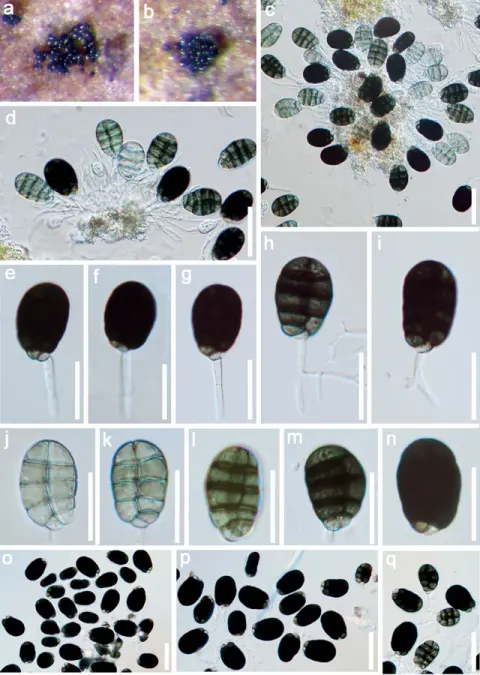
Saprobic on dead, decaying stems of Typha sp. Sexual morph: Undetermined. Asexual morph: Hyphomycetous. Colonies black, effuse, sporodochial. Mycelium 1.2–2.5 μm (x̄ = 2 μm, n = 30), immersed, smooth, subhyaline to pale brown, branched, septate, thin-walled. Chlamydospores 4–5 × 6.5–8.5 μm (x̄ = 4.5 × 7 μm, n = 30), intercalary or terminal, solitary, catenated, straight, or curved, brown to dark brown with a pale intermediate cell, smooth walls thickened with axial performative canals 1–8 transverse and occasionally 1 or more oblique or longitudinal septa, constricted at the septa. Conidiophores 2–6 μm wide (x̄ = 4.5 μm, n = 10), micronematous, mononematous, subhyaline to pale brown, smooth, straight to flexuous, septate. Conidiogenous cells 4.5–6 × 5.5–8 μm (x̄ = 5.5 × 7.8 μm, n = 30), holoblastic, integrated, intercalary, determinate, cylindrical, pale brown to brown with thin walls, conidial secession rhexolytic. Conidia 24–30 × 15–20 μm (x̄ = 26.5 × 17.5 μm, n = 30), pyriform or elongated pyriform, solitary, intercalary, smooth, thin-walled, muriform, rounded at the apex, pale grey olivaceous to pale brown, acropetal pigmentation during conidium formation. Conidia germinating on malt extract agar (MEA) within 24 h. Germ tube produced from the base of conidia. Colonies growing on MEA, reaching 40 mm in 4 weeks at 25 °C. Mycelia superficial, effuse to flat or undulate, from above olivaceous to greyish canter to the complete edge, from reverse greenish-black at the canter, light brown to black to hyaline edge.
Habitat dan peran ekologis
Saprobic on dead, decaying stems of Typha sp. Sexual morph: Undetermined. Asexual morph: Hyphomycetous. Colonies black, effuse, sporodochial. Mycelium 1.2–2.5 μm (x̄ = 2 μm, n = 30), immersed, smooth, subhyaline to pale brown, branched, septate, thin-walled. Chlamydospores 4–5 × 6.5–8.5 μm (x̄ = 4.5 × 7 μm, n = 30), intercalary or terminal, solitary, catenated, straight, or curved, brown to dark brown with a pale intermediate cell, smooth walls thickened with axial performative canals 1–8 transverse and occasionally 1 or more oblique or longitudinal septa, constricted at the septa. Conidiophores 2–6 μm wide (x̄ = 4.5 μm, n = 10), micronematous, mononematous, subhyaline to pale brown, smooth, straight to flexuous, septate. Conidiogenous cells 4.5–6 × 5.5–8 μm (x̄ = 5.5 × 7.8 μm, n = 30), holoblastic, integrated, intercalary, determinate, cylindrical, pale brown to brown with thin walls, conidial secession rhexolytic. Conidia 24–30 × 15–20 μm (x̄ = 26.5 × 17.5 μm, n = 30), pyriform or elongated pyriform, solitary, intercalary, smooth, thin-walled, muriform, rounded at the apex, pale grey olivaceous to pale brown, acropetal pigmentation during conidium formation. Thailand • Prachuap Khiri Khan Province, Pran Buri District, Pran Buri Wetland, on decaying stems of Typha sp. (Typhaceae), 25 August 2023, Tharindu Bhagya, TB113 (MFLU 25-0195), living culture (MFLUCC 25-0242).
- Habitat atau konteks temuan
- kultur yang didokumentasikan
- Substrat
- Informasi belum tersedia pada sumber rilis ini.
- Peran atau konteks
- Pengurai
Reproduksi
Saprobic on dead, decaying stems of Typha sp. Sexual morph: Undetermined. Asexual morph: Hyphomycetous. Colonies black, effuse, sporodochial. Mycelium 1.2–2.5 μm (x̄ = 2 μm, n = 30), immersed, smooth, subhyaline to pale brown, branched, septate, thin-walled. Chlamydospores 4–5 × 6.5–8.5 μm (x̄ = 4.5 × 7 μm, n = 30), intercalary or terminal, solitary, catenated, straight, or curved, brown to dark brown with a pale intermediate cell, smooth walls thickened with axial performative canals 1–8 transverse and occasionally 1 or more oblique or longitudinal septa, constricted at the septa. Conidiophores 2–6 μm wide (x̄ = 4.5 μm, n = 10), micronematous, mononematous, subhyaline to pale brown, smooth, straight to flexuous, septate.
Catatan identitas dan cakupan
- Nama diterima mengikuti Catalogue of Life Base2026-09-11; uraian mempertahankan konsep dan nama sumber aslinya.
- Preserve original treatment localities, hosts and substrate scope. Materials examined describe documented specimens, not the full global range.
- Impor dan terjemahan otomatis belum diperiksa editorial per profil. Struktur reproduktif yang disebutkan tidak membuktikan seluruh siklus hidup diketahui.
- Pengukuran pada uraian mengikuti spesimen, kultur, dan metode sumber; angka tidak diperluas ke semua populasi.
Catatan distribusi dalam narasi mengikuti sumbernya. Dokumentasi spesimen atau foto mengikuti catatan sumber. Bukti wilayah Indonesia dan penilaian konservasi tidak disimpulkan dari gambar.
Melihat dengan konteks
Dematipyriforma aquilariae (MFLU 25-0195). a. Typha sp. host material; b, c. Colonies on host surface; d. Squash mount of conidia; e. Culture on MEA above; f. Reverse; g, h. Chlamydospores; i–s. Conidial development. Scale bars: 500 µm (b); 250 µm (c); 50 µm (d); 20 µm (g–s).
- Jenis
- Pelat ilmiah
- Kredit
- Amuhenage T. Bhagya, Chayanard Phukhamsakda, Pattana Kakumyan, Ali H. Bahkali, E. B. Gareth Jones, Kevin D. Hyde
- Lisensi
- CC BY 4.0
- Sumber media
- Buka entri sumber
Sumber profil
- [1] Taxonomic novelties and host associations of Sordariomycetes from wetland-dwelling Poales in Thailand — Dematipyriforma aquilariae
- [2] Catalogue of Life Base2026-09-11 — Dematipyriforma aquilariae
- [3] Dokumentasi visual — Dematipyriforma aquilariae
Rujukan halaman ini
Fungi. Dematipyriforma aquilariae. Rilis data fungi-2026-10-12-expansion-2. https://fungi-atlas.mgadib.chatgpt.site/jamur/dematipyriforma-aquilariae/.
Status: impor sumber; pemeriksaan editorial per profil belum selesai. Untuk klaim biologis, gunakan rujukan pada bagian terkait dan periksa konteks sumber aslinya.