Ciri dan struktur
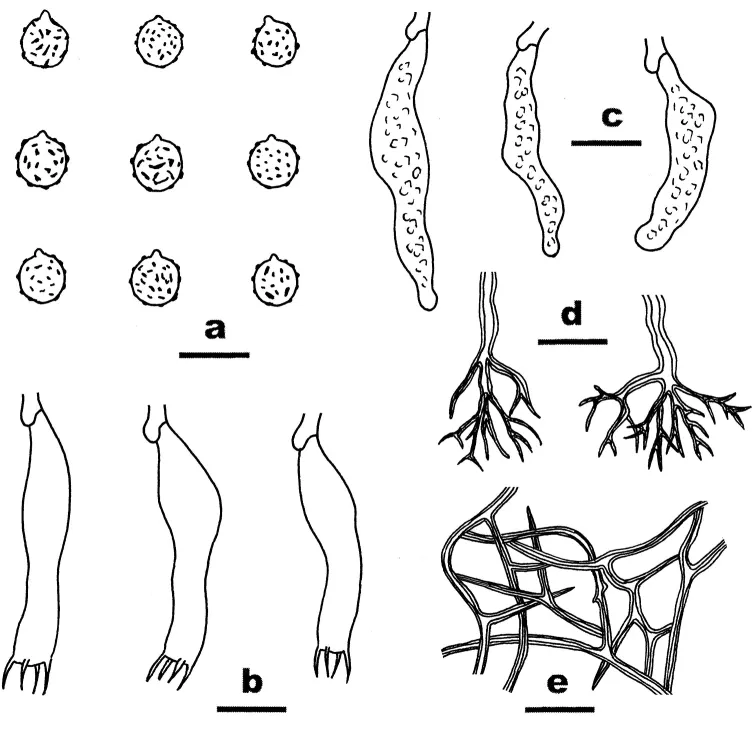
Hyphal system dimitic. Context thickening, compact, composed of generative hyphae, dichohyphae, embedded basidiospores and abundant crystals. Generative hyphae rare, with clamp connections, hyaline, thin- to slightly thick-walled, 2–3 µm in diam. Dichohyphae dominant, hyaline to yellow, distinctly thick-walled, dextriniod, frequently branched, aseptate, 1–2 µm in diam. Catahymenium composed of dichohyphae, gloeocystidia, basidia and basidioles. Dichohyphae in this layer abundant, hyaline to pale yellow, distinctly thick-walled, strongly dextriniod, dichotomously branched with acute terminal tips, 15–30 μm across, 2–4 µm wide at lowest part. Gloeocystidia abundant, fusiform to subclavate, hyaline, thin-walled, with solidified contents, 20–50 × 5–10 µm. Basidia subcylindrical with basal part slightly swollen, hyaline, thin-walled, with 4 sterigmata and a basal clamp connection, 30–45 × 6–9 µm; basidioles in shape similar to basidia, but slightly smaller. Basidiospores subglobose with a distinct apiculus, hyaline to pale yellowish-brown in KOH, thick-walled, strongly amyloid, 6–7 (–8) µm in diam.; walls ornamented with dense, large warts and crests.
Habitat dan peran ekologis
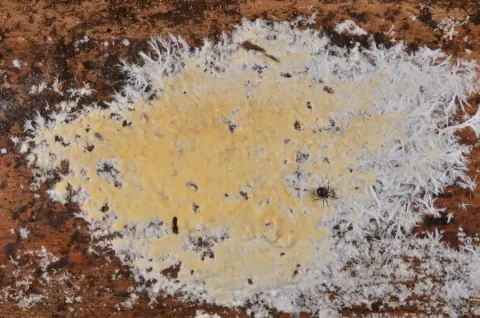
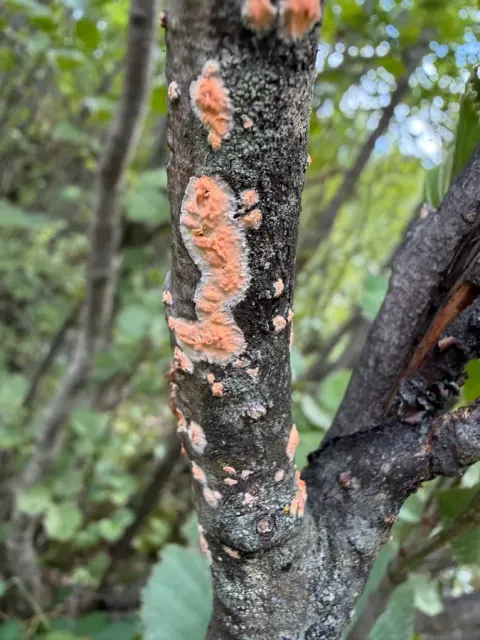
CHINA. Fujian Province, Wuyishan County, Wuyishan Nature Reserve, on bark of living Castanopsis, 6 Apr 2018, He 5374 (holotype, BJFC, ITS GenBank accession number: MH538318; isotype in CFMR). Dichostereum eburneum is characterised by the pale basidiomata on bark of living tree, the presence of abundant crystals in context and basidiospores with dense and large ornamentations. Ecologically and macroscopically, D. eburneum resembles Dendrothele Höhn. & Litsch., but the microscopic features are largely different (Nakasone and Burdsall 2011). Dichostereum kenyense Boidin & Lanq. is similar to D. eburneum by sharing the large ornamentations of basidiospores, but differs in having wider span of dichohyphae, slightly larger basidiospores (7–8 µm) and a distribution in Africa (Boidin and Lanquetin 1980).
- Habitat atau konteks temuan
- Informasi belum tersedia pada sumber rilis ini.
- Substrat
- kulit kayu
- Peran atau konteks
- Belum dikategorikan pada rilis ini.
Reproduksi
Hyphal system dimitic. Context thickening, compact, composed of generative hyphae, dichohyphae, embedded basidiospores and abundant crystals. Generative hyphae rare, with clamp connections, hyaline, thin- to slightly thick-walled, 2–3 µm in diam. Dichohyphae dominant, hyaline to yellow, distinctly thick-walled, dextriniod, frequently branched, aseptate, 1–2 µm in diam. Catahymenium composed of dichohyphae, gloeocystidia, basidia and basidioles. Dichohyphae in this layer abundant, hyaline to pale yellow, distinctly thick-walled, strongly dextriniod, dichotomously branched with acute terminal tips, 15–30 μm across, 2–4 µm wide at lowest part. Gloeocystidia abundant, fusiform to subclavate, hyaline, thin-walled, with solidified contents, 20–50 × 5–10 µm.
Catatan identitas dan cakupan
- Nama diterima mengikuti Catalogue of Life Base2026-09-11; uraian mempertahankan konsep dan nama sumber aslinya.
- Preserve original treatment localities, hosts and substrate scope. Materials examined describe documented specimens, not the full global range.
- Impor dan terjemahan otomatis belum diperiksa editorial per profil. Struktur reproduktif yang disebutkan tidak membuktikan seluruh siklus hidup diketahui.
- Pengukuran pada uraian mengikuti spesimen, kultur, dan metode sumber; angka tidak diperluas ke semua populasi.
Catatan distribusi dalam narasi mengikuti sumbernya. Dokumentasi spesimen atau foto mengikuti catatan sumber. Bukti wilayah Indonesia dan penilaian konservasi tidak disimpulkan dari gambar.
Melihat dengan konteks
Microscopic structures of Dichostereum eburneum (drawn from the holotype). a Basidiospores; b Basidia c Gloeocystidia d Dichohyphae from hymenium e Dichohyphae from subiculum. Scale bar: 10 µm.
- Jenis
- Pelat ilmiah
- Kredit
- Shi-Liang Liu, Shuang-Hui He
- Lisensi
- CC BY 4.0
- Sumber media
- Buka entri sumber
Dokumentasi tambahan

Basidiomata of Dichostereum species. a D. austrosinense (holotype, He 4871) b D. boidinii (holotype, He 5026) c D. eburneum (holotype, He 5374) d D. granulosum (He 1887) e D. pallescens (He 3266) f D. rhodosporum (Dai 18625A). Scale bar: 1 cm.
Kredit dan penggunaan
Shi-Liang Liu, Shuang-Hui He
Ukuran dan format gambar disesuaikan tanpa pemotongan, retus, atau penambahan skala. Lisensi sumber dipertahankan.
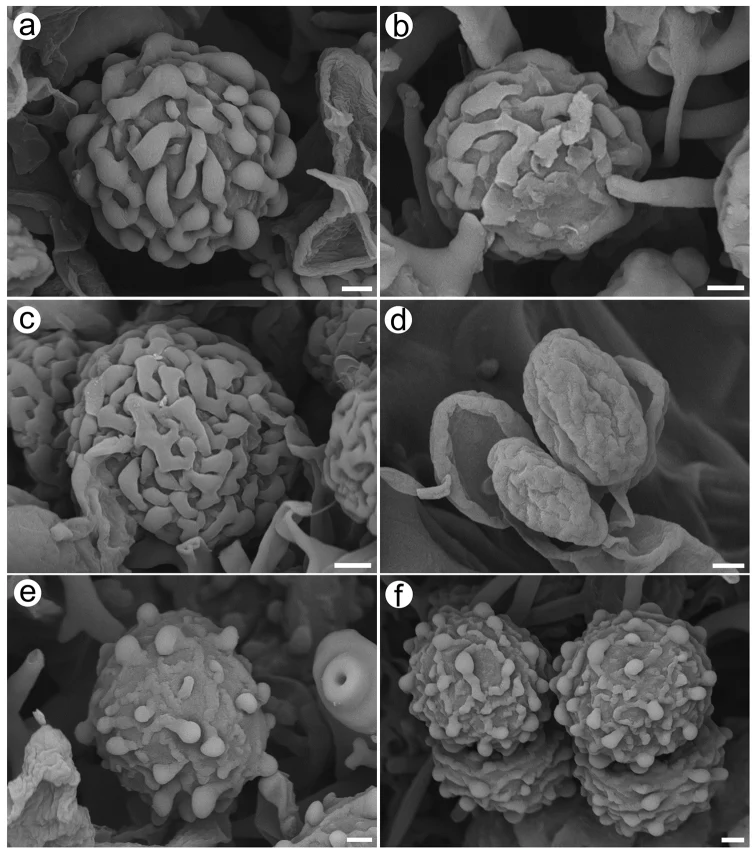
Scanning electron micrographs (SEM) of basidiospores of Dichostereum. a D. austrosinense (holotype, He 4871) b D. boidinii (holotype, He 5026) c D. eburneum (holotype, He 5374) d D. granulosum (He 1887) e D. pallescens (He 3266) f D. rhodosporum (Dai 18625A). Scale bar: 1 µm.
Kredit dan penggunaan
Shi-Liang Liu, Shuang-Hui He
Ukuran dan format gambar disesuaikan tanpa pemotongan, retus, atau penambahan skala. Lisensi sumber dipertahankan.
Sumber profil
- [1] Taxonomy and phylogeny of Dichostereum (Russulales), with descriptions of three new species from southern China — Dichostereum eburneum
- [2] Catalogue of Life Base2026-09-11 — Dichostereum eburneum
- [3] Dokumentasi visual — Dichostereum eburneum
- [4] Dokumentasi visual — Dichostereum eburneum
- [5] Dokumentasi visual — Dichostereum eburneum
Rujukan halaman ini
Fungi. Dichostereum eburneum. Rilis data fungi-2026-10-12-expansion-2. https://fungi-atlas.mgadib.chatgpt.site/jamur/dichostereum-eburneum/.
Status: impor sumber; pemeriksaan editorial per profil belum selesai. Untuk klaim biologis, gunakan rujukan pada bagian terkait dan periksa konteks sumber aslinya.