01 / Morfologi

Ciri dan struktur

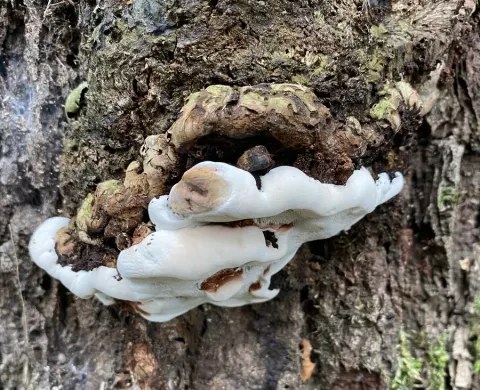
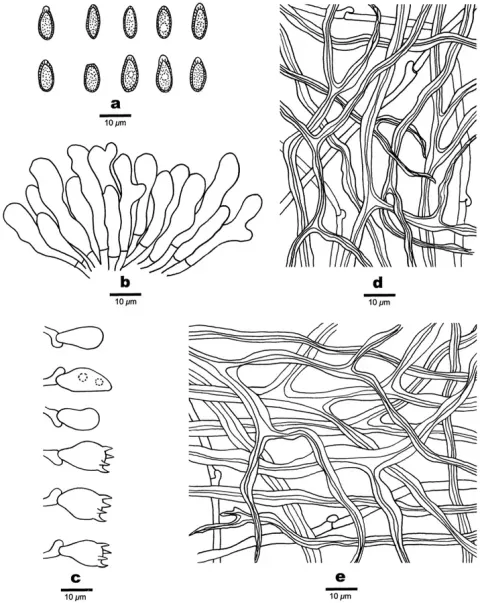
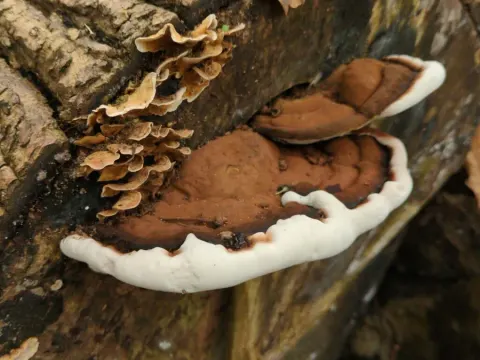
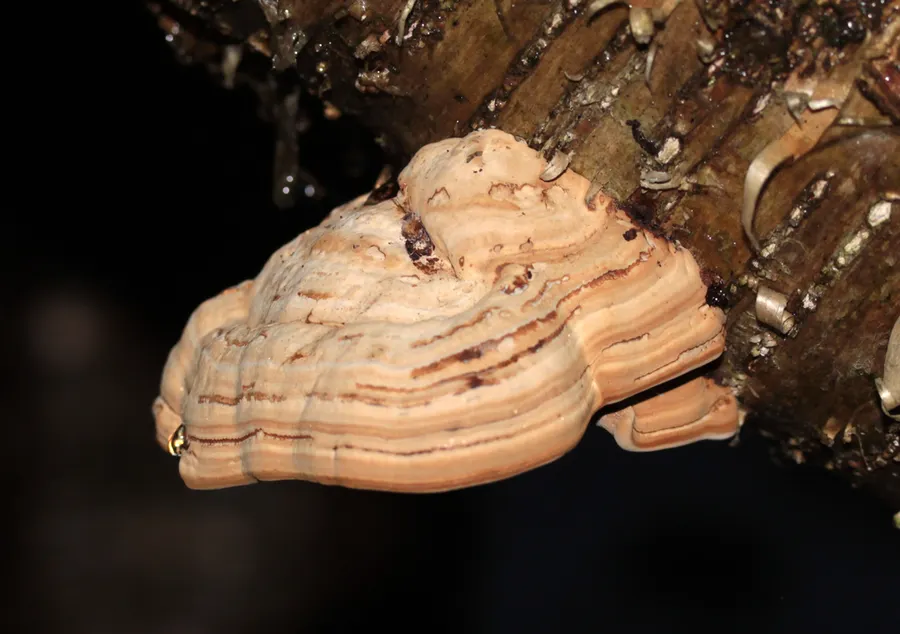
Fomes fomentarius has a fruit body of between 5 and 45 cm across, 3 and 25 cm wide and 2 and 25 cm thick, which attaches broadly to the tree on which the fungus is growing. The underside has round pores of a cream colour when new, maturing to brown, though they darken when handled. The pores are circular, and there are 2–3 per millimetre. The tubes are 2 to 7 mm long and a rusty brown colour. The colouration and size of the fruit body can vary based on where the specimen has grown. Silvery-white, greyish and nearly black specimens have been known. The darkest fruit bodies were previously classified as Fomes nigricans, but this is now recognised as a synonym of Fomes fomentarius. The colour is typically lighter at lower latitudes and altitudes, as well as on fruit bodies in the Northern Hemisphere that grow on the south side of trees. However, studies have concluded that there is no reliable way to differentiate varieties; instead, the phenotypic differences can "be attributed either to different ecotypes or to interactions between the genotype and its environment". The spores are lemon-yellow in colour, and oblong-ellipsoid in shape. They measure 15–20 by 5–7 μm. The species has a trimitic hyphal structure (meaning that it has generative, skeletal and binding hyphae), with generative hyphae (hyphae that are relatively undifferentiated and can develop reproductive structures) with clamp connections.

Sebagian uraian ditampilkan dalam bahasa sumber; terjemahannya belum tersedia atau belum lolos pemeriksaan.

Rujukan: [1]

Pengukuran mengikuti objek, spesimen atau kultur, dan metode yang disebutkan sumber. Baca uraian asli untuk konteks lengkap.

02 / Kehidupan

Habitat dan peran ekologis

Fomes fomentarius memiliki distribusi sirkumoreal serta ditemukan di Afrika utara dan selatan, di seluruh Asia and ke Amerika Utara timur, dan di seluruh Eropa, dan sering ditemukan. Suhu optimal untuk pertumbuhan spesies adalah antara 27 dan 30 C dan maksimum antara 34 dan 38 C. F. fomentarius biasanya tumbuh sendiri, tetapi beberapa buah tubuh kadang-kadang dapat ditemukan pada batang inang yang sama. Spesies ini paling sering tumbuh di atas kayu keras. Di daerah utara, ini paling umum di birch, sementara, di selatan, beech lebih khas. Di Mediterania, ek adalah tuan rumah yang khas. Spesies ini juga dikenal tumbuh di maple, ceri, hickory, pohon limau, poplar, willow, alder, hornbeam, sycamore, dan bahkan, kecuali, kayu lunak, seperti konifer. Fomes fomentarius adalah jamur putih-kotoran yang terkait dengan batang yang merusak lignin dan selulosa dalam jaringan kayu keras, menghasilkan kayu pucat dan serat. Although long dianggap terutama sebagai patogen pohon hidup, spesies ini telah dijelaskan sebagai tampaknya tidak dapat mencolok kayu sapu yang baru terluka secara langsung, sebaliknya membutuhkan koloniasi kayu sebelumnya oleh mikroorganisme lain. Dalam penelitian ini, F. fomentarius diisolasi terutama dari jaringan batang bukan cabang, yang sesuai dengan posisi khas basidiocarps pada pohon matang.

Rujukan: [1]

Habitat atau konteks temuan
Informasi belum tersedia pada sumber rilis ini.
Substrat
Informasi belum tersedia pada sumber rilis ini.
Peran atau konteks
Belum dikategorikan pada rilis ini.
Temukan hubungan serupa
03 / Siklus hidup

Reproduksi

The spores are lemon-yellow in colour, and oblong-ellipsoid in shape. They measure 15–20 by 5–7 μm. The species has a trimitic hyphal structure (meaning that it has generative, skeletal and binding hyphae), with generative hyphae (hyphae that are relatively undifferentiated and can develop reproductive structures) with clamp connections.

Sebagian uraian ditampilkan dalam bahasa sumber; terjemahannya belum tersedia atau belum lolos pemeriksaan.

Rujukan: [1]

Sinonim menurut acuan taksonomi rilis: Agaricus fomentarius; Boletus fomentarius; Elfvingia fomentaria; Elfvingiella fomentaria; Fomes excavatus; Fomes fomentarius f. inzengae; Fomes fomentarius var. leuciticus; Fomes inzengae; Ochroporus fomentarius; Placodes fomentarius; Polyporus fomentarius; Polyporus fomentarius var. excavatus; Polyporus fomentarius var. lineatus; Polyporus fomentarius var. stratosus; Polyporus inzengae; Pyrenium fomentarium; Pyropolyporus fomentarius; Scindalma fomentarium; Ungulina fomentaria; Ungulina fomentaria subsp. nigricans
04 / Batas informasi

Catatan identitas dan cakupan

  • Nama diterima mengikuti Catalogue of Life Base2026-09-11; uraian mempertahankan konsep dan nama sumber aslinya.
  • Original geographic, specimen and life-cycle scope retained; source import awaits individual editorial review.
  • Impor dan terjemahan otomatis belum diperiksa editorial per profil. Struktur reproduktif yang disebutkan tidak membuktikan seluruh siklus hidup diketahui.
  • Pengukuran pada uraian mengikuti spesimen, kultur, dan metode sumber; angka tidak diperluas ke semua populasi.

Catatan distribusi dalam narasi mengikuti sumbernya. Dokumentasi spesimen atau foto mengikuti catatan sumber. Bukti wilayah Indonesia dan penilaian konservasi tidak disimpulkan dari gambar.

05 / Dokumentasi

Melihat dengan konteks

Dokumentasi Fomes fomentarius menurut asosiasi foto pada record takson iNaturalist. Kredit: Jamie Griffiths. Identitas mengikuti sumber; bukan penentuan spesimen independen.

Jenis
Fotografi
Kredit
(c) Jamie Griffiths, bazı hakları saklıdır (CC BY), yükleyen: Jamie Griffiths
Lisensi
CC BY 4.0
Sumber media
Buka entri sumber

Gambar menunjukkan objek menurut identifikasi sumber, bukan verifikasi independen spesimen oleh Fungi. Tidak ada skala baru yang ditambahkan.

06 / Rujukan

Sumber profil

  1. [1] Fomes fomentarius — Wikipedia (en)Bagian sumber: Frozen revision 1379609841
    Tanggal penghimpunan sumber: 2026-10-12
    Teks sumber: CC BY-SA4.0 · Wikipedia contributors
  2. [2] Catalogue of Life Base2026-09-11 — Fomes fomentariusBagian sumber: ColDP NameUsage.tsv ID 6JCQK; accepted species; source 2073
    Tanggal penghimpunan sumber: 2026-10-12
  3. [3] Dokumentasi visual — Fomes fomentariusBagian sumber: Individual media record; identification follows the source, not independent determination
    Tanggal penghimpunan sumber: 2026-10-12
    Media sumber: CC BY 4.0 · (c) Jamie Griffiths, bazı hakları saklıdır (CC BY), yükleyen: Jamie Griffiths

Adaptasi teks: CC BY-SA 4.0. Wikipedia contributors — Fomes fomentarius — Wikipedia (en)

Uraian asli dan riwayat sumber

Riwayat atau halaman sumber

Ringkasan sumber

Fomes fomentarius has a fruit body of between 5 and 45 cm across, 3 and 25 cm wide and 2 and 25 cm thick, which attaches broadly to the tree on which the fungus is growing. The underside has round pores of a cream colour when new, maturing to brown, though they darken when handled. The pores are circular, and there are 2–3 per millimetre. The tubes are 2 to 7 mm long and a rusty brown colour. The colouration and size of the fruit body can vary based on where the specimen has grown. Silvery-white, greyish and nearly black specimens have been known.

Revisi sumber

Morfologi sumber

Fomes fomentarius has a fruit body of between 5 and 45 cm across, 3 and 25 cm wide and 2 and 25 cm thick, which attaches broadly to the tree on which the fungus is growing. The underside has round pores of a cream colour when new, maturing to brown, though they darken when handled. The pores are circular, and there are 2–3 per millimetre. The tubes are 2 to 7 mm long and a rusty brown colour. The colouration and size of the fruit body can vary based on where the specimen has grown. Silvery-white, greyish and nearly black specimens have been known. The darkest fruit bodies were previously classified as Fomes nigricans, but this is now recognised as a synonym of Fomes fomentarius. The colour is typically lighter at lower latitudes and altitudes, as well as on fruit bodies in the Northern Hemisphere that grow on the south side of trees. However, studies have concluded that there is no reliable way to differentiate varieties; instead, the phenotypic differences can "be attributed either to different ecotypes or to interactions between the genotype and its environment". The spores are lemon-yellow in colour, and oblong-ellipsoid in shape. They measure 15–20 by 5–7 μm. The species has a trimitic hyphal structure (meaning that it has generative, skeletal and binding hyphae), with generative hyphae (hyphae that are relatively undifferentiated and can develop reproductive structures) with clamp connections.

Revisi sumber

Ekologi sumber

Fomes fomentarius has a circumboreal distribution as well as being found in both northern and southern Africa, throughout Asia and into eastern North America, and throughout Europe, and is frequently encountered. The optimal temperature for the species's growth is between 27 and 30 C and the maximum is between 34 and 38 C. F. fomentarius typically grows alone, but multiple fruit bodies can sometimes be found upon the same host trunk. The species most typically grows upon hardwoods. In northern areas, it is most common on birch, while, in the south, beech is more typical. In the Mediterranean, oak is the typical host. The species has also been known to grow upon maple, cherry, hickory, lime tree, poplar, willow, alder, hornbeam, sycamore, and even, exceptionally, softwoods, such as conifers. Fomes fomentarius is a stem-associated white-rot fungus that degrades both lignin and cellulose in hardwood tissues, resulting in pale, fibrous wood. Although long regarded primarily as a pathogen of living trees, The species has been described as apparently unable to colonise freshly wounded sapwood directly, instead requiring prior wood colonisation by other microorganisms. In these studies, F. fomentarius was isolated predominantly from stem tissues rather than branches, corresponding to the typical position of basidiocarps on mature trees.

Revisi sumber

Struktur reproduksi sumber

The spores are lemon-yellow in colour, and oblong-ellipsoid in shape. They measure 15–20 by 5–7 μm. The species has a trimitic hyphal structure (meaning that it has generative, skeletal and binding hyphae), with generative hyphae (hyphae that are relatively undifferentiated and can develop reproductive structures) with clamp connections.

Revisi sumber

Rujukan halaman ini

Fungi. Fomes fomentarius. Rilis data fungi-2026-10-12-expansion-2. https://fungi-atlas.mgadib.chatgpt.site/jamur/fomes-fomentarius/.

Status: impor sumber; pemeriksaan editorial per profil belum selesai. Untuk klaim biologis, gunakan rujukan pada bagian terkait dan periksa konteks sumber aslinya.