Ciri dan struktur
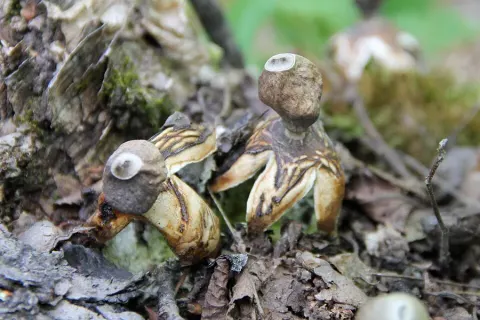
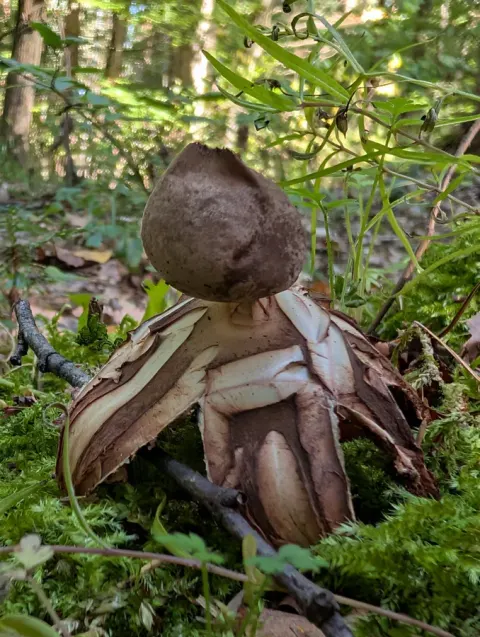
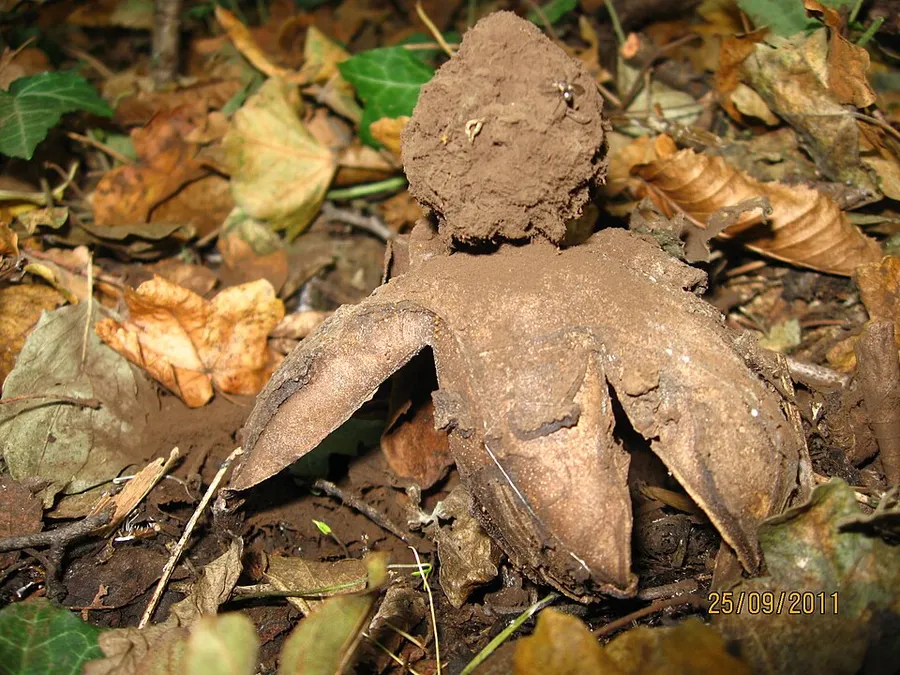
Geastrum melanocephalum produces medium to large basidiomata (fruiting bodies) that undergo dramatic morphological changes as they mature. When young, the fruiting bodies are epigeous (growing above ground), rounded, and often onion-shaped, measuring up to 12 cm in diameter. They typically feature a smooth, cracked, or scaly outer surface that is not encrusted with debris, and may have an umbo (raised knob) at the apex. A distinct characteristic is that the surface turns violet when damaged in fresh specimens. As the fungus matures, the exoperidium (outer wall) splits into 4–8 rays (occasionally up to 13) that arch outward, often forming a characteristic "collar" similar to that seen in Geastrum triplex. The most distinctive feature of G. melanocephalum is its evanescent (quickly disappearing) endoperidium (inner spore sac), which bursts open during development. This results in the complete exposure of the naked gleba (spore mass) and reveals a prominent, stout columella (central column) with a short stalk beneath it. The basidiospores are dark brown, globose to subglobose (nearly spherical), densely to coarsely verrucose (warty), and measure approximately 4–5.5 μm in diameter. The surface ornamentation consists of verrucae (warts) up to 1 μm high with flat or somewhat rounded tips.
Habitat dan peran ekologis
Geastrum melanocephalum is primarily a Eurasian species with a distribution spanning across Europe and extending into Central and Eastern Asia. The fungus demonstrates specific habitat preferences, typically growing in well-drained, calcareous, sandy, and alkaline environments within dry to humid temperate zones. Collection sites have been documented across much of Europe, including Belgium, Czechoslovakia (now Czech Republic and Slovakia), Denmark, Germany, Hungary, Poland, Serbia, Spain, Sweden, and Ukraine (where it was first described). In Asia, specimens have been recorded from Kazakhstan and the desert regions of Western China. Unlike many other fungi in its order, G. melanocephalum does not appear to form mycorrhizal relationships with trees or other plants. It grows as a saprotroph, obtaining nutrients by decomposing organic matter in the soil. This ecological strategy is consistent with most other members of the order Geastrales, which are predominantly saprotrophic. The fungus typically appears in open habitats rather than dense forest environments. Despite its saprotrophic nature (which often allows for widespread distribution due to less dependence on specific plant hosts), molecular studies suggest that the distribution and dispersal of Geastrum species, including G. melanocephalum, may be restricted by geographic and environmental conditions such as climate, soil properties, and vegetation types.
- Habitat atau konteks temuan
- hutan
- Substrat
- Informasi belum tersedia pada sumber rilis ini.
- Peran atau konteks
- Pengurai
Reproduksi
Geastrum melanocephalum produces medium to large basidiomata (fruiting bodies) that undergo dramatic morphological changes as they mature. When young, the fruiting bodies are epigeous (growing above ground), rounded, and often onion-shaped, measuring up to 12 cm in diameter. They typically feature a smooth, cracked, or scaly outer surface that is not encrusted with debris, and may have an umbo (raised knob) at the apex. A distinct characteristic is that the surface turns violet when damaged in fresh specimens. As the fungus matures, the exoperidium (outer wall) splits into 4–8 rays (occasionally up to 13) that arch outward, often forming a characteristic "collar" similar to that seen in Geastrum triplex.
Catatan identitas dan cakupan
- Nama diterima mengikuti Catalogue of Life Base2026-09-11; uraian mempertahankan konsep dan nama sumber aslinya.
- Original geographic, specimen and life-cycle scope retained; source import awaits individual editorial review.
- Impor dan terjemahan otomatis belum diperiksa editorial per profil. Struktur reproduktif yang disebutkan tidak membuktikan seluruh siklus hidup diketahui.
- Pengukuran pada uraian mengikuti spesimen, kultur, dan metode sumber; angka tidak diperluas ke semua populasi.
Catatan distribusi dalam narasi mengikuti sumbernya. Dokumentasi spesimen atau foto mengikuti catatan sumber. Bukti wilayah Indonesia dan penilaian konservasi tidak disimpulkan dari gambar.
Melihat dengan konteks
Dokumentasi Geastrum melanocephalum dari Wikimedia Commons. STRICTLY PROTECTED SPECIES. Inedible mushrooms. Vegetate in light woods and near rivers. His head is completely uncovered clearly distinct from other stars. Mushroom found in the image, near Nis, SERBIA, a member of GD Nis Fungi - ing. Bojan Milenkovic. Identifikasi mengikuti record berkas sumber.
- Jenis
- Fotografi
- Kredit
- GLJIVARSKO DRUSTVO NIS from Serbia
- Lisensi
- CC BY 2.0
- Sumber media
- Buka entri sumber
Sumber profil
- [1] Geastrum melanocephalum — Wikipedia (en)
- [2] Catalogue of Life Base2026-09-11 — Geastrum melanocephalum
- [3] Dokumentasi visual — Geastrum melanocephalum
Rujukan halaman ini
Fungi. Geastrum melanocephalum. Rilis data fungi-2026-10-12-expansion-2. https://fungi-atlas.mgadib.chatgpt.site/jamur/geastrum-melanocephalum/.
Status: impor sumber; pemeriksaan editorial per profil belum selesai. Untuk klaim biologis, gunakan rujukan pada bagian terkait dan periksa konteks sumber aslinya.