01 / Morfologi

Ciri dan struktur

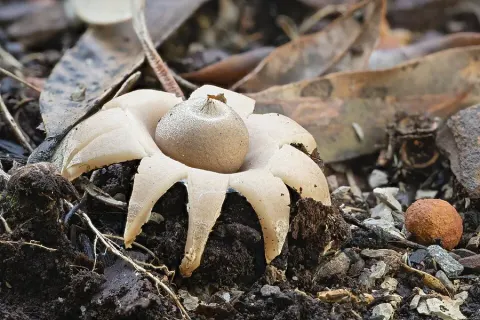
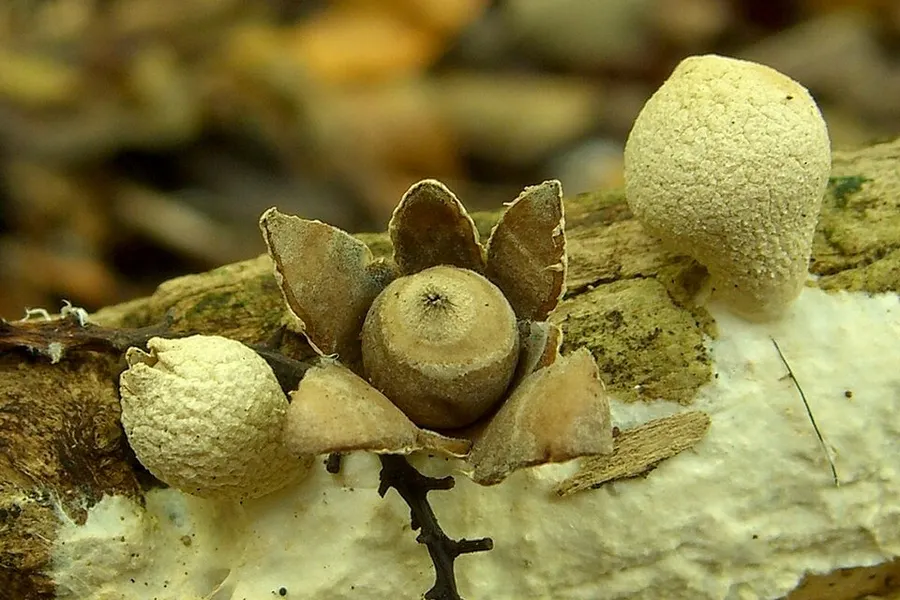
Plants seated upon a mycelial subiculum, small, obovate, umbonate, superficial, attached by a central basal rhizomorph, becoming tardily expanded when to 3 cm. across. Exoperidium saccate, split to about the middle into 6-7 bluntly pointed expanded rays; fleshy layer bay brown, continuous, adnate; exterior free from debris, bay brown, glabrous; base convex, with an umbilical scar. Endoperidium 7-10 mm. diameter, sessile, subglobose, umber brown, glabrous, lower half enclosed by the saccate base of the exoperidium; peristome flattened, obscurely fibrillose, concolorous, seated on a depressed zone. Gleba umber; pseudo-columella inevident. Spores globose, 3.5-4.5um diameter, epispore chestnut brown, 0.75um thick, delicately verruculose. Fructifications grow crowded upon a white subiculum covering the surface of decaying vegetable debris on the forest floor. The species may be identified by the small almost smooth spores. The collection from New South Wales is referred to G.subiculosum partly because of these features, partly as it agrees with the description drawn by Coker & Couch (1928, p. 119) from the type at Kew. They referred here a Jamaican collection which differed in that the spores were smooth and 2-3um diameter.

Sebagian uraian ditampilkan dalam bahasa sumber; terjemahannya belum tersedia atau belum lolos pemeriksaan.

Rujukan: [1]

Pengukuran mengikuti objek, spesimen atau kultur, dan metode yang disebutkan sumber. Baca uraian asli untuk konteks lengkap.

02 / Kehidupan

Habitat dan peran ekologis

Geastrum subiculosum is an inedible species of fungus belonging to the genus Geastrum, or earthstar fungi. The fungus was first described scientifically by Cooke and Massee in 1887 (as Geaster subiculosus; Geaster is an older name for the genus Geastrum), based on material found near Trinity Bay, Australia. The fungus grows on decaying wood, and the fruit bodies are characterized by an extensive velvet-like subiculum (a crust-like growth of mycelium). The spores are roughly spherical and measure 3.6–4.2 μm. The species is found in Australia, Africa (South Africa and the Congo), North America, and South America.

Sebagian uraian ditampilkan dalam bahasa sumber; terjemahannya belum tersedia atau belum lolos pemeriksaan.

Rujukan: [2]

Habitat atau konteks temuan
Informasi belum tersedia pada sumber rilis ini.
Substrat
kayu
Peran atau konteks
Belum dikategorikan pada rilis ini.
Temukan hubungan serupa
03 / Siklus hidup

Reproduksi

Plants seated upon a mycelial subiculum, small, obovate, umbonate, superficial, attached by a central basal rhizomorph, becoming tardily expanded when to 3 cm. across. Exoperidium saccate, split to about the middle into 6-7 bluntly pointed expanded rays; fleshy layer bay brown, continuous, adnate; exterior free from debris, bay brown, glabrous; base convex, with an umbilical scar. Endoperidium 7-10 mm. diameter, sessile, subglobose, umber brown, glabrous, lower half enclosed by the saccate base of the exoperidium; peristome flattened, obscurely fibrillose, concolorous, seated on a depressed zone. Gleba umber; pseudo-columella inevident. Spores globose, 3.5-4.5um diameter, epispore chestnut brown, 0.75um thick, delicately verruculose.

Sebagian uraian ditampilkan dalam bahasa sumber; terjemahannya belum tersedia atau belum lolos pemeriksaan.

Rujukan: [1]

Sinonim menurut acuan taksonomi rilis: Geastrum mirabile var. subiculosum
04 / Batas informasi

Catatan identitas dan cakupan

  • Nama diterima mengikuti Catalogue of Life Base2026-09-11; uraian mempertahankan konsep dan nama sumber aslinya.
  • Uraian digabungkan dari sumber spesies yang sama; lingkup geografis, bahan, dan kultur setiap sumber dipertahankan. Historical description as cited by BiotaNZ. Preserve explicit New Zealand/locality, host and specimen qualifiers. Distribution is the cited source scope, not a current global range. Original geographic, specimen and life-cycle scope retained; source import awaits individual editorial review.
  • Impor dan terjemahan otomatis belum diperiksa editorial per profil. Struktur reproduktif yang disebutkan tidak membuktikan seluruh siklus hidup diketahui.
  • Pengukuran pada uraian mengikuti spesimen, kultur, dan metode sumber; angka tidak diperluas ke semua populasi.

Catatan distribusi dalam narasi mengikuti sumbernya. Dokumentasi spesimen atau foto mengikuti catatan sumber. Bukti wilayah Indonesia dan penilaian konservasi tidak disimpulkan dari gambar.

05 / Dokumentasi

Melihat dengan konteks

Dokumentasi Geastrum subiculosum dari Wikimedia Commons. A fruit body of the fungus Geastrum subiculosum Cooke & Massee. Specimen photographed in Buttonwood, south Key Largo, Monroe Co., Florida, USA. Identifikasi mengikuti record berkas sumber.

Jenis
Fotografi
Kredit
Jason Hollinger
Sumber media
Buka entri sumber

Gambar menunjukkan objek menurut identifikasi sumber, bukan verifikasi independen spesimen oleh Fungi. Tidak ada skala baru yang ditambahkan.

06 / Rujukan

Sumber profil

  1. [1] Cunningham, G.H. 1944: The Gasteromycetes of Australia and New Zealand. John McIndoe. — Geastrum subiculosumBagian sumber: biota:1cb0e239-36b9-11d5-9548-00d0592d548c:1cb18b17-36b9-11d5-9548-00d0592d548c
    Tanggal penghimpunan sumber: 2026-10-12
    Teks sumber: CC BY 4.0 · Cunningham, G.H. 1944: The Gasteromycetes of Australia and New Zealand. John McIndoe.
  2. [2] Geastrum subiculosum — Wikipedia (en)Bagian sumber: Frozen revision 1194774561
    Tanggal penghimpunan sumber: 2026-10-12
    Teks sumber: CC BY-SA4.0 · Wikipedia contributors
  3. [3] Catalogue of Life Base2026-09-11 — Geastrum subiculosumBagian sumber: ColDP NameUsage.tsv ID 6JZ7X; accepted species; source 2073
    Tanggal penghimpunan sumber: 2026-10-12
  4. [4] Dokumentasi visual — Geastrum subiculosumBagian sumber: Individual media record; identification follows the source, not independent determination
    Tanggal penghimpunan sumber: 2026-10-12
    Media sumber: CC BY-SA 3.0 · Jason Hollinger

Adaptasi teks: CC BY-SA 4.0. Cunningham, G.H. 1944: The Gasteromycetes of Australia and New Zealand. John McIndoe. — Cunningham, G.H. 1944: The Gasteromycetes of Australia and New Zealand. John McIndoe. — Geastrum subiculosum; Wikipedia contributors — Geastrum subiculosum — Wikipedia (en)

Uraian asli dan riwayat sumber

Riwayat atau halaman sumber

Ringkasan sumber

Plants seated upon a mycelial subiculum, small, obovate, umbonate, superficial, attached by a central basal rhizomorph, becoming tardily expanded when to 3 cm. across. Exoperidium saccate, split to about the middle into 6-7 bluntly pointed expanded rays; fleshy layer bay brown, continuous, adnate; exterior free from debris, bay brown, glabrous; base convex, with an umbilical scar. Endoperidium 7-10 mm. diameter, sessile, subglobose, umber brown, glabrous, lower half enclosed by the saccate base of the exoperidium; peristome flattened, obscurely fibrillose, concolorous, seated on a depressed zone.

Revisi sumber

Morfologi sumber

Plants seated upon a mycelial subiculum, small, obovate, umbonate, superficial, attached by a central basal rhizomorph, becoming tardily expanded when to 3 cm. across. Exoperidium saccate, split to about the middle into 6-7 bluntly pointed expanded rays; fleshy layer bay brown, continuous, adnate; exterior free from debris, bay brown, glabrous; base convex, with an umbilical scar. Endoperidium 7-10 mm. diameter, sessile, subglobose, umber brown, glabrous, lower half enclosed by the saccate base of the exoperidium; peristome flattened, obscurely fibrillose, concolorous, seated on a depressed zone. Gleba umber; pseudo-columella inevident. Spores globose, 3.5-4.5um diameter, epispore chestnut brown, 0.75um thick, delicately verruculose. Fructifications grow crowded upon a white subiculum covering the surface of decaying vegetable debris on the forest floor. The species may be identified by the small almost smooth spores. The collection from New South Wales is referred to G.subiculosum partly because of these features, partly as it agrees with the description drawn by Coker & Couch (1928, p. 119) from the type at Kew. They referred here a Jamaican collection which differed in that the spores were smooth and 2-3um diameter.

Revisi sumber

Ekologi sumber

Geastrum subiculosum is an inedible species of fungus belonging to the genus Geastrum, or earthstar fungi. The fungus was first described scientifically by Cooke and Massee in 1887 (as Geaster subiculosus; Geaster is an older name for the genus Geastrum), based on material found near Trinity Bay, Australia. The fungus grows on decaying wood, and the fruit bodies are characterized by an extensive velvet-like subiculum (a crust-like growth of mycelium). The spores are roughly spherical and measure 3.6–4.2 μm. The species is found in Australia, Africa (South Africa and the Congo), North America, and South America.

Revisi sumber

Struktur reproduksi sumber

Plants seated upon a mycelial subiculum, small, obovate, umbonate, superficial, attached by a central basal rhizomorph, becoming tardily expanded when to 3 cm. across. Exoperidium saccate, split to about the middle into 6-7 bluntly pointed expanded rays; fleshy layer bay brown, continuous, adnate; exterior free from debris, bay brown, glabrous; base convex, with an umbilical scar. Endoperidium 7-10 mm. diameter, sessile, subglobose, umber brown, glabrous, lower half enclosed by the saccate base of the exoperidium; peristome flattened, obscurely fibrillose, concolorous, seated on a depressed zone. Gleba umber; pseudo-columella inevident. Spores globose, 3.5-4.5um diameter, epispore chestnut brown, 0.75um thick, delicately verruculose.

Revisi sumber

Rujukan halaman ini

Fungi. Geastrum subiculosum. Rilis data fungi-2026-10-12-expansion-2. https://fungi-atlas.mgadib.chatgpt.site/jamur/geastrum-subiculosum/.

Status: impor sumber; pemeriksaan editorial per profil belum selesai. Untuk klaim biologis, gunakan rujukan pada bagian terkait dan periksa konteks sumber aslinya.