01 / Morfologi

Ciri dan struktur

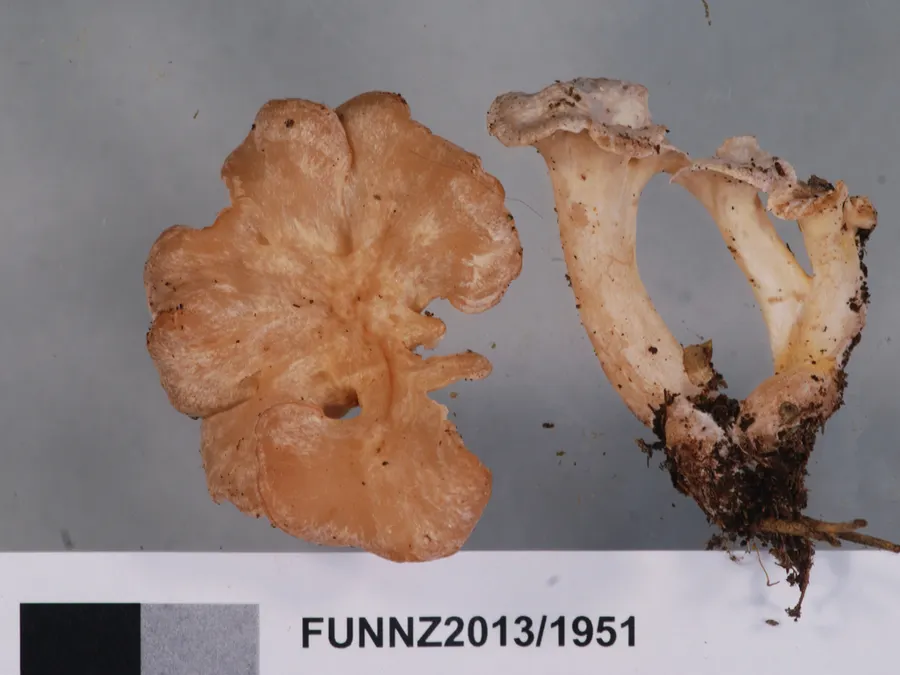
Basidiomes thin fleshy, 35-70 mm in height, mainly mesopodal but sometimes slightly pleuropodal or tending towards merismatoid, turbinate, 20 mm wide at the top, tapering gradually to 3 mm at base, or tapering more sharply to a distinct stipe. Pileus 12-28 mm diam., dull ochraceous to pale salmon, shallow depressed to widely infundibuliform, and sometimes perforate, fleshy, dry, matt to velvety; margin straight to slightly incurved, becoming more or less undulate, fairly thin; flesh at edge of pileus turns reddish on cutting but not on bruising. Stipe 3-6 mm diam., very variable in length (5-50 mm) depending on shape of fruiting body, cylindrical to flattened or grooved, hollow, velvety, concolorous with pileus, staining reddish on bruising. Hymenial surface deeply decurrent, slightly darker than pileus, is almost smooth or with distant, very shallow, lamellar folds, not intervenose. Flesh ochraceous, soft. Colour of fruiting body changes very little on drying. Smell not noticeable, taste slightly bitter. Reactions: KOH yellowish; FeSO, purplish black to black. Hyphae of pileal surface thin-walled (walls yellowish), 3-6 µm diam., clamped, with narrower upturned ends. Hyphae of context up to 10 µm diam., thin-walled, more or less parallel and tightly interwoven, not inflated, clamped; gloeoplerous hyphae scattered but more frequent near the hymenium, tortuous, occasionally branched, rarely septate but clamped, forming inflated coils, contents yellow in bright field, strongly cyanophilic, not colouring in sulphovanillin, but becoming conspicuously broken into droplets or bars in the strong acid; some gloeoplerous elements end among the basidia to form tortuous pseudocystidia.

Sebagian uraian ditampilkan dalam bahasa sumber; terjemahannya belum tersedia atau belum lolos pemeriksaan.

Rujukan: [1]

Pengukuran mengikuti objek, spesimen atau kultur, dan metode yang disebutkan sumber. Baca uraian asli untuk konteks lengkap.

02 / Kehidupan

Habitat dan peran ekologis

G. novae-zelandiae is a relatively small, fragile species with an almost smooth hymenium, found in litter under various trees in mixed podocarp-broadieaf forest. The genus Gomphus has been variously subdivided into subgenera and sections by different authors (Corner 1966, 1969; Petersen 1968, 1971 a, b, 1976). G. novae-zelandiae would be placed in Petersen's (1971 a) subgenus Gomphus on the basis of smooth pileus and presence of clamp connections.

Sebagian uraian ditampilkan dalam bahasa sumber; terjemahannya belum tersedia atau belum lolos pemeriksaan.

Rujukan: [1]

Habitat atau konteks temuan
hutan
Substrat
Informasi belum tersedia pada sumber rilis ini.
Peran atau konteks
Belum dikategorikan pada rilis ini.
Temukan hubungan serupa
03 / Siklus hidup

Reproduksi

Basidiomes thin fleshy, 35-70 mm in height, mainly mesopodal but sometimes slightly pleuropodal or tending towards merismatoid, turbinate, 20 mm wide at the top, tapering gradually to 3 mm at base, or tapering more sharply to a distinct stipe. Pileus 12-28 mm diam., dull ochraceous to pale salmon, shallow depressed to widely infundibuliform, and sometimes perforate, fleshy, dry, matt to velvety; margin straight to slightly incurved, becoming more or less undulate, fairly thin; flesh at edge of pileus turns reddish on cutting but not on bruising. Stipe 3-6 mm diam., very variable in length (5-50 mm) depending on shape of fruiting body, cylindrical to flattened or grooved, hollow, velvety, concolorous with pileus, staining reddish on bruising.

Sebagian uraian ditampilkan dalam bahasa sumber; terjemahannya belum tersedia atau belum lolos pemeriksaan.

Rujukan: [1]

Sinonim menurut acuan taksonomi rilis: Gomphus novae-zelandiae
04 / Batas informasi

Catatan identitas dan cakupan

  • Nama diterima mengikuti Catalogue of Life Base2026-09-11; uraian mempertahankan konsep dan nama sumber aslinya.
  • Historical description as cited by BiotaNZ. Preserve explicit New Zealand/locality, host and specimen qualifiers. Distribution is the cited source scope, not a current global range.
  • Impor dan terjemahan otomatis belum diperiksa editorial per profil. Struktur reproduktif yang disebutkan tidak membuktikan seluruh siklus hidup diketahui.
  • Pengukuran pada uraian mengikuti spesimen, kultur, dan metode sumber; angka tidak diperluas ke semua populasi.

Catatan distribusi dalam narasi mengikuti sumbernya. Dokumentasi spesimen atau foto mengikuti catatan sumber. Bukti wilayah Indonesia dan penilaian konservasi tidak disimpulkan dari gambar.

05 / Dokumentasi

Melihat dengan konteks

Dokumentasi Gloeocantharellus novae-zelandiae menurut asosiasi foto pada record takson iNaturalist. Kredit: Jerry Cooper. Identitas mengikuti sumber; bukan penentuan spesimen independen.

Jenis
Fotografi
Kredit
(c) Jerry Cooper, some rights reserved (CC BY), uploaded by Jerry Cooper
Lisensi
CC BY 4.0
Sumber media
Buka entri sumber

Gambar menunjukkan objek menurut identifikasi sumber, bukan verifikasi independen spesimen oleh Fungi. Tidak ada skala baru yang ditambahkan.

06 / Rujukan

Sumber profil

  1. [1] Segedin, B.P. 1985: Two new species of Gomphus Pers. (Aphyllophorales) from New Zealand. New Zealand Journal of Botany 22(4): 533-537. — Gomphus novae-zelandiaeBagian sumber: biota:1cb0fae5-36b9-11d5-9548-00d0592d548c:1cb18be3-36b9-11d5-9548-00d0592d548c
    Tanggal penghimpunan sumber: 2026-10-12
    Teks sumber: CC BY 4.0 · Segedin, B.P. 1985: Two new species of Gomphus Pers. (Aphyllophorales) from New Zealand. New Zealand Journal of Botany 22(4): 533-537.
  2. [2] Catalogue of Life Base2026-09-11 — Gloeocantharellus novae-zelandiaeBagian sumber: ColDP NameUsage.tsv ID 6KK5J; accepted species; source 2073
    Tanggal penghimpunan sumber: 2026-10-12
  3. [3] Dokumentasi visual — Gloeocantharellus novae-zelandiaeBagian sumber: Individual media record; identification follows the source, not independent determination
    Tanggal penghimpunan sumber: 2026-10-12
    Media sumber: CC BY 4.0 · (c) Jerry Cooper, some rights reserved (CC BY), uploaded by Jerry Cooper

Adaptasi teks: CC BY 4.0. Segedin, B.P. 1985: Two new species of Gomphus Pers. (Aphyllophorales) from New Zealand. New Zealand Journal of Botany 22(4): 533-537. — Segedin, B.P. 1985: Two new species of Gomphus Pers. (Aphyllophorales) from New Zealand. New Zealand Journal of Botany 22(4): 533-537. — Gomphus novae-zelandiae

Uraian asli dan riwayat sumber

Riwayat atau halaman sumber

Ringkasan sumber

Basidiomes thin fleshy, 35-70 mm in height, mainly mesopodal but sometimes slightly pleuropodal or tending towards merismatoid, turbinate, 20 mm wide at the top, tapering gradually to 3 mm at base, or tapering more sharply to a distinct stipe. Pileus 12-28 mm diam., dull ochraceous to pale salmon, shallow depressed to widely infundibuliform, and sometimes perforate, fleshy, dry, matt to velvety; margin straight to slightly incurved, becoming more or less undulate, fairly thin; flesh at edge of pileus turns reddish on cutting but not on bruising.

Revisi sumber

Morfologi sumber

Basidiomes thin fleshy, 35-70 mm in height, mainly mesopodal but sometimes slightly pleuropodal or tending towards merismatoid, turbinate, 20 mm wide at the top, tapering gradually to 3 mm at base, or tapering more sharply to a distinct stipe. Pileus 12-28 mm diam., dull ochraceous to pale salmon, shallow depressed to widely infundibuliform, and sometimes perforate, fleshy, dry, matt to velvety; margin straight to slightly incurved, becoming more or less undulate, fairly thin; flesh at edge of pileus turns reddish on cutting but not on bruising. Stipe 3-6 mm diam., very variable in length (5-50 mm) depending on shape of fruiting body, cylindrical to flattened or grooved, hollow, velvety, concolorous with pileus, staining reddish on bruising. Hymenial surface deeply decurrent, slightly darker than pileus, is almost smooth or with distant, very shallow, lamellar folds, not intervenose. Flesh ochraceous, soft. Colour of fruiting body changes very little on drying. Smell not noticeable, taste slightly bitter. Reactions: KOH yellowish; FeSO, purplish black to black. Hyphae of pileal surface thin-walled (walls yellowish), 3-6 µm diam., clamped, with narrower upturned ends. Hyphae of context up to 10 µm diam., thin-walled, more or less parallel and tightly interwoven, not inflated, clamped; gloeoplerous hyphae scattered but more frequent near the hymenium, tortuous, occasionally branched, rarely septate but clamped, forming inflated coils, contents yellow in bright field, strongly cyanophilic, not colouring in sulphovanillin, but becoming conspicuously broken into droplets or bars in the strong acid; some gloeoplerous elements end among the basidia to form tortuous pseudocystidia.

Revisi sumber

Ekologi sumber

G. novae-zelandiae is a relatively small, fragile species with an almost smooth hymenium, found in litter under various trees in mixed podocarp-broadieaf forest. The genus Gomphus has been variously subdivided into subgenera and sections by different authors (Corner 1966, 1969; Petersen 1968, 1971 a, b, 1976). G. novae-zelandiae would be placed in Petersen's (1971 a) subgenus Gomphus on the basis of smooth pileus and presence of clamp connections.

Revisi sumber

Struktur reproduksi sumber

Basidiomes thin fleshy, 35-70 mm in height, mainly mesopodal but sometimes slightly pleuropodal or tending towards merismatoid, turbinate, 20 mm wide at the top, tapering gradually to 3 mm at base, or tapering more sharply to a distinct stipe. Pileus 12-28 mm diam., dull ochraceous to pale salmon, shallow depressed to widely infundibuliform, and sometimes perforate, fleshy, dry, matt to velvety; margin straight to slightly incurved, becoming more or less undulate, fairly thin; flesh at edge of pileus turns reddish on cutting but not on bruising. Stipe 3-6 mm diam., very variable in length (5-50 mm) depending on shape of fruiting body, cylindrical to flattened or grooved, hollow, velvety, concolorous with pileus, staining reddish on bruising.

Revisi sumber

Rujukan halaman ini

Fungi. Gloeocantharellus novae-zelandiae. Rilis data fungi-2026-10-12-expansion-2. https://fungi-atlas.mgadib.chatgpt.site/jamur/gloeocantharellus-novae-zelandiae/.

Status: impor sumber; pemeriksaan editorial per profil belum selesai. Untuk klaim biologis, gunakan rujukan pada bagian terkait dan periksa konteks sumber aslinya.