Ciri dan struktur
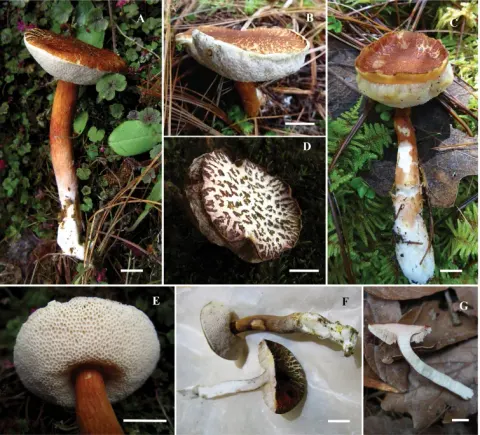
Pileus dark violet to dark brown, whitish context; hymenophore pink-purple to violet-brown; stipe surface tomentose to longitudinally fribrillose; basidiospores 9–13 × 4–5 µm, surface with cylindrical pits; pleurocystidia and cheilocystidia fusiform-ventricose to lanceolate. Pileus 35–70 mm in diameter, convex when young, becoming plano-convex with age, dark violet (16F6-16F4), violet-brown (11F5-11F8), orange-brown (5E7), with lighter shades of dark brown (6F5-6F8) lighter towards margin, whole edge, straight, dry surface, finely scamose, slightly areolate at the centre. Hymenophore adnate, slightly depressed, pores 0.5–2 mm in diameter, subangular to angular, pink-purple (14A4), lilac (14B4–14C4), magenta-grey (14C4–14D4), ruby-grey (12C4–12D4), colour unchanging when injured, tubes 7–10 mm, concolorous with the pores. Context 7–12 mm thick, solid, whitish, with slight yellowish-brown tones near the epicutis. Stipe 62–77 × 8–9 mm, central, cylindrical, with wider base, surface with longitudinal striations, whitish at the apex, yellowish-brown (5D5-5E5), orange-brown (5C5) shades in the middle, base with yellowish (5B6) to whitish shades; whitish context, unchanged when cut. Whitish basal mycelium. Odour pleasant. Taste slightly acidic. Chemical reactions: KOH reddish-brown in pileus, brown in hymenophore, slightly pinkish in context, yellowish-brown in stipe. NH 4 OH orange with violet tones on pileus, yellow in hymenophore, pale yellow in context, red-orange in stipe. Basidiospores 9–13 (–14.5) × 4–5 (–8) µm, X = 12.14 × 5.2 µm, std = 2.08 × 1.36 µm, (n = 35), Q = (1.8) 2.1–2.2 (2.5) (holotype); (10–) 12–14 × 4–5 (–7) µm, X = 11.94 × 5.14 µm, std = 1.60 × 1.13 µm, (n = 35), Q = (2.2) 2.3–2.4 (2.5), (paratype MEXU -30103); (10–) 14–15 (–16) × (4–) 5–6 (–7) µm, X = 14.29 × 5.8 µm, std = 1.69 × 0.76 µm, (n = 40), Q = (2.2) 2.3–2.5 (2.6), (paratype colpos-CP5); subfusiform to cylindrical, slightly rough or dotted, apex rounded to subacute, with suprahilar depression, yellowish.
Habitat dan peran ekologis
Pinus - Quercus forests and Quercus forests, associated with Q. liebmanii and other Quercus spp. Currently only known from Neovolcanic Axis and Sierra Madre del Sur, Mexico.
- Habitat atau konteks temuan
- hutan
- Substrat
- Informasi belum tersedia pada sumber rilis ini.
- Peran atau konteks
- Belum dikategorikan pada rilis ini.
Reproduksi
Pileus dark violet to dark brown, whitish context; hymenophore pink-purple to violet-brown; stipe surface tomentose to longitudinally fribrillose; basidiospores 9–13 × 4–5 µm, surface with cylindrical pits; pleurocystidia and cheilocystidia fusiform-ventricose to lanceolate. Pileus 35–70 mm in diameter, convex when young, becoming plano-convex with age, dark violet (16F6-16F4), violet-brown (11F5-11F8), orange-brown (5E7), with lighter shades of dark brown (6F5-6F8) lighter towards margin, whole edge, straight, dry surface, finely scamose, slightly areolate at the centre. Hymenophore adnate, slightly depressed, pores 0.5–2 mm in diameter, subangular to angular, pink-purple (14A4), lilac (14B4–14C4), magenta-grey (14C4–14D4), ruby-grey (12C4–12D4), colour unchanging when injured, tubes 7–10 mm, concolorous with the pores.
Catatan identitas dan cakupan
- Nama diterima mengikuti Catalogue of Life Base2026-09-11; uraian mempertahankan konsep dan nama sumber aslinya.
- Preserve original treatment localities, hosts and substrate scope. Materials examined describe documented specimens, not the full global range.
- Impor dan terjemahan otomatis belum diperiksa editorial per profil. Struktur reproduktif yang disebutkan tidak membuktikan seluruh siklus hidup diketahui.
- Pengukuran pada uraian mengikuti spesimen, kultur, dan metode sumber; angka tidak diperluas ke semua populasi.
Catatan distribusi dalam narasi mengikuti sumbernya. Dokumentasi spesimen atau foto mengikuti catatan sumber. Bukti wilayah Indonesia dan penilaian konservasi tidak disimpulkan dari gambar.
Melihat dengan konteks
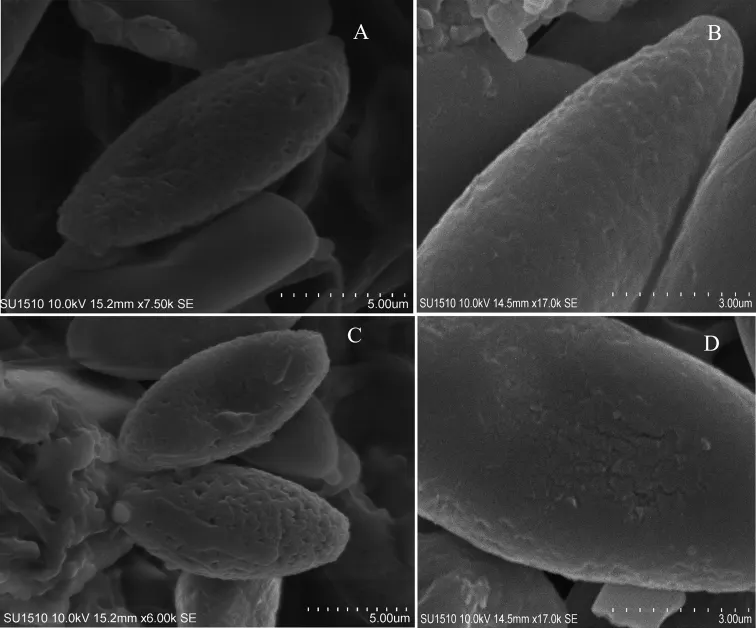
Basidiospore ornamentation of Hemiaustroboletus revealed by SEM A, C Hemiaustroboletus vinaceus (AV868- ITCV, MEXU -30051, Holotype) B, D Hemiaustroboletus vinaceobrunneus (AV1168- ITCV, MEXU -30053 Isotype).
- Jenis
- Pelat ilmiah
- Kredit
- Olivia Ayala-Vásquez, Jesús García-Jiménez, Elvira Aguirre-Acosta, Rigoberto Castro-Rivera, Rodolfo Enrique Ángeles-Argáiz, Ángel Emmanuel Saldivar, Roberto Garibay-Orijel
- Lisensi
- CC BY 4.0
- Sumber media
- Buka entri sumber
Dokumentasi tambahan
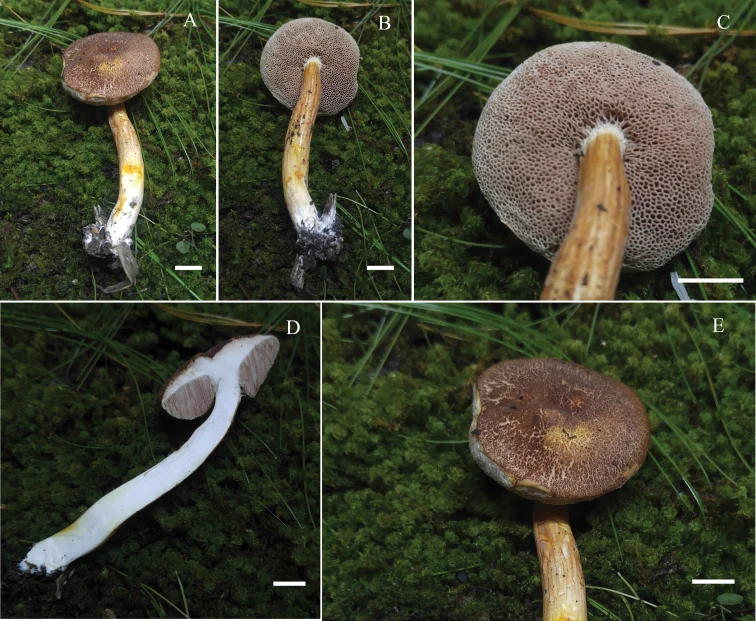
Hemiaustroboletus vinaceus (AES334- IBUG, Holotype) A, B basidiomata C hymenophore D context E pileus surface. Scale bar: 10 mm (A–E).
Kredit dan penggunaan
Olivia Ayala-Vásquez, Jesús García-Jiménez, Elvira Aguirre-Acosta, Rigoberto Castro-Rivera, Rodolfo Enrique Ángeles-Argáiz, Ángel Emmanuel Saldivar, Roberto Garibay-Orijel
Ukuran dan format gambar disesuaikan tanpa pemotongan, retus, atau penambahan skala. Lisensi sumber dipertahankan.
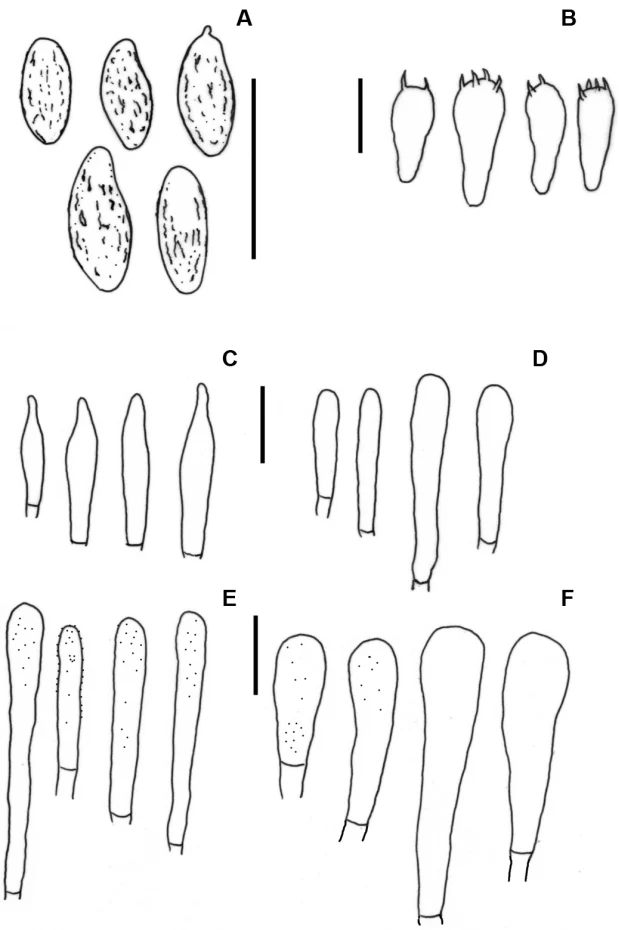
Hemiaustroboletus vinaceus (AES334- IBUG, Holotype) A basidiospores B basidia C pleurocystidia D cheilocystidia E pileipellis F caulocystidia. Scale bars: 10 µm (A–F).
Kredit dan penggunaan
Olivia Ayala-Vásquez, Jesús García-Jiménez, Elvira Aguirre-Acosta, Rigoberto Castro-Rivera, Rodolfo Enrique Ángeles-Argáiz, Ángel Emmanuel Saldivar, Roberto Garibay-Orijel
Ukuran dan format gambar disesuaikan tanpa pemotongan, retus, atau penambahan skala. Lisensi sumber dipertahankan.
Sumber profil
- [1] Hemiaustroboletus, a new genus in the subfamily Austroboletoideae (Boletaceae, Boletales) — Hemiaustroboletus vinaceus
- [2] Catalogue of Life Base2026-09-11 — Hemiaustroboletus vinaceus
- [3] Dokumentasi visual — Hemiaustroboletus vinaceus
- [4] Dokumentasi visual — Hemiaustroboletus vinaceus
- [5] Dokumentasi visual — Hemiaustroboletus vinaceus
Rujukan halaman ini
Fungi. Hemiaustroboletus vinaceus. Rilis data fungi-2026-10-12-expansion-2. https://fungi-atlas.mgadib.chatgpt.site/jamur/hemiaustroboletus-vinaceus/.
Status: impor sumber; pemeriksaan editorial per profil belum selesai. Untuk klaim biologis, gunakan rujukan pada bagian terkait dan periksa konteks sumber aslinya.