01 / Morfologi

Ciri dan struktur

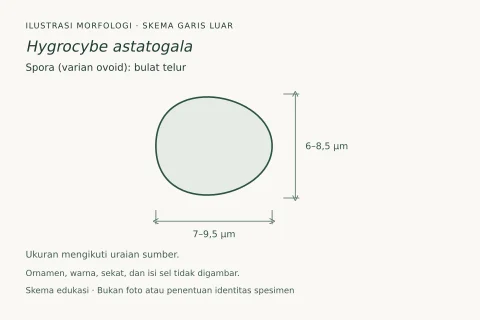
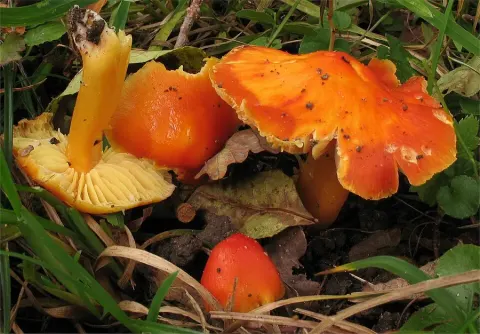
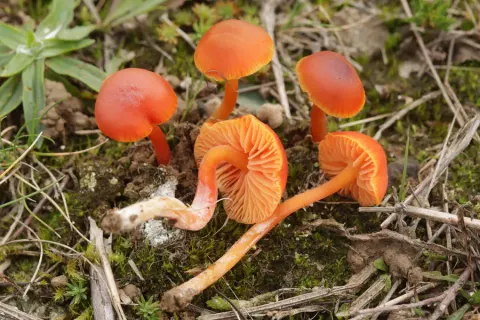
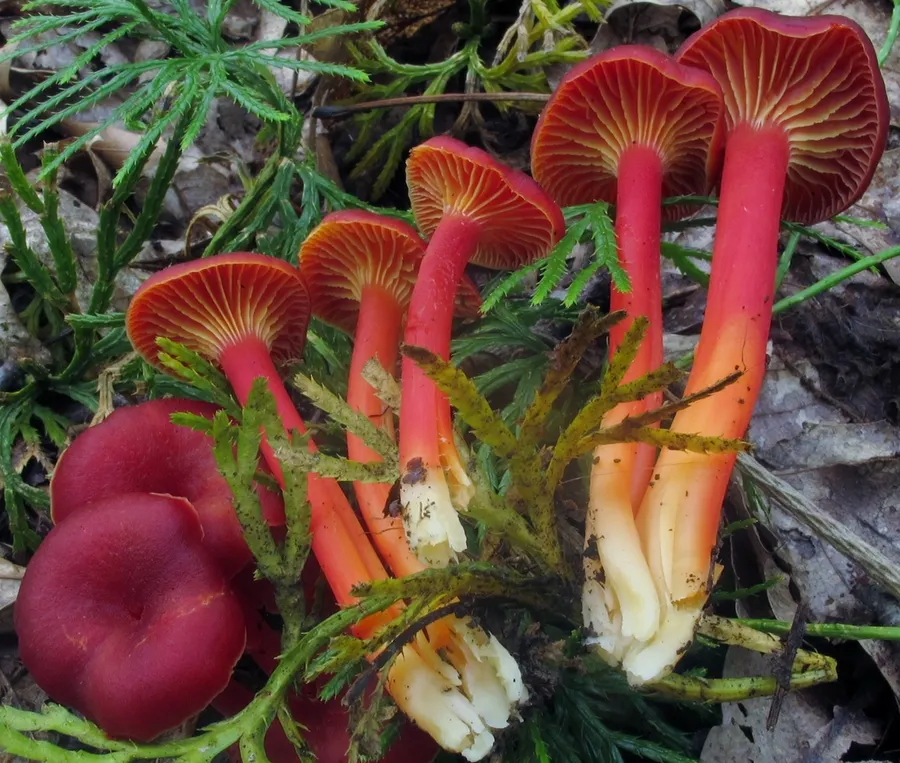
Fruitbodies of H. appalachianensis have convex caps that are 2 – 7 cm in diameter. As the mushroom matures, the cap margins curl upward, and the central depression in the cap deepens, becoming more or less funnel shaped. Hygrocybe appalachianensis mushrooms produce a white spore print. Both the spores and the basidia are dimorphic. The larger spores (macrospores) are smooth, ellipsoid, and measure 11–17.5 by 7–10 μm. They are hyaline (translucent), and inamyloid. The macrobasidia are club shaped, measuring 38–57 by 8–14 μm, and can be one- two-, three- or four-spored. The ratio of macrobasidia length to macrospore length is usually less than five to one. Clamp connections are present on the hyphae of several tissues of the mushroom. The hyphae of the gills (the lamellar trama) are arranged in a parallel fashion. The colors of Hygrocybe mushrooms originate from betalains, a class of red and yellow indole-derived pigments. Specific betalains found in H. appalachianensis include muscaflavin, and a group of compounds called hygroaurins, which are derived from muscaflavin by conjugation with amino acids.

Sebagian uraian ditampilkan dalam bahasa sumber; terjemahannya belum tersedia atau belum lolos pemeriksaan.

Rujukan: [1]

Pengukuran mengikuti objek, spesimen atau kultur, dan metode yang disebutkan sumber. Baca uraian asli untuk konteks lengkap.

02 / Kehidupan

Habitat dan peran ekologis

Fruit bodies of Hygrocybe appalachianensis grow singly, in groups, or clusters on the ground. Like all Hygrocybe species, the fungus is believed to be saprophytic, meaning it obtains nutrients by breaking down organic matter. It fruits in deciduous or mixed forest, typically appearing between the months of July and December. Its range covers a region extending from the states Ohio and West Virginia south to South Carolina and Tennessee. Its occurrence is occasional to locally common.

Sebagian uraian ditampilkan dalam bahasa sumber; terjemahannya belum tersedia atau belum lolos pemeriksaan.

Rujukan: [1]

Habitat atau konteks temuan
hutan
Substrat
tanah
Peran atau konteks
Belum dikategorikan pada rilis ini.
Temukan hubungan serupa
03 / Siklus hidup

Reproduksi

Hygrocybe appalachianensis mushrooms produce a white spore print. Both the spores and the basidia are dimorphic. The larger spores (macrospores) are smooth, ellipsoid, and measure 11–17.5 by 7–10 μm. They are hyaline (translucent), and inamyloid. The macrobasidia are club shaped, measuring 38–57 by 8–14 μm, and can be one- two-, three- or four-spored. The ratio of macrobasidia length to macrospore length is usually less than five to one. Clamp connections are present on the hyphae of several tissues of the mushroom. The hyphae of the gills (the lamellar trama) are arranged in a parallel fashion.

Sebagian uraian ditampilkan dalam bahasa sumber; terjemahannya belum tersedia atau belum lolos pemeriksaan.

Rujukan: [1]

Sinonim menurut acuan taksonomi rilis: Hygrophorus appalachianensis
04 / Batas informasi

Catatan identitas dan cakupan

  • Nama diterima mengikuti Catalogue of Life Base2026-09-11; uraian mempertahankan konsep dan nama sumber aslinya.
  • Original geographic, specimen and life-cycle scope retained; source import awaits individual editorial review.
  • Impor dan terjemahan otomatis belum diperiksa editorial per profil. Struktur reproduktif yang disebutkan tidak membuktikan seluruh siklus hidup diketahui.
  • Pengukuran pada uraian mengikuti spesimen, kultur, dan metode sumber; angka tidak diperluas ke semua populasi.

Catatan distribusi dalam narasi mengikuti sumbernya. Dokumentasi spesimen atau foto mengikuti catatan sumber. Bukti wilayah Indonesia dan penilaian konservasi tidak disimpulkan dari gambar.

05 / Dokumentasi

Melihat dengan konteks

Dokumentasi Hygrocybe appalachianensis menurut asosiasi foto pada record takson iNaturalist. Kredit: mycowalt. Identitas mengikuti sumber; bukan penentuan spesimen independen.

Jenis
Fotografi
Kredit
(c) mycowalt, some rights reserved (CC BY-SA), uploaded by mycowalt
Sumber media
Buka entri sumber

Gambar menunjukkan objek menurut identifikasi sumber, bukan verifikasi independen spesimen oleh Fungi. Tidak ada skala baru yang ditambahkan.

06 / Rujukan

Sumber profil

  1. [1] Hygrocybe appalachianensis — Wikipedia (en)Bagian sumber: Frozen revision 1223750296
    Tanggal penghimpunan sumber: 2026-10-12
    Teks sumber: CC BY-SA4.0 · Wikipedia contributors
  2. [2] Catalogue of Life Base2026-09-11 — Hygrocybe appalachianensisBagian sumber: ColDP NameUsage.tsv ID 3NB3T; accepted species; source 2073
    Tanggal penghimpunan sumber: 2026-10-12
  3. [3] Dokumentasi visual — Hygrocybe appalachianensisBagian sumber: Individual media record; identification follows the source, not independent determination
    Tanggal penghimpunan sumber: 2026-10-12
    Media sumber: CC BY-SA 4.0 · (c) mycowalt, some rights reserved (CC BY-SA), uploaded by mycowalt

Adaptasi teks: CC BY-SA 4.0. Wikipedia contributors — Hygrocybe appalachianensis — Wikipedia (en)

Uraian asli dan riwayat sumber

Riwayat atau halaman sumber

Ringkasan sumber

Hygrocybe appalachianensis, commonly known as the Appalachian waxy cap, is a gilled fungus of the waxcap family. It is found in the eastern United States, where it fruits singly, in groups, or clusters on the ground in deciduous and mixed forests. The species, described in 1963 from collections made in the Appalachian Mountains, was originally classified in the related genus Hygrophorus. It was transferred to Hygrocybe in 1998, in which it has been proposed as the type species of section Pseudofirmae.

Revisi sumber

Morfologi sumber

Fruitbodies of H. appalachianensis have convex caps that are 2 – 7 cm in diameter. As the mushroom matures, the cap margins curl upward, and the central depression in the cap deepens, becoming more or less funnel shaped. Hygrocybe appalachianensis mushrooms produce a white spore print. Both the spores and the basidia are dimorphic. The larger spores (macrospores) are smooth, ellipsoid, and measure 11–17.5 by 7–10 μm. They are hyaline (translucent), and inamyloid. The macrobasidia are club shaped, measuring 38–57 by 8–14 μm, and can be one- two-, three- or four-spored. The ratio of macrobasidia length to macrospore length is usually less than five to one. Clamp connections are present on the hyphae of several tissues of the mushroom. The hyphae of the gills (the lamellar trama) are arranged in a parallel fashion. The colors of Hygrocybe mushrooms originate from betalains, a class of red and yellow indole-derived pigments. Specific betalains found in H. appalachianensis include muscaflavin, and a group of compounds called hygroaurins, which are derived from muscaflavin by conjugation with amino acids.

Revisi sumber

Ekologi sumber

Fruit bodies of Hygrocybe appalachianensis grow singly, in groups, or clusters on the ground. Like all Hygrocybe species, the fungus is believed to be saprophytic, meaning it obtains nutrients by breaking down organic matter. It fruits in deciduous or mixed forest, typically appearing between the months of July and December. Its range covers a region extending from the states Ohio and West Virginia south to South Carolina and Tennessee. Its occurrence is occasional to locally common.

Revisi sumber

Struktur reproduksi sumber

Hygrocybe appalachianensis mushrooms produce a white spore print. Both the spores and the basidia are dimorphic. The larger spores (macrospores) are smooth, ellipsoid, and measure 11–17.5 by 7–10 μm. They are hyaline (translucent), and inamyloid. The macrobasidia are club shaped, measuring 38–57 by 8–14 μm, and can be one- two-, three- or four-spored. The ratio of macrobasidia length to macrospore length is usually less than five to one. Clamp connections are present on the hyphae of several tissues of the mushroom. The hyphae of the gills (the lamellar trama) are arranged in a parallel fashion.

Revisi sumber

Rujukan halaman ini

Fungi. Hygrocybe appalachianensis. Rilis data fungi-2026-10-12-expansion-2. https://fungi-atlas.mgadib.chatgpt.site/jamur/hygrocybe-appalachianensis/.

Status: impor sumber; pemeriksaan editorial per profil belum selesai. Untuk klaim biologis, gunakan rujukan pada bagian terkait dan periksa konteks sumber aslinya.