01 / Morfologi

Ciri dan struktur

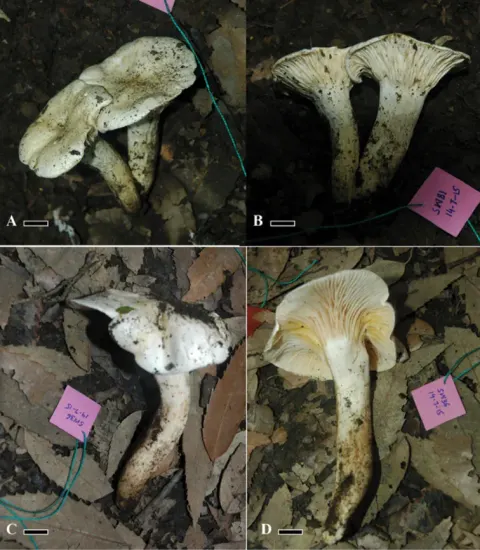
Basidiomata small to medium-sized, fleshy. Pileus 2.5–6 cm diam., convex when young, expanding to broadly convex to plane with age; initially creamy to pale reddish-brown, maturing to brownish-red, darkening when dry, turning light pink after cooking, unchanged when damaged. Lamellae 0.3–0.7 cm wide, subdecurrent, slightly close, with 50–70 full lamellae per pileus; lamellulae numerous, narrowed; off-white to cream-white. Stipe 2.5–5 cm long, 0.8–2 cm diam., central, cylindrical, white; context firm, white. Odour and taste mild. Basidiospores [40/2/1] (7.5–) 8–10 × 5–6.5 (–7) μm, Q = 1.31–1.67 (–1.76), Q m = 1.52 ± 0.11, ovoid to ellipsoid, occasionally oblong, smooth, thin-walled, hyaline, inamyloid. Basidia 38–53 (–64) × 7.5–10 μm, clavate, slender, thin-walled, 4-sterigmate; sterigmata up to 10 μm long. Hymenophoral trama slightly divergent, non-gelatinised, composed of cylindrical hyphae 3–20 μm diam. and inflated elements up to 32 μm diam., thin-walled, hyaline. Subhymenial layer next to hymenium, not gelatinised, composed of short elements, 12–40 × 3–7 μm, thin-walled, hyaline, cylindrical, irregularly-shaped. Pileipellis an ixotrichoderm, gelatinised, of narrow, closely interwoven hyphae 2–5 μm diam., thin-walled, branched or unbranched. Pileal trama of dense, thin-walled hyphae 4–30 μm diam. Stipitipellis a trichoderm, of hyphae 3–7 μm diam., thin-walled. Stipititrama of parallel, thin-walled, hyphae 4–17 μm diam. Mycelial hyphae 2–5 μm diam., smooth. Clamp connections present in all tissues.

Sebagian uraian ditampilkan dalam bahasa sumber; terjemahannya belum tersedia atau belum lolos pemeriksaan.

Rujukan: [1]

Pengukuran mengikuti objek, spesimen atau kultur, dan metode yang disebutkan sumber. Baca uraian asli untuk konteks lengkap.

02 / Kehidupan

Habitat dan peran ekologis

Anhui, Henan and Zhejiang Provinces, China; Japan. Gregarious in mixed broadleaf-conifer forests dominated by Quercus, likely associated with Quercus serrata and Q. acutissima; occurs at elevations below 1500 m, fruiting from late winter to spring (February–April).

Sebagian uraian ditampilkan dalam bahasa sumber; terjemahannya belum tersedia atau belum lolos pemeriksaan.

Rujukan: [1]

Habitat atau konteks temuan
hutan
Substrat
Informasi belum tersedia pada sumber rilis ini.
Peran atau konteks
Belum dikategorikan pada rilis ini.
Temukan hubungan serupa
03 / Siklus hidup

Reproduksi

Basidiomata small to medium-sized, fleshy. Pileus 2.5–6 cm diam., convex when young, expanding to broadly convex to plane with age; initially creamy to pale reddish-brown, maturing to brownish-red, darkening when dry, turning light pink after cooking, unchanged when damaged. Lamellae 0.3–0.7 cm wide, subdecurrent, slightly close, with 50–70 full lamellae per pileus; lamellulae numerous, narrowed; off-white to cream-white. Stipe 2.5–5 cm long, 0.8–2 cm diam., central, cylindrical, white; context firm, white. Odour and taste mild. Basidiospores [40/2/1] (7.5–) 8–10 × 5–6.5 (–7) μm, Q = 1.31–1.67 (–1.76), Q m = 1.52 ± 0.11, ovoid to ellipsoid, occasionally oblong, smooth, thin-walled, hyaline, inamyloid.

Sebagian uraian ditampilkan dalam bahasa sumber; terjemahannya belum tersedia atau belum lolos pemeriksaan.

Rujukan: [1]

04 / Batas informasi

Catatan identitas dan cakupan

  • Nama diterima mengikuti Catalogue of Life Base2026-09-11; uraian mempertahankan konsep dan nama sumber aslinya.
  • Preserve original treatment localities, hosts and substrate scope. Materials examined describe documented specimens, not the full global range.
  • Impor dan terjemahan otomatis belum diperiksa editorial per profil. Struktur reproduktif yang disebutkan tidak membuktikan seluruh siklus hidup diketahui.
  • Pengukuran pada uraian mengikuti spesimen, kultur, dan metode sumber; angka tidak diperluas ke semua populasi.

Catatan distribusi dalam narasi mengikuti sumbernya. Dokumentasi spesimen atau foto mengikuti catatan sumber. Bukti wilayah Indonesia dan penilaian konservasi tidak disimpulkan dari gambar.

05 / Dokumentasi

Melihat dengan konteks

Macroscopic and microscopic features of Hygrophorus yukishiro. A–D. Basidiomata (A–C. MHKMU HHY-1012; D. MHKMU HHY-1011); E. Basidiospores; F. Basidia.

Jenis
Pelat ilmiah
Kredit
Hong-Yan Huang, Wen-Hao Zhang, Tie-Zhi Liu, Guo-Li Zhang, Shu-Da Yang, Hai-Jiao Li, Gabriel Moreno, Li-Ping Tang
Lisensi
CC BY 4.0
Sumber media
Buka entri sumber

Gambar menunjukkan objek menurut identifikasi sumber, bukan verifikasi independen spesimen oleh Fungi. Tidak ada skala baru yang ditambahkan.

06 / Rujukan

Sumber profil

  1. [1] Taxonomic studies on Hygrophorus in China: New species and revised taxonomy — Hygrophorus yukishiroBagian sumber: PMC13294689_section_49
    Tanggal penghimpunan sumber: 2026-10-12
    Teks sumber: CC BY 4.0 · Huang HY, Zhang WH, Liu TZ, Zhang GL, Yang SD, Li HJ, Moreno G, Tang LP.
  2. [2] Catalogue of Life Base2026-09-11 — Hygrophorus yukishiroBagian sumber: ColDP NameUsage.tsv ID 3NCBP; accepted species; source 2073
    Tanggal penghimpunan sumber: 2026-10-12
  3. [3] Dokumentasi visual — Hygrophorus yukishiroBagian sumber: Individual media record; identification follows the source, not independent determination
    Tanggal penghimpunan sumber: 2026-10-12
    Media sumber: CC BY 4.0 · Hong-Yan Huang, Wen-Hao Zhang, Tie-Zhi Liu, Guo-Li Zhang, Shu-Da Yang, Hai-Jiao Li, Gabriel Moreno, Li-Ping Tang

Adaptasi teks: CC BY 4.0. Huang HY, Zhang WH, Liu TZ, Zhang GL, Yang SD, Li HJ, Moreno G, Tang LP. — Taxonomic studies on Hygrophorus in China: New species and revised taxonomy — Hygrophorus yukishiro

Uraian asli dan riwayat sumber

Riwayat atau halaman sumber

Ringkasan sumber

Basidiomata small to medium-sized, fleshy. Pileus 2.5–6 cm diam., convex when young, expanding to broadly convex to plane with age; initially creamy to pale reddish-brown, maturing to brownish-red, darkening when dry, turning light pink after cooking, unchanged when damaged. Lamellae 0.3–0.7 cm wide, subdecurrent, slightly close, with 50–70 full lamellae per pileus; lamellulae numerous, narrowed; off-white to cream-white. Stipe 2.5–5 cm long, 0.8–2 cm diam., central, cylindrical, white; context firm, white.

Revisi sumber

Morfologi sumber

Basidiomata small to medium-sized, fleshy. Pileus 2.5–6 cm diam., convex when young, expanding to broadly convex to plane with age; initially creamy to pale reddish-brown, maturing to brownish-red, darkening when dry, turning light pink after cooking, unchanged when damaged. Lamellae 0.3–0.7 cm wide, subdecurrent, slightly close, with 50–70 full lamellae per pileus; lamellulae numerous, narrowed; off-white to cream-white. Stipe 2.5–5 cm long, 0.8–2 cm diam., central, cylindrical, white; context firm, white. Odour and taste mild. Basidiospores [40/2/1] (7.5–) 8–10 × 5–6.5 (–7) μm, Q = 1.31–1.67 (–1.76), Q m = 1.52 ± 0.11, ovoid to ellipsoid, occasionally oblong, smooth, thin-walled, hyaline, inamyloid. Basidia 38–53 (–64) × 7.5–10 μm, clavate, slender, thin-walled, 4-sterigmate; sterigmata up to 10 μm long. Hymenophoral trama slightly divergent, non-gelatinised, composed of cylindrical hyphae 3–20 μm diam. and inflated elements up to 32 μm diam., thin-walled, hyaline. Subhymenial layer next to hymenium, not gelatinised, composed of short elements, 12–40 × 3–7 μm, thin-walled, hyaline, cylindrical, irregularly-shaped. Pileipellis an ixotrichoderm, gelatinised, of narrow, closely interwoven hyphae 2–5 μm diam., thin-walled, branched or unbranched. Pileal trama of dense, thin-walled hyphae 4–30 μm diam. Stipitipellis a trichoderm, of hyphae 3–7 μm diam., thin-walled. Stipititrama of parallel, thin-walled, hyphae 4–17 μm diam. Mycelial hyphae 2–5 μm diam., smooth. Clamp connections present in all tissues.

Revisi sumber

Ekologi sumber

Anhui, Henan and Zhejiang Provinces, China; Japan. Gregarious in mixed broadleaf-conifer forests dominated by Quercus, likely associated with Quercus serrata and Q. acutissima; occurs at elevations below 1500 m, fruiting from late winter to spring (February–April).

Revisi sumber

Struktur reproduksi sumber

Basidiomata small to medium-sized, fleshy. Pileus 2.5–6 cm diam., convex when young, expanding to broadly convex to plane with age; initially creamy to pale reddish-brown, maturing to brownish-red, darkening when dry, turning light pink after cooking, unchanged when damaged. Lamellae 0.3–0.7 cm wide, subdecurrent, slightly close, with 50–70 full lamellae per pileus; lamellulae numerous, narrowed; off-white to cream-white. Stipe 2.5–5 cm long, 0.8–2 cm diam., central, cylindrical, white; context firm, white. Odour and taste mild. Basidiospores [40/2/1] (7.5–) 8–10 × 5–6.5 (–7) μm, Q = 1.31–1.67 (–1.76), Q m = 1.52 ± 0.11, ovoid to ellipsoid, occasionally oblong, smooth, thin-walled, hyaline, inamyloid.

Revisi sumber

Rujukan halaman ini

Fungi. Hygrophorus yukishiro. Rilis data fungi-2026-10-12-expansion-2. https://fungi-atlas.mgadib.chatgpt.site/jamur/hygrophorus-yukishiro/.

Status: impor sumber; pemeriksaan editorial per profil belum selesai. Untuk klaim biologis, gunakan rujukan pada bagian terkait dan periksa konteks sumber aslinya.