01 / Morfologi

Ciri dan struktur

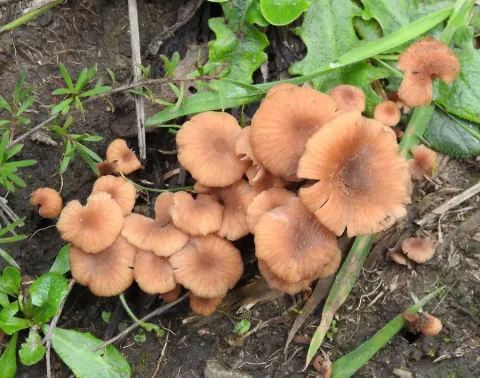
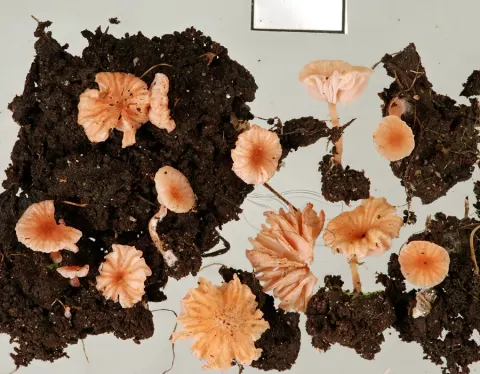
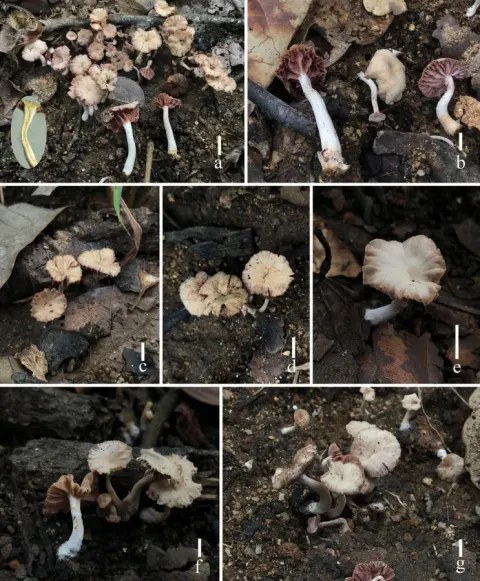
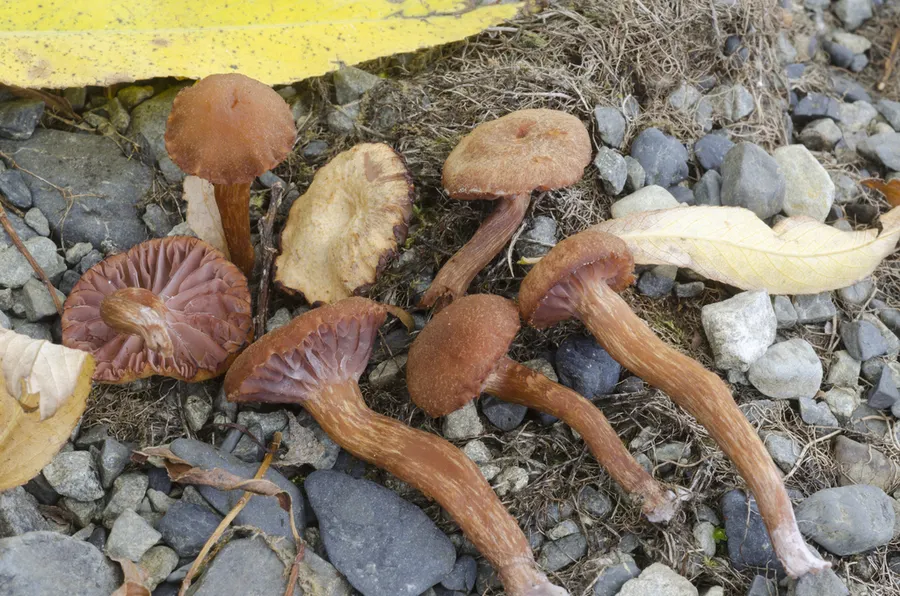
Basidiomata medium-sized. Pileus 10–56 mm in diameter, initially hemispherical to convex, becoming applanate with age, often plano-concave at maturity, occasionally with an uplifted margin; surface glabrous to finely fibrillose, becoming more distinctly fibrillose with age, distinctly striate to translucent-striate when fresh; hygrophanous, orange-brown (#a6532a) when fresh, fading rapidly to pale brown (#f2b790) and finally buff (#f0dcb4); margin crenate, orange-brown (#a6532a); context thin, 1–2 mm thick. Lamellae distant, segmentiform to subventricose, adnexed to subdecurrent, waxy, pinkish-flesh-colored (#d28c8c), 1–3 mm high; edge even or entire; lamellulae in 2–3 tiers. Stipe 20–76 × 3–6 mm, cylindrical, central, either nearly equal or slightly enlarged and subclavate toward the base, occasionally caespitose; surface dry, subglabrous to finely fibrillose, often faintly longitudinally striate, concolorous with the pileus; basal mycelium white; context broadly fistulose, orange-brown (#a6532a). Odor and taste not observed. Basidia 44–68 × 11–17 µm, av. 53.5 ± 5.9 × 14.1 ± 1.5 μm, clavate, 2–spored, sterigmata 6–14 µm × 3–5 µm, av. 10.1 ± 1.7 × 3.9 ± 1.5 μm. Basidiospores (excluding ornamentation) [100/2/2] (9.5–)10–13 (–14.1) × (8.9–) 9–12 (–13.5) µm, av. 11.4 ± 0.79 × 10.6 ± 0.98 μm, Q m = 1.02–1.13, Q av. = 1.07 ± 0.30, subglobose to broadly ellipsoid, occasionally globose or ellipsoid, hyaline, echinulate, spines 1–2 µm long, 0.8–1.2 µm wide at the base, crowded. Cheilocystidia 18–39 × 4–8 µm, av. 29.5 ± 5.3 × 5.9 ± 0.9 μm, narrowly clavate, flexuose or mucronate, rarely branched, thin-walled, colorless, and hyaline, abundant.

Sebagian uraian ditampilkan dalam bahasa sumber; terjemahannya belum tersedia atau belum lolos pemeriksaan.

Rujukan: [1]

Pengukuran mengikuti objek, spesimen atau kultur, dan metode yang disebutkan sumber. Baca uraian asli untuk konteks lengkap.

02 / Kehidupan

Habitat dan peran ekologis

Scattered, gregarious, or caespitose on the edges of ditches, in grasslands, on sandy soils, and beside woods.

Sebagian uraian ditampilkan dalam bahasa sumber; terjemahannya belum tersedia atau belum lolos pemeriksaan.

Rujukan: [1]

Habitat atau konteks temuan
Informasi belum tersedia pada sumber rilis ini.
Substrat
Informasi belum tersedia pada sumber rilis ini.
Peran atau konteks
Belum dikategorikan pada rilis ini.
Temukan hubungan serupa
03 / Siklus hidup

Reproduksi

Basidiomata medium-sized. Pileus 10–56 mm in diameter, initially hemispherical to convex, becoming applanate with age, often plano-concave at maturity, occasionally with an uplifted margin; surface glabrous to finely fibrillose, becoming more distinctly fibrillose with age, distinctly striate to translucent-striate when fresh; hygrophanous, orange-brown (#a6532a) when fresh, fading rapidly to pale brown (#f2b790) and finally buff (#f0dcb4); margin crenate, orange-brown (#a6532a); context thin, 1–2 mm thick. Lamellae distant, segmentiform to subventricose, adnexed to subdecurrent, waxy, pinkish-flesh-colored (#d28c8c), 1–3 mm high; edge even or entire; lamellulae in 2–3 tiers. Stipe 20–76 × 3–6 mm, cylindrical, central, either nearly equal or slightly enlarged and subclavate toward the base, occasionally caespitose; surface dry, subglabrous to finely fibrillose, often faintly longitudinally striate, concolorous with the pileus; basal mycelium white; context broadly fistulose, orange-brown (#a6532a).

Sebagian uraian ditampilkan dalam bahasa sumber; terjemahannya belum tersedia atau belum lolos pemeriksaan.

Rujukan: [1]

Sinonim menurut acuan taksonomi rilis: Clitocybe pumila; Laccaria altaica
04 / Batas informasi

Catatan identitas dan cakupan

  • Nama diterima mengikuti Catalogue of Life Base2026-09-11; uraian mempertahankan konsep dan nama sumber aslinya.
  • Preserve original treatment localities, hosts and substrate scope. Materials examined describe documented specimens, not the full global range.
  • Impor dan terjemahan otomatis belum diperiksa editorial per profil. Struktur reproduktif yang disebutkan tidak membuktikan seluruh siklus hidup diketahui.
  • Pengukuran pada uraian mengikuti spesimen, kultur, dan metode sumber; angka tidak diperluas ke semua populasi.

Catatan distribusi dalam narasi mengikuti sumbernya. Dokumentasi spesimen atau foto mengikuti catatan sumber. Bukti wilayah Indonesia dan penilaian konservasi tidak disimpulkan dari gambar.

05 / Dokumentasi

Melihat dengan konteks

Dokumentasi Laccaria pumila menurut asosiasi foto pada record takson iNaturalist. Kredit: Jerry Cooper. Identitas mengikuti sumber; bukan penentuan spesimen independen.

Jenis
Fotografi
Kredit
(c) Jerry Cooper, some rights reserved (CC BY), uploaded by Jerry Cooper
Lisensi
CC BY 4.0
Sumber media
Buka entri sumber

Gambar menunjukkan objek menurut identifikasi sumber, bukan verifikasi independen spesimen oleh Fungi. Tidak ada skala baru yang ditambahkan.

06 / Rujukan

Sumber profil

  1. [1] Species diversity of edible mushrooms III: new species of Laccaria (Agaricales, Basidiomycota) from southwestern China based on morphology and multilocus phylogeny — Laccaria pumilaBagian sumber: PMC13542773_section_26
    Tanggal penghimpunan sumber: 2026-10-12
    Teks sumber: CC BY 4.0 · Zhao G, Qu YH, Tang LY, Zhang J, Suo HN, Niu KY, Luo ZL, Song HB, Tang SM.
  2. [2] Catalogue of Life Base2026-09-11 — Laccaria pumilaBagian sumber: ColDP NameUsage.tsv ID 3RLFL; accepted species; source 2073
    Tanggal penghimpunan sumber: 2026-10-12
  3. [3] Dokumentasi visual — Laccaria pumilaBagian sumber: Individual media record; identification follows the source, not independent determination
    Tanggal penghimpunan sumber: 2026-10-12
    Media sumber: CC BY 4.0 · (c) Jerry Cooper, some rights reserved (CC BY), uploaded by Jerry Cooper

Adaptasi teks: CC BY 4.0. Zhao G, Qu YH, Tang LY, Zhang J, Suo HN, Niu KY, Luo ZL, Song HB, Tang SM. — Species diversity of edible mushrooms III: new species of Laccaria (Agaricales, Basidiomycota) from southwestern China based on morphology and multilocus phylogeny — Laccaria pumila

Uraian asli dan riwayat sumber

Riwayat atau halaman sumber

Ringkasan sumber

Basidiomata medium-sized. Pileus 10–56 mm in diameter, initially hemispherical to convex, becoming applanate with age, often plano-concave at maturity, occasionally with an uplifted margin; surface glabrous to finely fibrillose, becoming more distinctly fibrillose with age, distinctly striate to translucent-striate when fresh; hygrophanous, orange-brown (#a6532a) when fresh, fading rapidly to pale brown (#f2b790) and finally buff (#f0dcb4); margin crenate, orange-brown (#a6532a); context thin, 1–2 mm thick.

Revisi sumber

Morfologi sumber

Basidiomata medium-sized. Pileus 10–56 mm in diameter, initially hemispherical to convex, becoming applanate with age, often plano-concave at maturity, occasionally with an uplifted margin; surface glabrous to finely fibrillose, becoming more distinctly fibrillose with age, distinctly striate to translucent-striate when fresh; hygrophanous, orange-brown (#a6532a) when fresh, fading rapidly to pale brown (#f2b790) and finally buff (#f0dcb4); margin crenate, orange-brown (#a6532a); context thin, 1–2 mm thick. Lamellae distant, segmentiform to subventricose, adnexed to subdecurrent, waxy, pinkish-flesh-colored (#d28c8c), 1–3 mm high; edge even or entire; lamellulae in 2–3 tiers. Stipe 20–76 × 3–6 mm, cylindrical, central, either nearly equal or slightly enlarged and subclavate toward the base, occasionally caespitose; surface dry, subglabrous to finely fibrillose, often faintly longitudinally striate, concolorous with the pileus; basal mycelium white; context broadly fistulose, orange-brown (#a6532a). Odor and taste not observed. Basidia 44–68 × 11–17 µm, av. 53.5 ± 5.9 × 14.1 ± 1.5 μm, clavate, 2–spored, sterigmata 6–14 µm × 3–5 µm, av. 10.1 ± 1.7 × 3.9 ± 1.5 μm. Basidiospores (excluding ornamentation) [100/2/2] (9.5–)10–13 (–14.1) × (8.9–) 9–12 (–13.5) µm, av. 11.4 ± 0.79 × 10.6 ± 0.98 μm, Q m = 1.02–1.13, Q av. = 1.07 ± 0.30, subglobose to broadly ellipsoid, occasionally globose or ellipsoid, hyaline, echinulate, spines 1–2 µm long, 0.8–1.2 µm wide at the base, crowded. Cheilocystidia 18–39 × 4–8 µm, av. 29.5 ± 5.3 × 5.9 ± 0.9 μm, narrowly clavate, flexuose or mucronate, rarely branched, thin-walled, colorless, and hyaline, abundant.

Revisi sumber

Ekologi sumber

Scattered, gregarious, or caespitose on the edges of ditches, in grasslands, on sandy soils, and beside woods.

Revisi sumber

Struktur reproduksi sumber

Basidiomata medium-sized. Pileus 10–56 mm in diameter, initially hemispherical to convex, becoming applanate with age, often plano-concave at maturity, occasionally with an uplifted margin; surface glabrous to finely fibrillose, becoming more distinctly fibrillose with age, distinctly striate to translucent-striate when fresh; hygrophanous, orange-brown (#a6532a) when fresh, fading rapidly to pale brown (#f2b790) and finally buff (#f0dcb4); margin crenate, orange-brown (#a6532a); context thin, 1–2 mm thick. Lamellae distant, segmentiform to subventricose, adnexed to subdecurrent, waxy, pinkish-flesh-colored (#d28c8c), 1–3 mm high; edge even or entire; lamellulae in 2–3 tiers. Stipe 20–76 × 3–6 mm, cylindrical, central, either nearly equal or slightly enlarged and subclavate toward the base, occasionally caespitose; surface dry, subglabrous to finely fibrillose, often faintly longitudinally striate, concolorous with the pileus; basal mycelium white; context broadly fistulose, orange-brown (#a6532a).

Revisi sumber

Rujukan halaman ini

Fungi. Laccaria pumila. Rilis data fungi-2026-10-12-expansion-2. https://fungi-atlas.mgadib.chatgpt.site/jamur/laccaria-pumila/.

Status: impor sumber; pemeriksaan editorial per profil belum selesai. Untuk klaim biologis, gunakan rujukan pada bagian terkait dan periksa konteks sumber aslinya.