01 / Morfologi

Ciri dan struktur

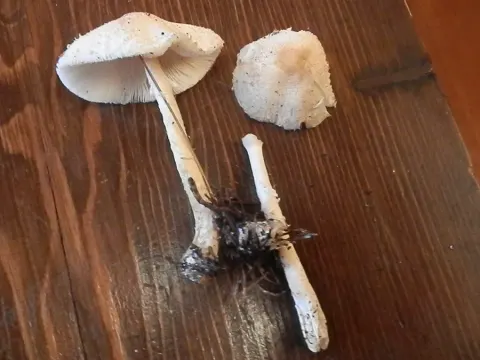
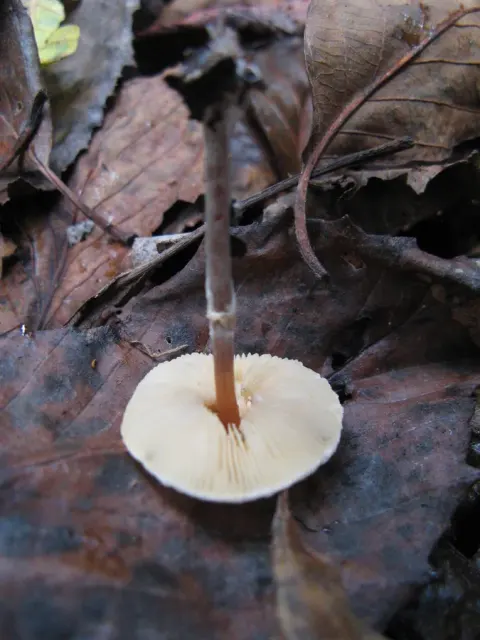
The fruit bodies of Lepiota castaneidisca have white, bell-shaped to convex caps 0.8 to 3.2 cm in diameter, with an orange-reddish to pale orange-brown center. Mature specimens fade and lose the reddish shades. The cap surface develops small pale pink or cream patches (especially on the outermost zone) on a white background that has radially arranged fibrils. The gills are somewhat crowded to moderately distant, with typically 40–45 full length gills, and 1–5 tiers of interspersed lamellulae (short gills that do not extend fully from the cap margin to the stem). They are slightly ventricose, measuring 2.5–5 mm wide, and have a white fringed or irregular edge. Whitish when young and cream-colored in age, they have a free gill attachment to the stem. The stem is 25 – 65 mm long by 2 – 6 mm thick, cylindrical, slightly widened at the base, hollow, and fibrillose. Its color is pinkish in the lower part, and it stains reddish where damaged, especially in older specimens. The flesh is whitish, sometimes with cream tones, or reddish-brown in mature specimens. There is a ring that points upward in young specimens, but in maturity it degrades to remnants that are left behind on the stem. It has a sharp odor similar to rubber or cod liver oil. The mushroom is not known to be poisonous, but consumption is not recommended due to the risk of possible confusion with Lepiota species that contain deadly amatoxins. The smooth, dextrinoid spores are in side view triangular with a spurred base, in frontal view oblong, and typically measure 5–9 by 3–4 μm. Staining with Cresyl blue shows them to be somewhat metachromatic, and binucleate.

Sebagian uraian ditampilkan dalam bahasa sumber; terjemahannya belum tersedia atau belum lolos pemeriksaan.

Rujukan: [1]

Pengukuran mengikuti objek, spesimen atau kultur, dan metode yang disebutkan sumber. Baca uraian asli untuk konteks lengkap.

02 / Kehidupan

Habitat dan peran ekologis

Lepiota castaneidisca is a saprobic fungus. Fruit bodies appear in the late fall and winter (November to February), where they grow gregariously near cypress, redwood or in mixed coast live oak forests. The fungus is common in coastal and northern California, and is often found in the San Francisco Bay Area. The northern limit of its distribution is Washington state and southern British Columbia, and it has been recorded as far south as Mexico.

Sebagian uraian ditampilkan dalam bahasa sumber; terjemahannya belum tersedia atau belum lolos pemeriksaan.

Rujukan: [1]

Habitat atau konteks temuan
hutan
Substrat
Informasi belum tersedia pada sumber rilis ini.
Peran atau konteks
Pengurai
Temukan hubungan serupa
03 / Siklus hidup

Reproduksi

The smooth, dextrinoid spores are in side view triangular with a spurred base, in frontal view oblong, and typically measure 5–9 by 3–4 μm. Staining with Cresyl blue shows them to be somewhat metachromatic, and binucleate. Cystidia on the gill edge (cheilocystidia) are club-shaped to cylindric or sometimes spheropedunculate (somewhat spherical with a stem), and have dimensions of 20–44 by 6.5–13.5 μm. Basidia are 18–30 by 5–8 μm, mostly four-spored, and are absent on the gill edge. Pleurocystidia (cystidia on the gill face) are absent. The cap cuticle is a hymeniderm (lengthened cells arranged side by side) with mostly colorless elements of different lengths, measuring 16–62 by 8–18 μm. The stipitipellis (outer covering of the stem) comprises a layer of colorless hyphae measuring about 2–3 μm wide.

Sebagian uraian ditampilkan dalam bahasa sumber; terjemahannya belum tersedia atau belum lolos pemeriksaan.

Rujukan: [1]

04 / Batas informasi

Catatan identitas dan cakupan

  • Nama diterima mengikuti Catalogue of Life Base2026-09-11; uraian mempertahankan konsep dan nama sumber aslinya.
  • Original geographic, specimen and life-cycle scope retained; source import awaits individual editorial review.
  • Impor dan terjemahan otomatis belum diperiksa editorial per profil. Struktur reproduktif yang disebutkan tidak membuktikan seluruh siklus hidup diketahui.
  • Pengukuran pada uraian mengikuti spesimen, kultur, dan metode sumber; angka tidak diperluas ke semua populasi.

Catatan distribusi dalam narasi mengikuti sumbernya. Dokumentasi spesimen atau foto mengikuti catatan sumber. Bukti wilayah Indonesia dan penilaian konservasi tidak disimpulkan dari gambar.

05 / Dokumentasi

Melihat dengan konteks

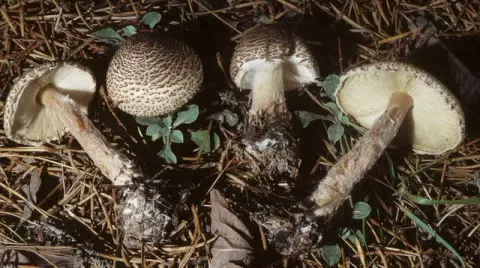
Dokumentasi Lepiota castaneidisca menurut asosiasi foto pada record takson iNaturalist. Kredit: Ken-ichi Ueda. Identitas mengikuti sumber; bukan penentuan spesimen independen.

Jenis
Fotografi
Kredit
(c) Ken-ichi Ueda, some rights reserved (CC BY), uploaded by Ken-ichi Ueda
Lisensi
CC BY 4.0
Sumber media
Buka entri sumber

Gambar menunjukkan objek menurut identifikasi sumber, bukan verifikasi independen spesimen oleh Fungi. Tidak ada skala baru yang ditambahkan.

06 / Rujukan

Sumber profil

  1. [1] Lepiota castaneidisca — Wikipedia (en)Bagian sumber: Frozen revision 1292717220
    Tanggal penghimpunan sumber: 2026-10-12
    Teks sumber: CC BY-SA4.0 · Wikipedia contributors
  2. [2] Catalogue of Life Base2026-09-11 — Lepiota castaneidiscaBagian sumber: ColDP NameUsage.tsv ID 6PDN5; accepted species; source 2073
    Tanggal penghimpunan sumber: 2026-10-12
  3. [3] Dokumentasi visual — Lepiota castaneidiscaBagian sumber: Individual media record; identification follows the source, not independent determination
    Tanggal penghimpunan sumber: 2026-10-12
    Media sumber: CC BY 4.0 · (c) Ken-ichi Ueda, some rights reserved (CC BY), uploaded by Ken-ichi Ueda

Adaptasi teks: CC BY-SA 4.0. Wikipedia contributors — Lepiota castaneidisca — Wikipedia (en)

Uraian asli dan riwayat sumber

Riwayat atau halaman sumber

Ringkasan sumber

Lepiota castaneidisca is a species of agaric fungus in the family Agaricaceae. Formally described in 1912, it was for a long time considered the same species as the similar Lepiota cristata until molecular analysis reported in 2001 demonstrated that it was genetically distinct. It is most common in coastal and northern California, and has also been recorded in Mexico. A saprobic species, it is usually found under redwood and Monterey cypress. Its fruit bodies (mushrooms) have white caps with an orange-red to orange-brown center that measure up to 3.2 cm wide.

Revisi sumber

Morfologi sumber

The fruit bodies of Lepiota castaneidisca have white, bell-shaped to convex caps 0.8 to 3.2 cm in diameter, with an orange-reddish to pale orange-brown center. Mature specimens fade and lose the reddish shades. The cap surface develops small pale pink or cream patches (especially on the outermost zone) on a white background that has radially arranged fibrils. The gills are somewhat crowded to moderately distant, with typically 40–45 full length gills, and 1–5 tiers of interspersed lamellulae (short gills that do not extend fully from the cap margin to the stem). They are slightly ventricose, measuring 2.5–5 mm wide, and have a white fringed or irregular edge. Whitish when young and cream-colored in age, they have a free gill attachment to the stem. The stem is 25 – 65 mm long by 2 – 6 mm thick, cylindrical, slightly widened at the base, hollow, and fibrillose. Its color is pinkish in the lower part, and it stains reddish where damaged, especially in older specimens. The flesh is whitish, sometimes with cream tones, or reddish-brown in mature specimens. There is a ring that points upward in young specimens, but in maturity it degrades to remnants that are left behind on the stem. It has a sharp odor similar to rubber or cod liver oil. The mushroom is not known to be poisonous, but consumption is not recommended due to the risk of possible confusion with Lepiota species that contain deadly amatoxins. The smooth, dextrinoid spores are in side view triangular with a spurred base, in frontal view oblong, and typically measure 5–9 by 3–4 μm. Staining with Cresyl blue shows them to be somewhat metachromatic, and binucleate.

Revisi sumber

Ekologi sumber

Lepiota castaneidisca is a saprobic fungus. Fruit bodies appear in the late fall and winter (November to February), where they grow gregariously near cypress, redwood or in mixed coast live oak forests. The fungus is common in coastal and northern California, and is often found in the San Francisco Bay Area. The northern limit of its distribution is Washington state and southern British Columbia, and it has been recorded as far south as Mexico.

Revisi sumber

Struktur reproduksi sumber

The smooth, dextrinoid spores are in side view triangular with a spurred base, in frontal view oblong, and typically measure 5–9 by 3–4 μm. Staining with Cresyl blue shows them to be somewhat metachromatic, and binucleate. Cystidia on the gill edge (cheilocystidia) are club-shaped to cylindric or sometimes spheropedunculate (somewhat spherical with a stem), and have dimensions of 20–44 by 6.5–13.5 μm. Basidia are 18–30 by 5–8 μm, mostly four-spored, and are absent on the gill edge. Pleurocystidia (cystidia on the gill face) are absent. The cap cuticle is a hymeniderm (lengthened cells arranged side by side) with mostly colorless elements of different lengths, measuring 16–62 by 8–18 μm. The stipitipellis (outer covering of the stem) comprises a layer of colorless hyphae measuring about 2–3 μm wide.

Revisi sumber

Rujukan halaman ini

Fungi. Lepiota castaneidisca. Rilis data fungi-2026-10-12-expansion-2. https://fungi-atlas.mgadib.chatgpt.site/jamur/lepiota-castaneidisca/.

Status: impor sumber; pemeriksaan editorial per profil belum selesai. Untuk klaim biologis, gunakan rujukan pada bagian terkait dan periksa konteks sumber aslinya.