Ciri dan struktur
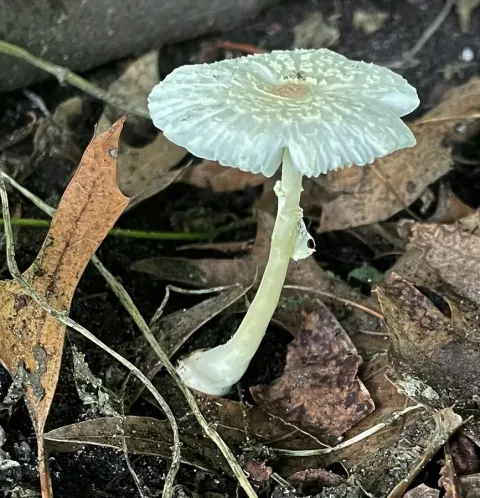
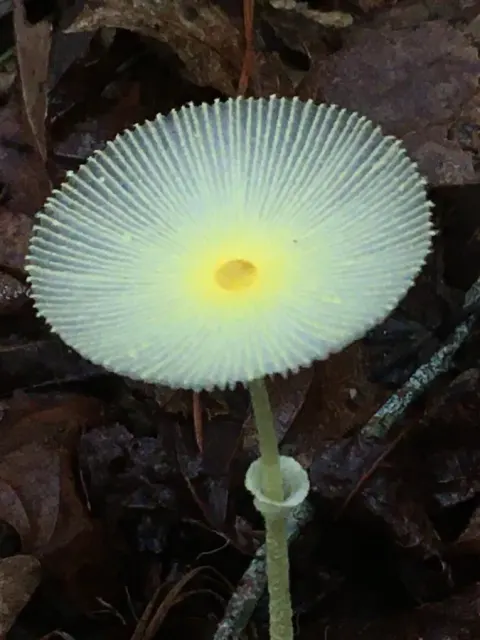
Leucocoprinus discoideus is a small dapperling mushroom with whitish flesh which discolours pinkish brown. Cap: 3-6cm wide with a white, campanulate (bell shaped) to conical cap and a slight brown umbo. It is covered in small brownish ochre scales which are concentrated on the centre disc or umbo and sparsely scattered on the rest of the cap surface. The cap edges have striations which extend about halfway across the cap. Gills: Free, crowded and white. Stem: 7–8 cm tall and 4–5 mm thick with a hairy (tomentose) coating. It is hollow, white and discolours pale pinkish brown with age. The fragile, membranous stem ring is white and located towards the top of the stem. Spore print: White. Spores: Ellipsoid with a pore. (8.1)9.1–11.3 × (5.7)6.3–7.3 μm. Taste: Bitter. When dry it discolours light brown.
Habitat dan peran ekologis
L. discoideus is scarcely recorded and little known. The specimens studied by Heinemann were found in the forest of the Eala region in Zaïre (now the Democratic Republic of the Congo). They were growing in a dense group on a dead tree trunk and on the ground in a dry forest area. Additional specimens were found near Lubumbashi in the South of the country and found growing on decomposing coffee in a plantation near lake Edward and lake Kivu to the North East.
- Habitat atau konteks temuan
- hutan
- Substrat
- tanah
- Peran atau konteks
- Belum dikategorikan pada rilis ini.
Reproduksi
Cap: 3-6cm wide with a white, campanulate (bell shaped) to conical cap and a slight brown umbo. It is covered in small brownish ochre scales which are concentrated on the centre disc or umbo and sparsely scattered on the rest of the cap surface. The cap edges have striations which extend about halfway across the cap. Gills: Free, crowded and white. Stem: 7–8 cm tall and 4–5 mm thick with a hairy (tomentose) coating. It is hollow, white and discolours pale pinkish brown with age. The fragile, membranous stem ring is white and located towards the top of the stem. Spore print: White. Spores: Ellipsoid with a pore. (8.1)9.1–11.3 × (5.7)6.3–7.3 μm. Taste: Bitter. When dry it discolours light brown.
Catatan identitas dan cakupan
- Nama diterima mengikuti Catalogue of Life Base2026-09-11; uraian mempertahankan konsep dan nama sumber aslinya.
- Original geographic, specimen and life-cycle scope retained; source import awaits individual editorial review.
- Impor dan terjemahan otomatis belum diperiksa editorial per profil. Struktur reproduktif yang disebutkan tidak membuktikan seluruh siklus hidup diketahui.
- Pengukuran pada uraian mengikuti spesimen, kultur, dan metode sumber; angka tidak diperluas ke semua populasi.
Catatan distribusi dalam narasi mengikuti sumbernya. Dokumentasi spesimen atau foto mengikuti catatan sumber. Bukti wilayah Indonesia dan penilaian konservasi tidak disimpulkan dari gambar.
Melihat dengan konteks
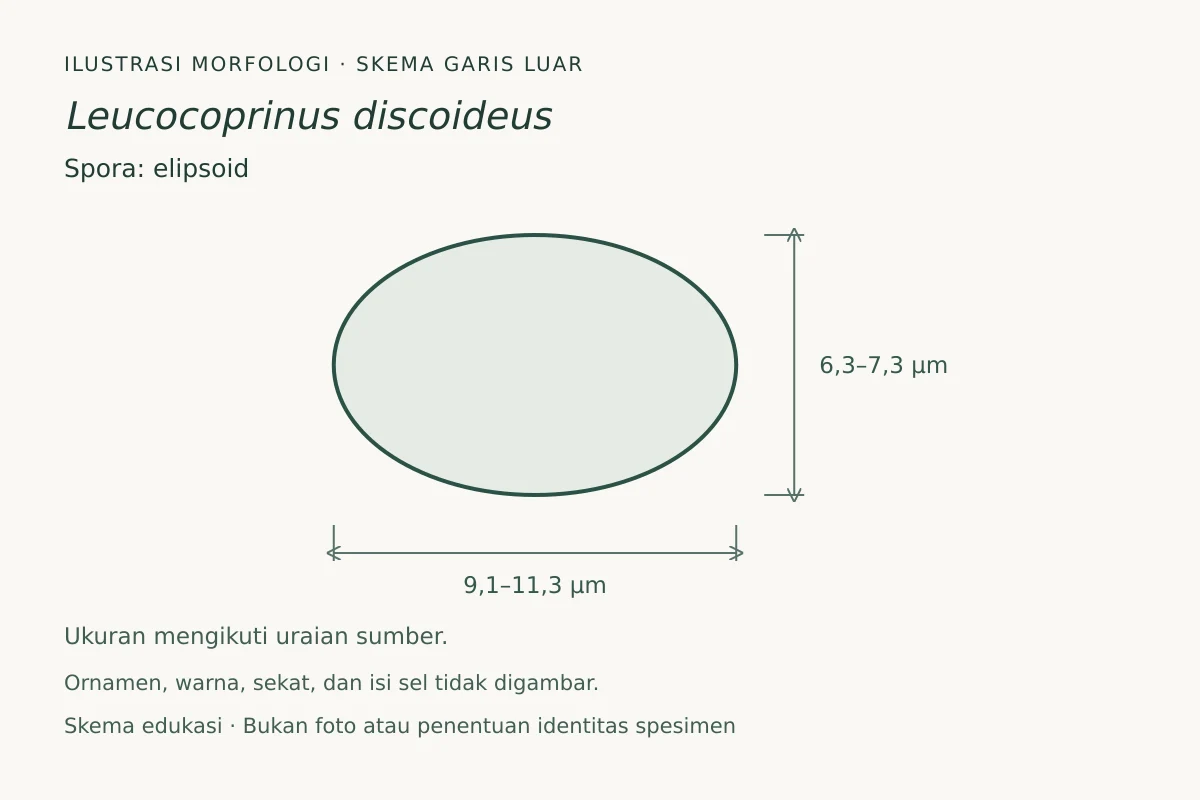
Ilustrasi skematis garis luar spora Leucocoprinus discoideus, berdasarkan uraian sumber; ukuran yang dilaporkan 9,1–11,3 × 6,3–7,3 µm. Proporsi disederhanakan, bukan salinan satu spesimen. Ornamen permukaan, warna, sekat, dan isi sel tidak direkonstruksi. Spora elipsoid, rentang utama 9,1–11,3 × 6,3–7,3 µm. Nilai ekstrem bawah 8,1 dan 5,7 µm serta pori tidak ditampilkan. Ornamen, warna, sekat, dan isi sel tidak digambar. Skema edukasi, bukan alat identifikasi.
- Jenis
- Ilustrasi skematis
- Kredit
- Fungi, ilustrasi orisinal (2026); fakta morfologi berdasarkan Wikipedia contributors
- Lisensi
- CC BY-SA 4.0
- Sumber media
- Buka entri sumber
Sumber profil
- [1] Leucocoprinus discoideus — Wikipedia (en)
- [2] Catalogue of Life Base2026-09-11 — Leucocoprinus discoideus
Rujukan halaman ini
Fungi. Leucocoprinus discoideus. Rilis data fungi-2026-10-12-expansion-2. https://fungi-atlas.mgadib.chatgpt.site/jamur/leucocoprinus-discoideus/.
Status: impor sumber; pemeriksaan editorial per profil belum selesai. Untuk klaim biologis, gunakan rujukan pada bagian terkait dan periksa konteks sumber aslinya.