01 / Morfologi

Ciri dan struktur

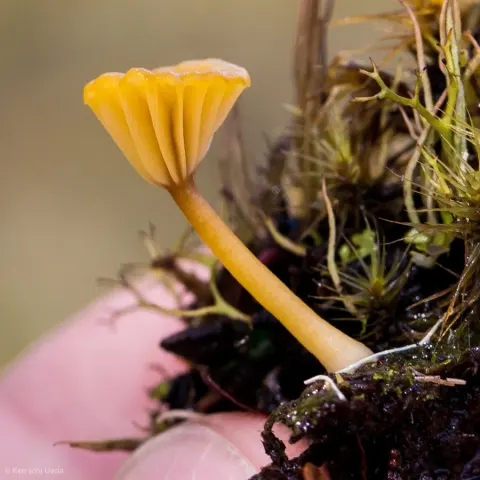
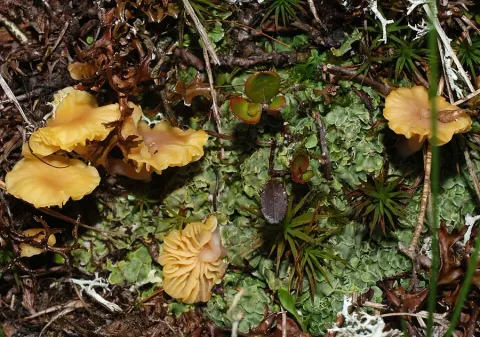
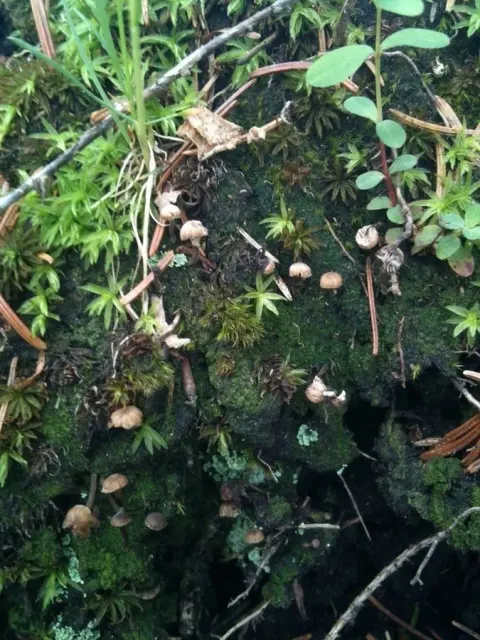
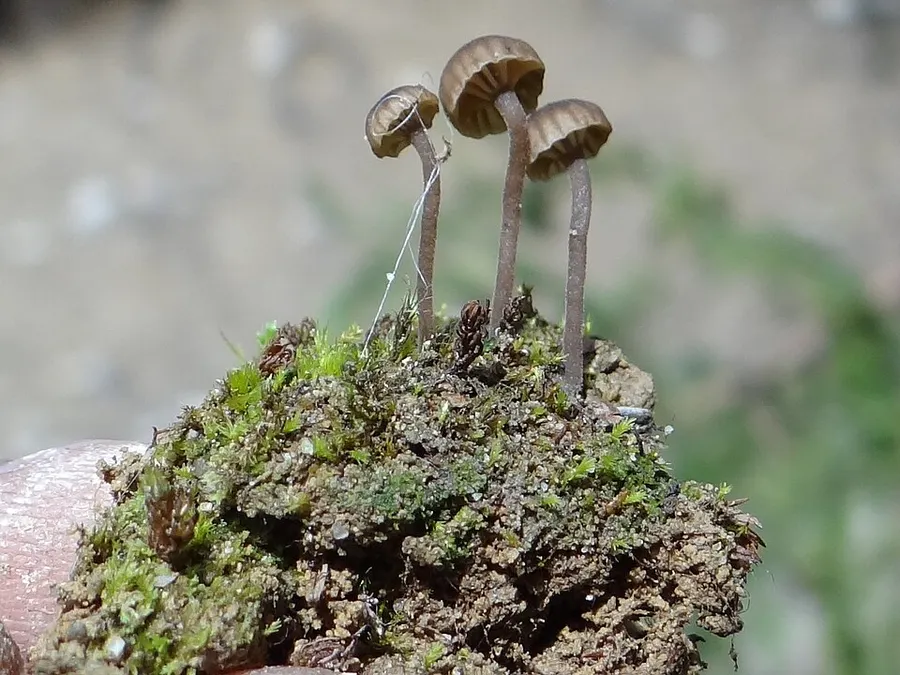
The thallus of Lichenomphalia velutina is subtle and resembles the Botrydina type; it is made up of globules that can be either dispersed or clustered, ranging in diameter from 35 to 90 μm. These globules turn translucent when wet and vary in colour from yellow-green to dark green. They are formed from clusters of single-celled green algae, known as Coccomyxa, surrounded by clear fungal threads (hyphae) which are 1–5 μm wide and do not have clamp connections. The basidiomata (fruiting body) of this species is mushroom-like, with a cap (pileus) that is 4–12 mm in diameter, varying in colour from grey-brown to dark brown. The cap is typically convex, with a depression in the centre, and may have a slightly wavy and streaked edge. It is smooth or somewhat fibrous and contains gills (lamellae) that are spaced apart, broad, and run down the stipe (decurrent), matching the cap in colour or slightly lighter. The flesh of the cap is thick and brittle, with interwoven hyphae that have a unique 'zebroid' (zebra-like) brown pattern. The cylindrical stipe ranges from 0.5 to 1.5 cm in height, matches the cap in colour or is lighter towards the base, and has a fuzzy appearance with a white fungal patch at its base. The reproductive structures include basidia, which are 14–25 by 4–8.5 μm in size and contain either four or occasionally two spores. The basidiospores are 6–9 by 4–6 μm, elliptical to almost round, clear, non-amyloid, and may contain oil droplets. Chemically, Lichenomphalia velutina does not react to standard lichen spot tests, indicating the absence of certain secondary metabolites in both the thallus and the basidiomata.

Sebagian uraian ditampilkan dalam bahasa sumber; terjemahannya belum tersedia atau belum lolos pemeriksaan.

Rujukan: [1]

Pengukuran mengikuti objek, spesimen atau kultur, dan metode yang disebutkan sumber. Baca uraian asli untuk konteks lengkap.

02 / Kehidupan

Habitat dan peran ekologis

Lichenomphalia velutina is a species of basidiolichen in the family Hygrophoraceae. It was first formally described in 1886 by the French mycologist Lucien Quélet, who classified it in the genus Omphalia. It was transferred to its current genus, Lichenomphalia, in 2002. Known primarily as having a European and North American distribution, the fungus was recorded from China (and Asia) for the first time in 2018. Chinese collections occur at elevations greater than 3000 m, while those in Europe tend to be at elevations under 1500 m. Lichenomphalia velutina also occurs in Greenland. It grows on soil and on moss.

Sebagian uraian ditampilkan dalam bahasa sumber; terjemahannya belum tersedia atau belum lolos pemeriksaan.

Rujukan: [1]

Habitat atau konteks temuan
Informasi belum tersedia pada sumber rilis ini.
Substrat
tanah
Peran atau konteks
Pembentuk liken
Temukan hubungan serupa
03 / Siklus hidup

Reproduksi

The basidiomata (fruiting body) of this species is mushroom-like, with a cap (pileus) that is 4–12 mm in diameter, varying in colour from grey-brown to dark brown. The cap is typically convex, with a depression in the centre, and may have a slightly wavy and streaked edge. It is smooth or somewhat fibrous and contains gills (lamellae) that are spaced apart, broad, and run down the stipe (decurrent), matching the cap in colour or slightly lighter. The flesh of the cap is thick and brittle, with interwoven hyphae that have a unique 'zebroid' (zebra-like) brown pattern. The cylindrical stipe ranges from 0.5 to 1.5 cm in height, matches the cap in colour or is lighter towards the base, and has a fuzzy appearance with a white fungal patch at its base.

Sebagian uraian ditampilkan dalam bahasa sumber; terjemahannya belum tersedia atau belum lolos pemeriksaan.

Rujukan: [1]

Sinonim menurut acuan taksonomi rilis: Botrydina velutina; Lichenomphalia grisella; Omphalia grisella; Omphalia velutina; Omphalina velutina; Phytoconis velutina
04 / Batas informasi

Catatan identitas dan cakupan

  • Nama diterima mengikuti Catalogue of Life Base2026-09-11; uraian mempertahankan konsep dan nama sumber aslinya.
  • Original geographic, specimen and life-cycle scope retained; source import awaits individual editorial review.
  • Impor dan terjemahan otomatis belum diperiksa editorial per profil. Struktur reproduktif yang disebutkan tidak membuktikan seluruh siklus hidup diketahui.
  • Pengukuran pada uraian mengikuti spesimen, kultur, dan metode sumber; angka tidak diperluas ke semua populasi.

Catatan distribusi dalam narasi mengikuti sumbernya. Dokumentasi spesimen atau foto mengikuti catatan sumber. Bukti wilayah Indonesia dan penilaian konservasi tidak disimpulkan dari gambar.

05 / Dokumentasi

Melihat dengan konteks

Dokumentasi Lichenomphalia velutina dari Wikimedia Commons. Lichenomphalia velutina (Location: Poland, West Tatra Mountains, Dolina Miętusia) Identifikasi mengikuti record berkas sumber.

Jenis
Fotografi
Kredit
Jerzy Opioła
Sumber media
Buka entri sumber

Gambar menunjukkan objek menurut identifikasi sumber, bukan verifikasi independen spesimen oleh Fungi. Tidak ada skala baru yang ditambahkan.

06 / Rujukan

Sumber profil

  1. [1] Lichenomphalia velutina — Wikipedia (en)Bagian sumber: Frozen revision 1224021632
    Tanggal penghimpunan sumber: 2026-10-12
    Teks sumber: CC BY-SA4.0 · Wikipedia contributors
  2. [2] Catalogue of Life Base2026-09-11 — Lichenomphalia velutinaBagian sumber: ColDP NameUsage.tsv ID 6Q9PJ; accepted species; source 2073
    Tanggal penghimpunan sumber: 2026-10-12
  3. [3] Dokumentasi visual — Lichenomphalia velutinaBagian sumber: Individual media record; identification follows the source, not independent determination
    Tanggal penghimpunan sumber: 2026-10-12
    Media sumber: CC BY-SA 4.0 · Jerzy Opioła

Adaptasi teks: CC BY-SA 4.0. Wikipedia contributors — Lichenomphalia velutina — Wikipedia (en)

Uraian asli dan riwayat sumber

Riwayat atau halaman sumber

Ringkasan sumber

Lichenomphalia velutina is a species of basidiolichen in the family Hygrophoraceae. It was first formally described in 1886 by the French mycologist Lucien Quélet, who classified it in the genus Omphalia. It was transferred to its current genus, Lichenomphalia, in 2002. Known primarily as having a European and North American distribution, the fungus was recorded from China (and Asia) for the first time in 2018. Chinese collections occur at elevations greater than 3000 m, while those in Europe tend to be at elevations under 1500 m.

Revisi sumber

Morfologi sumber

The thallus of Lichenomphalia velutina is subtle and resembles the Botrydina type; it is made up of globules that can be either dispersed or clustered, ranging in diameter from 35 to 90 μm. These globules turn translucent when wet and vary in colour from yellow-green to dark green. They are formed from clusters of single-celled green algae, known as Coccomyxa, surrounded by clear fungal threads (hyphae) which are 1–5 μm wide and do not have clamp connections. The basidiomata (fruiting body) of this species is mushroom-like, with a cap (pileus) that is 4–12 mm in diameter, varying in colour from grey-brown to dark brown. The cap is typically convex, with a depression in the centre, and may have a slightly wavy and streaked edge. It is smooth or somewhat fibrous and contains gills (lamellae) that are spaced apart, broad, and run down the stipe (decurrent), matching the cap in colour or slightly lighter. The flesh of the cap is thick and brittle, with interwoven hyphae that have a unique 'zebroid' (zebra-like) brown pattern. The cylindrical stipe ranges from 0.5 to 1.5 cm in height, matches the cap in colour or is lighter towards the base, and has a fuzzy appearance with a white fungal patch at its base. The reproductive structures include basidia, which are 14–25 by 4–8.5 μm in size and contain either four or occasionally two spores. The basidiospores are 6–9 by 4–6 μm, elliptical to almost round, clear, non-amyloid, and may contain oil droplets. Chemically, Lichenomphalia velutina does not react to standard lichen spot tests, indicating the absence of certain secondary metabolites in both the thallus and the basidiomata.

Revisi sumber

Ekologi sumber

Lichenomphalia velutina is a species of basidiolichen in the family Hygrophoraceae. It was first formally described in 1886 by the French mycologist Lucien Quélet, who classified it in the genus Omphalia. It was transferred to its current genus, Lichenomphalia, in 2002. Known primarily as having a European and North American distribution, the fungus was recorded from China (and Asia) for the first time in 2018. Chinese collections occur at elevations greater than 3000 m, while those in Europe tend to be at elevations under 1500 m. Lichenomphalia velutina also occurs in Greenland. It grows on soil and on moss.

Revisi sumber

Struktur reproduksi sumber

The basidiomata (fruiting body) of this species is mushroom-like, with a cap (pileus) that is 4–12 mm in diameter, varying in colour from grey-brown to dark brown. The cap is typically convex, with a depression in the centre, and may have a slightly wavy and streaked edge. It is smooth or somewhat fibrous and contains gills (lamellae) that are spaced apart, broad, and run down the stipe (decurrent), matching the cap in colour or slightly lighter. The flesh of the cap is thick and brittle, with interwoven hyphae that have a unique 'zebroid' (zebra-like) brown pattern. The cylindrical stipe ranges from 0.5 to 1.5 cm in height, matches the cap in colour or is lighter towards the base, and has a fuzzy appearance with a white fungal patch at its base.

Revisi sumber

Rujukan halaman ini

Fungi. Lichenomphalia velutina. Rilis data fungi-2026-10-12-expansion-2. https://fungi-atlas.mgadib.chatgpt.site/jamur/lichenomphalia-velutina/.

Status: impor sumber; pemeriksaan editorial per profil belum selesai. Untuk klaim biologis, gunakan rujukan pada bagian terkait dan periksa konteks sumber aslinya.