01 / Morfologi

Ciri dan struktur

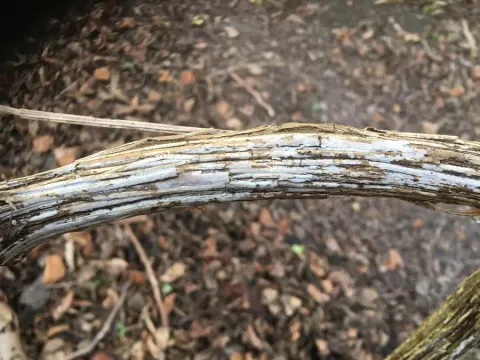
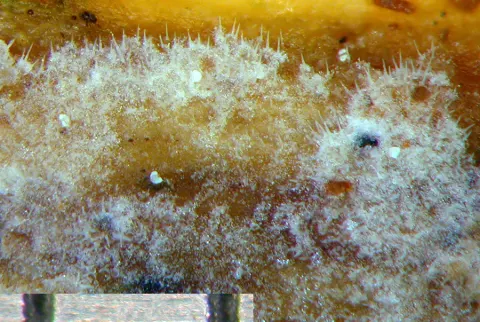
Basidiomata annual, resupinate, effused, closely adnate, thin, at first as irregular small patches, later confluent up to 7.5 cm long, 1.5 cm wide. Hymenophore surface smooth, hispidulous under lens due to the projecting cystidia (lyocystidia), white to gray, finely cracked; margin undifferentiated. Hyphal system monomitic; generative hyphae with clamp connections, colorless, tortuous, thin-walled, moderately branched, frequently septate, loosely interwoven, 2–3 μm in diam. Lyocystidia abundant, subulate, projecting beyond hymenium, multi-rooted, colorless, thick-walled, densely encrusted with minute crystals and fibrous hyphae, inner layer(s) dextrinoid, 70–90 × 8–10 μm. Basidia subclavate with a slight median constriction, colorless, thin-walled, with 4 sterigmata and a basal clamp connection, 29–32 × 8.5–9.5 μm. Basidiospores globose, distinctly apiculate, colorless, thin-walled, occasionally guttulate, inamyloid, indextrinoid, (6–)6.6–7.8(–8.8) × (5.5–)6–7(–8) μm. L = 7.2 μm, W = 6.5 μm, Q = 1–1.2 (n = 60/2; Chen 2742 and Wu 0102-4). See also Oberwinkler (1965) and Kisimova-Horovitz et al. (1997a).

Sebagian uraian ditampilkan dalam bahasa sumber; terjemahannya belum tersedia atau belum lolos pemeriksaan.

Rujukan: [1]

Pengukuran mengikuti objek, spesimen atau kultur, dan metode yang disebutkan sumber. Baca uraian asli untuk konteks lengkap.

02 / Kehidupan

Habitat dan peran ekologis

Mostly on gymnosperm branches, rarely on angiosperms (Gómez 1972). Widely distributed in both hemispheres (Oberwinkler 1965; Kisimova-Horovitz et al. 1997a; Tellería et al. 2009; Chikowski et al. 2020) and Taiwan (new record; this study).

Sebagian uraian ditampilkan dalam bahasa sumber; terjemahannya belum tersedia atau belum lolos pemeriksaan.

Rujukan: [1]

Habitat atau konteks temuan
Informasi belum tersedia pada sumber rilis ini.
Substrat
Informasi belum tersedia pada sumber rilis ini.
Peran atau konteks
Belum dikategorikan pada rilis ini.
Temukan hubungan serupa
03 / Siklus hidup

Reproduksi

Basidiomata annual, resupinate, effused, closely adnate, thin, at first as irregular small patches, later confluent up to 7.5 cm long, 1.5 cm wide. Hymenophore surface smooth, hispidulous under lens due to the projecting cystidia (lyocystidia), white to gray, finely cracked; margin undifferentiated. Hyphal system monomitic; generative hyphae with clamp connections, colorless, tortuous, thin-walled, moderately branched, frequently septate, loosely interwoven, 2–3 μm in diam. Lyocystidia abundant, subulate, projecting beyond hymenium, multi-rooted, colorless, thick-walled, densely encrusted with minute crystals and fibrous hyphae, inner layer(s) dextrinoid, 70–90 × 8–10 μm. Basidia subclavate with a slight median constriction, colorless, thin-walled, with 4 sterigmata and a basal clamp connection, 29–32 × 8.5–9.5 μm.

Sebagian uraian ditampilkan dalam bahasa sumber; terjemahannya belum tersedia atau belum lolos pemeriksaan.

Rujukan: [1]

Sinonim menurut acuan taksonomi rilis: Peniophora abietis; Peniophora aegerita subsp. abietis; Xenasma abietis
04 / Batas informasi

Catatan identitas dan cakupan

  • Nama diterima mengikuti Catalogue of Life Base2026-09-11; uraian mempertahankan konsep dan nama sumber aslinya.
  • Preserve original treatment localities, hosts and substrate scope. Materials examined describe documented specimens, not the full global range.
  • Impor dan terjemahan otomatis belum diperiksa editorial per profil. Struktur reproduktif yang disebutkan tidak membuktikan seluruh siklus hidup diketahui.
  • Pengukuran pada uraian mengikuti spesimen, kultur, dan metode sumber; angka tidak diperluas ke semua populasi.

Catatan distribusi dalam narasi mengikuti sumbernya. Dokumentasi spesimen atau foto mengikuti catatan sumber. Bukti wilayah Indonesia dan penilaian konservasi tidak disimpulkan dari gambar.

05 / Dokumentasi

Melihat dengan konteks

Dokumentasi visual yang memenuhi pemeriksaan subjek dan hak penggunaan belum tersedia. Foto gejala, label, dan gambar yang meragukan tidak dihitung.

06 / Rujukan

Sumber profil

  1. [1] Taxonomy and phylogeny of Litschauerella (Hymenochaetales) and Tubulicium (Trechisporales) in East Asia: Three new species and six new records — Litschauerella abietisBagian sumber: PMC13494573_section_13
    Tanggal penghimpunan sumber: 2026-10-12
    Teks sumber: CC BY 4.0 · Lin YC, Chen CC.
  2. [2] Catalogue of Life Base2026-09-11 — Litschauerella abietisBagian sumber: ColDP NameUsage.tsv ID 72L2Q; accepted species; source 2073
    Tanggal penghimpunan sumber: 2026-10-12

Adaptasi teks: CC BY 4.0. Lin YC, Chen CC. — Taxonomy and phylogeny of Litschauerella (Hymenochaetales) and Tubulicium (Trechisporales) in East Asia: Three new species and six new records — Litschauerella abietis

Uraian asli dan riwayat sumber

Riwayat atau halaman sumber

Ringkasan sumber

Basidiomata annual, resupinate, effused, closely adnate, thin, at first as irregular small patches, later confluent up to 7.5 cm long, 1.5 cm wide. Hymenophore surface smooth, hispidulous under lens due to the projecting cystidia (lyocystidia), white to gray, finely cracked; margin undifferentiated. Hyphal system monomitic; generative hyphae with clamp connections, colorless, tortuous, thin-walled, moderately branched, frequently septate, loosely interwoven, 2–3 μm in diam. Lyocystidia abundant, subulate, projecting beyond hymenium, multi-rooted, colorless, thick-walled, densely encrusted with minute crystals and fibrous hyphae, inner layer(s) dextrinoid, 70–90 × 8–10 μm.

Revisi sumber

Morfologi sumber

Basidiomata annual, resupinate, effused, closely adnate, thin, at first as irregular small patches, later confluent up to 7.5 cm long, 1.5 cm wide. Hymenophore surface smooth, hispidulous under lens due to the projecting cystidia (lyocystidia), white to gray, finely cracked; margin undifferentiated. Hyphal system monomitic; generative hyphae with clamp connections, colorless, tortuous, thin-walled, moderately branched, frequently septate, loosely interwoven, 2–3 μm in diam. Lyocystidia abundant, subulate, projecting beyond hymenium, multi-rooted, colorless, thick-walled, densely encrusted with minute crystals and fibrous hyphae, inner layer(s) dextrinoid, 70–90 × 8–10 μm. Basidia subclavate with a slight median constriction, colorless, thin-walled, with 4 sterigmata and a basal clamp connection, 29–32 × 8.5–9.5 μm. Basidiospores globose, distinctly apiculate, colorless, thin-walled, occasionally guttulate, inamyloid, indextrinoid, (6–)6.6–7.8(–8.8) × (5.5–)6–7(–8) μm. L = 7.2 μm, W = 6.5 μm, Q = 1–1.2 (n = 60/2; Chen 2742 and Wu 0102-4). See also Oberwinkler (1965) and Kisimova-Horovitz et al. (1997a).

Revisi sumber

Ekologi sumber

Mostly on gymnosperm branches, rarely on angiosperms (Gómez 1972). Widely distributed in both hemispheres (Oberwinkler 1965; Kisimova-Horovitz et al. 1997a; Tellería et al. 2009; Chikowski et al. 2020) and Taiwan (new record; this study).

Revisi sumber

Struktur reproduksi sumber

Basidiomata annual, resupinate, effused, closely adnate, thin, at first as irregular small patches, later confluent up to 7.5 cm long, 1.5 cm wide. Hymenophore surface smooth, hispidulous under lens due to the projecting cystidia (lyocystidia), white to gray, finely cracked; margin undifferentiated. Hyphal system monomitic; generative hyphae with clamp connections, colorless, tortuous, thin-walled, moderately branched, frequently septate, loosely interwoven, 2–3 μm in diam. Lyocystidia abundant, subulate, projecting beyond hymenium, multi-rooted, colorless, thick-walled, densely encrusted with minute crystals and fibrous hyphae, inner layer(s) dextrinoid, 70–90 × 8–10 μm. Basidia subclavate with a slight median constriction, colorless, thin-walled, with 4 sterigmata and a basal clamp connection, 29–32 × 8.5–9.5 μm.

Revisi sumber

Rujukan halaman ini

Fungi. Litschauerella abietis. Rilis data fungi-2026-10-12-expansion-2. https://fungi-atlas.mgadib.chatgpt.site/jamur/litschauerella-abietis/.

Status: impor sumber; pemeriksaan editorial per profil belum selesai. Untuk klaim biologis, gunakan rujukan pada bagian terkait dan periksa konteks sumber aslinya.