01 / Morfologi

Ciri dan struktur

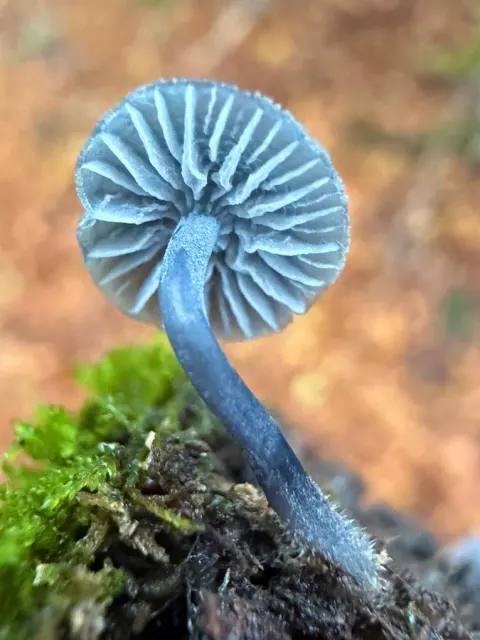
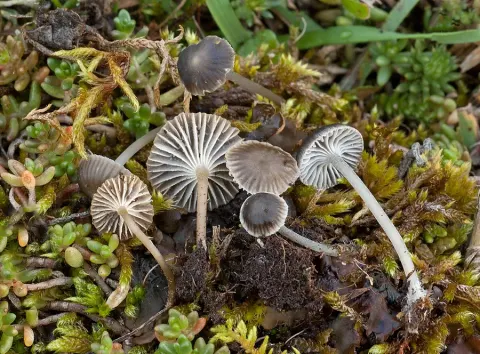
The cap of the M. polygramma fruit body is 2 to 4 cm in diameter, and initially egg- to cone-shaped, but expands to become conic to bell-shaped or nearly convex with an abrupt small umbo, or at times plane with a conic umbo. On young fruit bodies, the cap margin is slightly curved inward, and frequently has scalloped edges; in maturity the margin flares out or is recurved and wavy. The surface of the cap is initially covered with short, fine whitish or grayish hairs that often persist until near maturity. With age, the cap surface becomes smooth, the color dark brownish gray to black beneath the bloom, fading slowly to a pale gray, and nearly pinkish-buff at times. The cap margin is opaque and frequently has narrow, deep furrows or grooves, with the surface often more or less uneven and appearing as if streaked with glistening lines. The flesh is very hard and cartilaginous, watery grayish to white, rather thin, and with no distinctive odor and a mild taste. The gills are narrowly adnate (attached squarely to the stem) or have a short decurrent tooth, and are packed close together, with 30–38 gills reaching the stem. They are broad anteriorly (4–7 mm), white or whitish, in age flushed with pink, often with sordid-brownish stains, and with edges pallid and even. The stem is 6 to 15 cm long, 0.2 to 0.5 cm thick, very brittle and cartilaginous, equal, and tubular. It sometimes has a well-developed pseudorrhiza that resembles white cotton, and the base is covered with stiff white hairs, and often it stains reddish brown. The surface has fine straight or sometimes twisted longitudinal striations.

Sebagian uraian ditampilkan dalam bahasa sumber; terjemahannya belum tersedia atau belum lolos pemeriksaan.

Rujukan: [1]

Pengukuran mengikuti objek, spesimen atau kultur, dan metode yang disebutkan sumber. Baca uraian asli untuk konteks lengkap.

02 / Kehidupan

Habitat dan peran ekologis

The fruit bodies of M. polygramma grow in groups or sub-clusters under hardwoods, particularly deciduous trees such as oak, maple, and basswood. Di Amerika Utara, buah ini telah dikumpulkan dari North Carolina, Massachusetts, New York, dan Michigan, di mana buahnya mulai June to Oktober. The fruit bodies are susceptible to attack by the parasitic fungi Spinellus fusiger and S. macrocarpus. Typically found pada cabang atau kayu yang dikubur, jamur diketahui sebagai pengurai kuat lignin dan selulosa dalam daun. Mycena polygramma adalah jamur saprobik dan merupakan salah satu dari banyak jamur yang berkontribusi pada kerusakan sampah tanaman di ekosistem hutan melalui daur ulang nutrisi dan pembentukan humus di tanah. Ini adalah dekomposer lignocellulose dari larch litter, dan dapat memecah lignin dan karbohidrat, meskipun memiliki preferensi untuk karbohidrat. Dalam sebuah eksperimen menguji kemampuan beberapa jamur yang membusuk sampah untuk menghilangkan lignin dari daun rumput abadi Miscanthus sinensis, dalam kondisi budidaya murni, M. polygramma menunjukkan kemampuan terbatas untuk menyebabkan hilangnya massa lignin. Rare in North America, the fungus is common in Europe, including Great Britain. They have dikumpulkan di Kepulauan Falkland, dan Jepang.

Sebagian uraian ditampilkan dalam bahasa sumber; terjemahannya belum tersedia atau belum lolos pemeriksaan.

Rujukan: [1]

Habitat atau konteks temuan
hutan; kultur yang didokumentasikan
Substrat
tanah
Peran atau konteks
Pengurai
Temukan hubungan serupa
03 / Siklus hidup

Reproduksi

Collected in deposit, such as in a spore print, the spores appear white. Viewed with a light microscope, the spores are broadly ellipsoid in shape, smooth, amyloid, with dimensions of 7.5–10 by 5–6 μm. Occasionally the spores contain oil droplets. The basidia (pore-bearing cells) are four-spored, 26–30 by 7–8 μm. The cheilocystidia are scattered to abundant, aciculate or with the midportion somewhat enlarged and the apex forked or branched and give rise to two or several contorted finger-like projections. Pleurocystidia are not differentiated.

Sebagian uraian ditampilkan dalam bahasa sumber; terjemahannya belum tersedia atau belum lolos pemeriksaan.

Rujukan: [1]

Sinonim menurut acuan taksonomi rilis: Agaricus cynophallus; Agaricus fistulosus var. polygrammus; Agaricus polygrammus; Agaricus polygrammus var. cinerascens; Agaricus polygrammus var. cynophallus; Agaricus polygrammus var. niveus; Agaricus varius var. polygrammus; Mycena polygramma f. candida; Mycena polygramma f. laevipes; Mycena polygramma f. pumila; Mycena polygramma var. albida; Mycena polygramma var. candida; Mycena polygramma var. nana
04 / Batas informasi

Catatan identitas dan cakupan

  • Nama diterima mengikuti Catalogue of Life Base2026-09-11; uraian mempertahankan konsep dan nama sumber aslinya.
  • Original geographic, specimen and life-cycle scope retained; source import awaits individual editorial review.
  • Impor dan terjemahan otomatis belum diperiksa editorial per profil. Struktur reproduktif yang disebutkan tidak membuktikan seluruh siklus hidup diketahui.
  • Pengukuran pada uraian mengikuti spesimen, kultur, dan metode sumber; angka tidak diperluas ke semua populasi.

Catatan distribusi dalam narasi mengikuti sumbernya. Dokumentasi spesimen atau foto mengikuti catatan sumber. Bukti wilayah Indonesia dan penilaian konservasi tidak disimpulkan dari gambar.

05 / Dokumentasi

Melihat dengan konteks

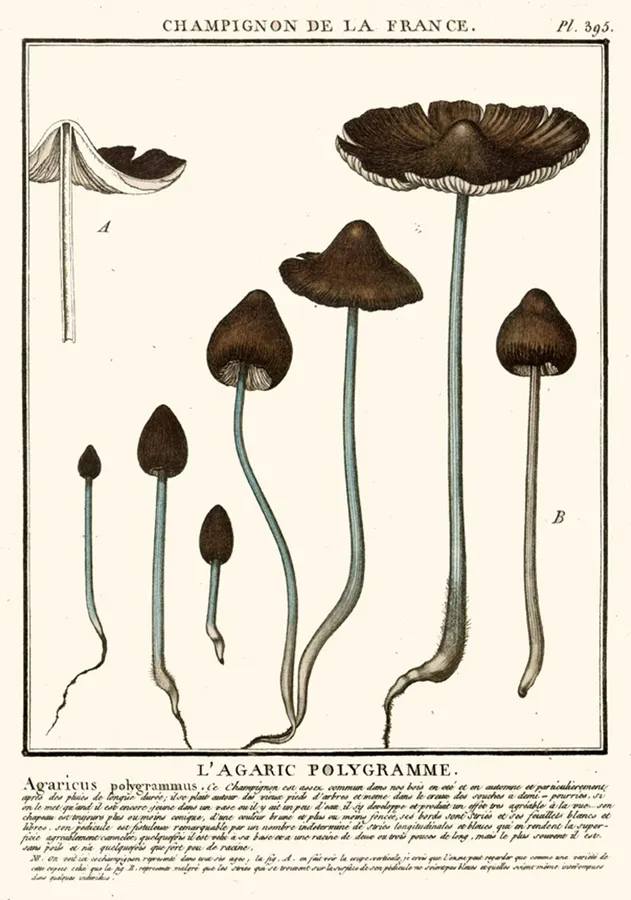
Dokumentasi Mycena polygramma dari Wikimedia Commons. Picture of the mushroom Agaricus polygramma , now known as Mycena polygramma (Bull.) Gray. Identifikasi mengikuti record berkas sumber.

Jenis
Fotografi
Kredit
JBF Bulliard
Sumber media
Buka entri sumber

Gambar menunjukkan objek menurut identifikasi sumber, bukan verifikasi independen spesimen oleh Fungi. Tidak ada skala baru yang ditambahkan.

06 / Rujukan

Sumber profil

  1. [1] Mycena polygramma — Wikipedia (en)Bagian sumber: Frozen revision 1224199749
    Tanggal penghimpunan sumber: 2026-10-12
    Teks sumber: CC BY-SA4.0 · Wikipedia contributors
  2. [2] Catalogue of Life Base2026-09-11 — Mycena polygrammaBagian sumber: ColDP NameUsage.tsv ID 44TNM; accepted species; source 2073
    Tanggal penghimpunan sumber: 2026-10-12
  3. [3] Dokumentasi visual — Mycena polygrammaBagian sumber: Individual media record; identification follows the source, not independent determination
    Tanggal penghimpunan sumber: 2026-10-12
    Media sumber: Public domain · JBF Bulliard

Adaptasi teks: CC BY-SA 4.0. Wikipedia contributors — Mycena polygramma — Wikipedia (en)

Uraian asli dan riwayat sumber

Riwayat atau halaman sumber

Ringkasan sumber

Mycena polygramma, commonly known as the grooved bonnet, is a species of mushroom in the family Mycenaceae. The inedible fruit bodies are small, pale gray-brown mushrooms with broadly conical caps, pinkish gills. They are found in small troops on stumps and branches of deciduous and occasionally coniferous trees. The mushroom is found in Asia, Europe, and North America, where it is typically found on twigs or buried wood, carrying out its role in the forest ecosystem by decomposing organic matter, recycling nutrients, and forming humus in the soil.

Revisi sumber

Morfologi sumber

The cap of the M. polygramma fruit body is 2 to 4 cm in diameter, and initially egg- to cone-shaped, but expands to become conic to bell-shaped or nearly convex with an abrupt small umbo, or at times plane with a conic umbo. On young fruit bodies, the cap margin is slightly curved inward, and frequently has scalloped edges; in maturity the margin flares out or is recurved and wavy. The surface of the cap is initially covered with short, fine whitish or grayish hairs that often persist until near maturity. With age, the cap surface becomes smooth, the color dark brownish gray to black beneath the bloom, fading slowly to a pale gray, and nearly pinkish-buff at times. The cap margin is opaque and frequently has narrow, deep furrows or grooves, with the surface often more or less uneven and appearing as if streaked with glistening lines. The flesh is very hard and cartilaginous, watery grayish to white, rather thin, and with no distinctive odor and a mild taste. The gills are narrowly adnate (attached squarely to the stem) or have a short decurrent tooth, and are packed close together, with 30–38 gills reaching the stem. They are broad anteriorly (4–7 mm), white or whitish, in age flushed with pink, often with sordid-brownish stains, and with edges pallid and even. The stem is 6 to 15 cm long, 0.2 to 0.5 cm thick, very brittle and cartilaginous, equal, and tubular. It sometimes has a well-developed pseudorrhiza that resembles white cotton, and the base is covered with stiff white hairs, and often it stains reddish brown. The surface has fine straight or sometimes twisted longitudinal striations.

Revisi sumber

Ekologi sumber

The fruit bodies of M. polygramma grow in groups or sub-clusters under hardwoods, particularly deciduous trees such as oak, maple, and basswood. In North America, it has been collected from North Carolina, Massachusetts, New York, and Michigan, where it fruits from June to October. The fruit bodies are susceptible to attack by the parasitic fungi Spinellus fusiger and S. macrocarpus. Typically found on twigs or buried wood, the fungus is known to be a vigorous decomposer of lignin and cellulose in leaf litter. Mycena polygramma is a saprobic fungus and is one of many fungi that contribute to plant litter decomposition in forest ecosystems through nutrient recycling and humus formation in soil. It is a lignocellulose decomposer of larch litter, and can break down both lignin and carbohydrates, although it has a preference for carbohydrates. In an experiment testing the ability of several litter-decomposing fungi to remove lignin from leaves of the perennial grass Miscanthus sinensis, under pure culture conditions, M. polygramma showed limited ability to cause the mass loss of lignin. Rare in North America, the fungus is common in Europe, including Great Britain. They have been collected on the Falkland Islands, and Japan.

Revisi sumber

Struktur reproduksi sumber

Collected in deposit, such as in a spore print, the spores appear white. Viewed with a light microscope, the spores are broadly ellipsoid in shape, smooth, amyloid, with dimensions of 7.5–10 by 5–6 μm. Occasionally the spores contain oil droplets. The basidia (pore-bearing cells) are four-spored, 26–30 by 7–8 μm. The cheilocystidia are scattered to abundant, aciculate or with the midportion somewhat enlarged and the apex forked or branched and give rise to two or several contorted finger-like projections. Pleurocystidia are not differentiated.

Revisi sumber

Rujukan halaman ini

Fungi. Mycena polygramma. Rilis data fungi-2026-10-12-expansion-2. https://fungi-atlas.mgadib.chatgpt.site/jamur/mycena-polygramma/.

Status: impor sumber; pemeriksaan editorial per profil belum selesai. Untuk klaim biologis, gunakan rujukan pada bagian terkait dan periksa konteks sumber aslinya.