01 / Morfologi

Ciri dan struktur

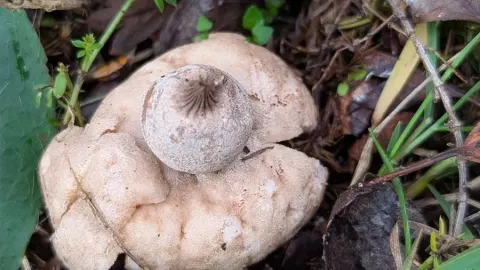
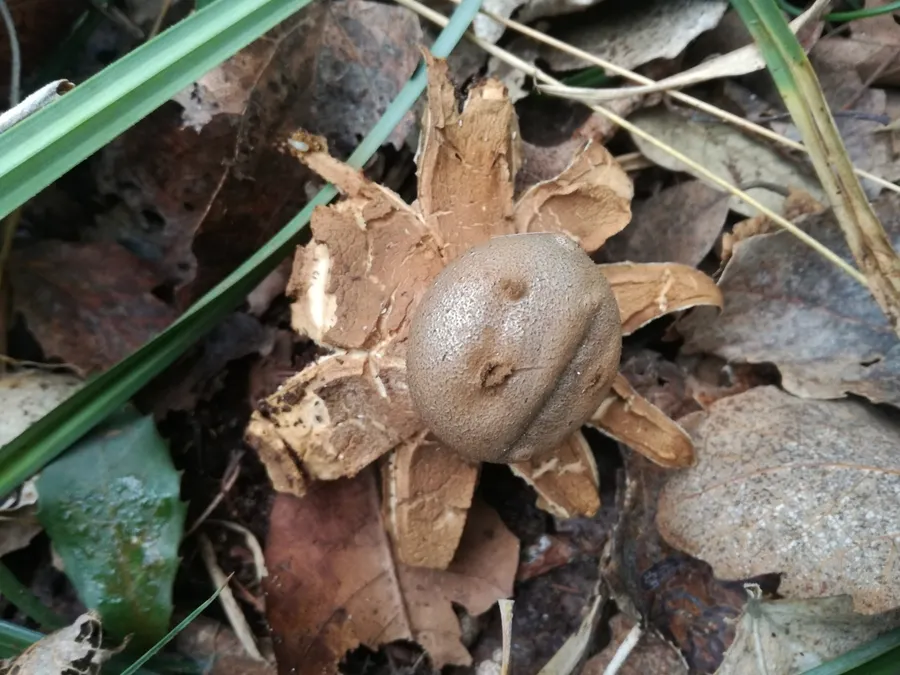
The fruit bodies start their development underground or buried in leaf debris, linked to a strand of mycelium at the base. As they mature, the exoperidium (the outer tissue layer of the peridium) splits open into 7 to 14 rays which curve backward; this pushes the fruit body above the substrate. Fully opened specimens can reach dimensions of 2-12 cm from ray tip to tip. The rays are of unequal size, with tips that often roll back inward. They comprise three distinct layers of tissue. The inner pseudoparenchymatous layer (so named for the resemblance to the tightly packed cells of plant parenchyma) is fleshy and thick when fresh, and initially pale beige but darkening to yellow or brown as it matures, often cracking and peeling off in the process. The exterior mycelial layer, often matted with fine leaf debris or dirt, usually cracks to reveal a middle fibrous layer, which is made of densely packed hyphae 1–2.5 μm wide. The base of the fruit body is concave to vaulted and often covered with adhering dirt. The roughly spherical spore sac (endoperidium) measures 1-5 cm in diameter, and is supported by a cluster of short columns shaped like flattened spheres. It is grey-brown and minutely roughened with small (under 0.1 mm high), lightly interconnected warts. There are several to many evenly dispersed mouths, the ostioles, mainly on the upper half of the endoperidium. They are roughly circular with fimbriate edges. The inedible fruit bodies have no distinct taste, although dried specimens develop an odour resembling curry powder or bouillon cubes. Like earthstars, the fungus uses the force of falling raindrops to help disperse the spores, which are ejected in little bursts when objects (such as rain) strike the outer wall of the spore sac.

Sebagian uraian ditampilkan dalam bahasa sumber; terjemahannya belum tersedia atau belum lolos pemeriksaan.

Rujukan: [1]

Pengukuran mengikuti objek, spesimen atau kultur, dan metode yang disebutkan sumber. Baca uraian asli untuk konteks lengkap.

02 / Kehidupan

Habitat dan peran ekologis

Myriostoma coliforme adalah saprotrof, memperoleh nutrisi dari bahan organik yang membusuk. Fruit bodies tumbuh dikelompokkan di tanah yang kering atau berpasir, seringkali di bawah bayangan pohon. The species occurs in deciduous forests and mixed forests, gardens, along hedges and grassy road banks, and grazed grasslands. Ia cenderung tumbuh di lereng yang berlubang yang berlawanan dengan selatan. Di Eropa, habitat utama adalah hutan campuran tepi pantai yang didominasi oleh Salix alba dan Populus alba di sepanjang sungai-sungai besar. Di Hawaii, telah dikumpulkan di ketinggian di atas 2000 m di mana tampaknya mendukung hutan mamane (Sophora chrysophylla) Spesies ini tersebar luas di wilayah berangin utara. It is rare in Europe, where it appears on the Regional Red Lists of 12 countries, and is one of 33 candidate species for listing in Appendix I of the Convention on the Conservation of European Wildlife and Natural Habitats (the "Bern Convention"). Although originally dijelaskan dari Inggris, dianggap punah di daratan Britain until ditemukan lagi di Suffolk in 2006 dekat Ipswich, salah satu lokasinya asli; terakhir dilaporkan di negara itu pada 1880. Jamur ini dianggap punah di Swiss. Lokasinya yang paling utara adalah Swedia selatan, meskipun umumnya jarang terjadi di Eropa utara.

Sebagian uraian ditampilkan dalam bahasa sumber; terjemahannya belum tersedia atau belum lolos pemeriksaan.

Rujukan: [1]

Habitat atau konteks temuan
hutan
Substrat
Informasi belum tersedia pada sumber rilis ini.
Peran atau konteks
Pengurai
Temukan hubungan serupa
03 / Siklus hidup

Reproduksi

The fruit bodies start their development underground or buried in leaf debris, linked to a strand of mycelium at the base. As they mature, the exoperidium (the outer tissue layer of the peridium) splits open into 7 to 14 rays which curve backward; this pushes the fruit body above the substrate. Fully opened specimens can reach dimensions of 2-12 cm from ray tip to tip. The rays are of unequal size, with tips that often roll back inward. They comprise three distinct layers of tissue. The inner pseudoparenchymatous layer (so named for the resemblance to the tightly packed cells of plant parenchyma) is fleshy and thick when fresh, and initially pale beige but darkening to yellow or brown as it matures, often cracking and peeling off in the process.

Sebagian uraian ditampilkan dalam bahasa sumber; terjemahannya belum tersedia atau belum lolos pemeriksaan.

Rujukan: [1]

Sinonim menurut acuan taksonomi rilis: Geastrum coliforme; Geastrum hygrometricum var. coliforme; Myriostoma anglicum; Polystoma coliforme
04 / Batas informasi

Catatan identitas dan cakupan

  • Nama diterima mengikuti Catalogue of Life Base2026-09-11; uraian mempertahankan konsep dan nama sumber aslinya.
  • Original geographic, specimen and life-cycle scope retained; source import awaits individual editorial review.
  • Impor dan terjemahan otomatis belum diperiksa editorial per profil. Struktur reproduktif yang disebutkan tidak membuktikan seluruh siklus hidup diketahui.
  • Pengukuran pada uraian mengikuti spesimen, kultur, dan metode sumber; angka tidak diperluas ke semua populasi.

Catatan distribusi dalam narasi mengikuti sumbernya. Dokumentasi spesimen atau foto mengikuti catatan sumber. Bukti wilayah Indonesia dan penilaian konservasi tidak disimpulkan dari gambar.

05 / Dokumentasi

Melihat dengan konteks

Dokumentasi Myriostoma coliforme menurut asosiasi foto pada record takson iNaturalist. Kredit: Davide Puddu. Identitas mengikuti sumber; bukan penentuan spesimen independen.

Jenis
Fotografi
Kredit
(c) Davide Puddu, some rights reserved (CC BY), uploaded by Davide Puddu
Lisensi
CC BY 4.0
Sumber media
Buka entri sumber

Gambar menunjukkan objek menurut identifikasi sumber, bukan verifikasi independen spesimen oleh Fungi. Tidak ada skala baru yang ditambahkan.

06 / Rujukan

Sumber profil

  1. [1] Myriostoma coliforme — Wikipedia (en)Bagian sumber: Frozen revision 1321666648
    Tanggal penghimpunan sumber: 2026-10-12
    Teks sumber: CC BY-SA4.0 · Wikipedia contributors
  2. [2] Catalogue of Life Base2026-09-11 — Myriostoma coliformeBagian sumber: ColDP NameUsage.tsv ID 4597T; accepted species; source 2073
    Tanggal penghimpunan sumber: 2026-10-12
  3. [3] Dokumentasi visual — Myriostoma coliformeBagian sumber: Individual media record; identification follows the source, not independent determination
    Tanggal penghimpunan sumber: 2026-10-12
    Media sumber: CC BY 4.0 · (c) Davide Puddu, some rights reserved (CC BY), uploaded by Davide Puddu

Adaptasi teks: CC BY-SA 4.0. Wikipedia contributors — Myriostoma coliforme — Wikipedia (en)

Uraian asli dan riwayat sumber

Riwayat atau halaman sumber

Ringkasan sumber

{{Speciesbox The fungus has a north temperate distribution, but was formerly thought to be more widespread due to confusion with related Myriostoma species. It is an uncommon species and appears on the Red Lists of 12 European countries. In 2004 it was one of 33 species proposed for protection under the Bern Convention by the European Council for Conservation of Fungi.

Revisi sumber

Morfologi sumber

The fruit bodies start their development underground or buried in leaf debris, linked to a strand of mycelium at the base. As they mature, the exoperidium (the outer tissue layer of the peridium) splits open into 7 to 14 rays which curve backward; this pushes the fruit body above the substrate. Fully opened specimens can reach dimensions of 2-12 cm from ray tip to tip. The rays are of unequal size, with tips that often roll back inward. They comprise three distinct layers of tissue. The inner pseudoparenchymatous layer (so named for the resemblance to the tightly packed cells of plant parenchyma) is fleshy and thick when fresh, and initially pale beige but darkening to yellow or brown as it matures, often cracking and peeling off in the process. The exterior mycelial layer, often matted with fine leaf debris or dirt, usually cracks to reveal a middle fibrous layer, which is made of densely packed hyphae 1–2.5 μm wide. The base of the fruit body is concave to vaulted and often covered with adhering dirt. The roughly spherical spore sac (endoperidium) measures 1-5 cm in diameter, and is supported by a cluster of short columns shaped like flattened spheres. It is grey-brown and minutely roughened with small (under 0.1 mm high), lightly interconnected warts. There are several to many evenly dispersed mouths, the ostioles, mainly on the upper half of the endoperidium. They are roughly circular with fimbriate edges. The inedible fruit bodies have no distinct taste, although dried specimens develop an odour resembling curry powder or bouillon cubes. Like earthstars, the fungus uses the force of falling raindrops to help disperse the spores, which are ejected in little bursts when objects (such as rain) strike the outer wall of the spore sac.

Revisi sumber

Ekologi sumber

Myriostoma coliforme is saprotrophic, deriving nutrients from decomposing organic matter. Fruit bodies grow grouped in well-drained or sandy soil, often in the partial shade of trees. The species occurs in deciduous forests and mixed forests, gardens, along hedges and grassy road banks, and grazed grasslands. It tends to grow on well-drained south-facing slopes. In Europe, its major habitat is riparian mixed forests dominated by Salix alba and Populus alba along the great rivers. In Hawaii, it has been collected at elevations above 2000 m where it appears to favour the mamane (Sophora chrysophylla) forest. The species is widespread in north temperate regions. It is rare in Europe, where it appears on the Regional Red Lists of 12 countries, and is one of 33 candidate species for listing in Appendix I of the Convention on the Conservation of European Wildlife and Natural Habitats (the "Bern Convention"). Although originally described from England, it was considered extinct in mainland Britain until it was found again in Suffolk in 2006 near Ipswich, one of its original localities; it had been last reported in the country in 1880. The fungus is considered extinct in Switzerland. Its most northerly location is southern Sweden, although it is generally rare in northern Europe.

Revisi sumber

Struktur reproduksi sumber

The fruit bodies start their development underground or buried in leaf debris, linked to a strand of mycelium at the base. As they mature, the exoperidium (the outer tissue layer of the peridium) splits open into 7 to 14 rays which curve backward; this pushes the fruit body above the substrate. Fully opened specimens can reach dimensions of 2-12 cm from ray tip to tip. The rays are of unequal size, with tips that often roll back inward. They comprise three distinct layers of tissue. The inner pseudoparenchymatous layer (so named for the resemblance to the tightly packed cells of plant parenchyma) is fleshy and thick when fresh, and initially pale beige but darkening to yellow or brown as it matures, often cracking and peeling off in the process.

Revisi sumber

Rujukan halaman ini

Fungi. Myriostoma coliforme. Rilis data fungi-2026-10-12-expansion-2. https://fungi-atlas.mgadib.chatgpt.site/jamur/myriostoma-coliforme/.

Status: impor sumber; pemeriksaan editorial per profil belum selesai. Untuk klaim biologis, gunakan rujukan pada bagian terkait dan periksa konteks sumber aslinya.