Ciri dan struktur
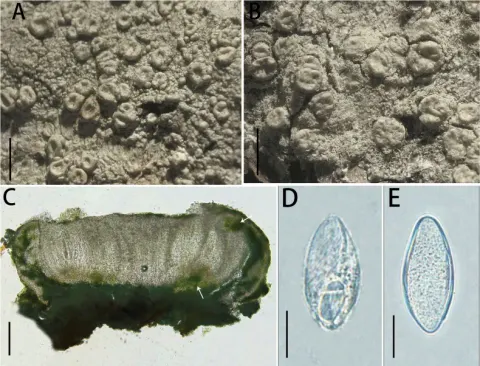
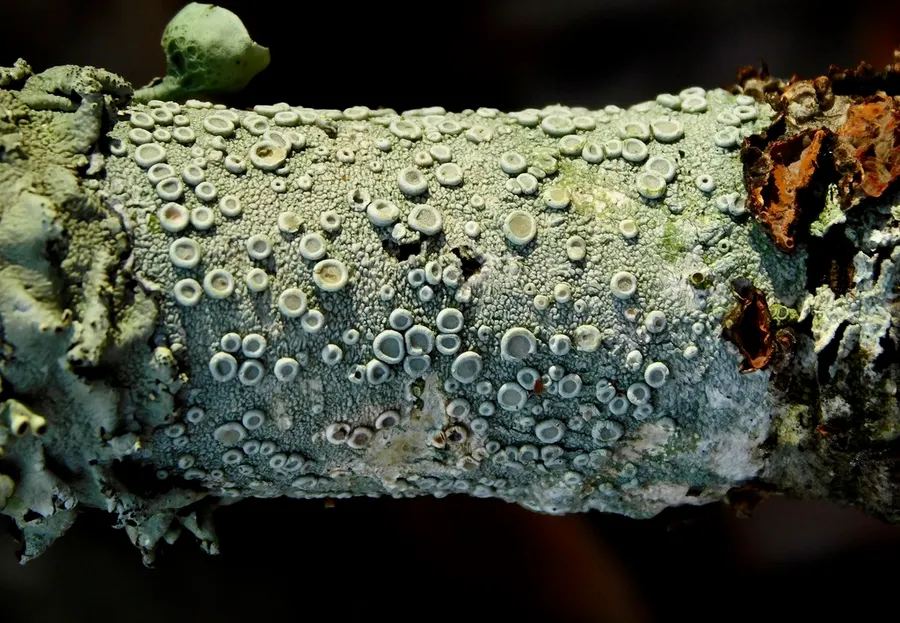
Ochrolechia africana has a crustose, yellowish-grey to gray thallus with a surface texture ranging from smooth to warted (verruculose or verrucose). The apothecia tend to be under 1.5 mm in diameter, and have thick margins; they are often covered with a "frosty"-looking pruina, although there are forms that lack pruina. The algal layer makes an almost complete layer under the hypothecium, forming abundant but discontinuous clumps. The ascospores measure 43–67 by 18–30 μm. Ochrolechia africana contains several secondary chemicals: the orcinol depsides gyrophoric acid, lecanoric acid, 5-methyl-O-methylhiascic acid, 4,5-di-O-methylhiascic acid, and the xanthone lichexanthone. It is this latter compound that causes the lichen to fluoresce bright yellow when shone with a UV light. The Chinese alpine species Ochrolechia alticola is somewhat similar in appearance to O. africana, but differs in the C+ red reaction of the apothecial margin cortex, the absence of 5-O-methylhiascic acid, as well as its habitat.
Habitat dan peran ekologis
Ochrolechia africana is a widely distributed species, found in tropical and subtropical areas of southern Africa, Asia, Australia, North America, and South America. Reported as new to China in 2013, it is one of about 25 Ochrolechia species known to occur in that country. It typically grows on both the wood and bark of deciduous trees, although it has also been recorded growing on rocks. Irwin Brodo and James Lendemer reported on an atypical population of Ochrolechia africana they found in the Coastal Plain of southeastern North America; these lichens were sorediate and fertile, rather than the typical asorediate and fertile population that was expected.
- Habitat atau konteks temuan
- Informasi belum tersedia pada sumber rilis ini.
- Substrat
- Informasi belum tersedia pada sumber rilis ini.
- Peran atau konteks
- Pembentuk liken
Reproduksi
Ochrolechia africana has a crustose, yellowish-grey to gray thallus with a surface texture ranging from smooth to warted (verruculose or verrucose). The apothecia tend to be under 1.5 mm in diameter, and have thick margins; they are often covered with a "frosty"-looking pruina, although there are forms that lack pruina. The algal layer makes an almost complete layer under the hypothecium, forming abundant but discontinuous clumps. The ascospores measure 43–67 by 18–30 μm.
Catatan identitas dan cakupan
- Nama diterima mengikuti Catalogue of Life Base2026-09-11; uraian mempertahankan konsep dan nama sumber aslinya.
- Original geographic, specimen and life-cycle scope retained; source import awaits individual editorial review.
- Impor dan terjemahan otomatis belum diperiksa editorial per profil. Struktur reproduktif yang disebutkan tidak membuktikan seluruh siklus hidup diketahui.
- Pengukuran pada uraian mengikuti spesimen, kultur, dan metode sumber; angka tidak diperluas ke semua populasi.
Catatan distribusi dalam narasi mengikuti sumbernya. Dokumentasi spesimen atau foto mengikuti catatan sumber. Bukti wilayah Indonesia dan penilaian konservasi tidak disimpulkan dari gambar.
Melihat dengan konteks
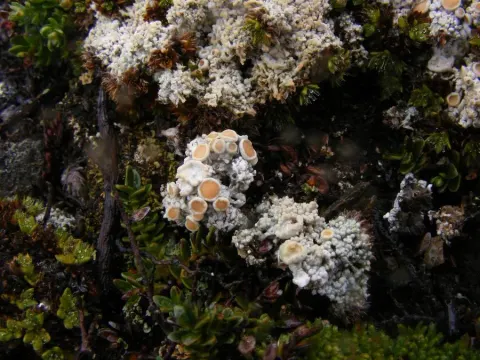
Dokumentasi Ochrolechia africana menurut asosiasi foto pada record takson iNaturalist. Kredit: Michael J. Papay. Identitas mengikuti sumber; bukan penentuan spesimen independen.
- Jenis
- Fotografi
- Kredit
- (c) Michael J. Papay, some rights reserved (CC BY), uploaded by Michael J. Papay
- Lisensi
- CC BY 4.0
- Sumber media
- Buka entri sumber
Dokumentasi tambahan
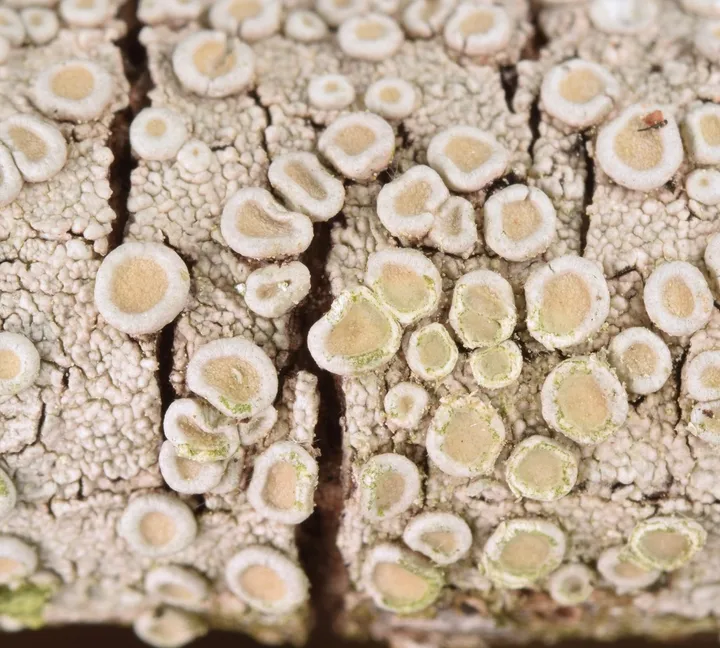
Foto yang diasosiasikan dengan Ochrolechia africana pada iNaturalist. Identifikasi mengikuti sumber; bukan penentuan spesimen independen.
Kredit dan penggunaan
(c) skitterbug, some rights reserved (CC BY), uploaded by skitterbug
Ukuran dan format gambar disesuaikan tanpa pemotongan, retus, atau penambahan skala. Lisensi sumber dipertahankan.
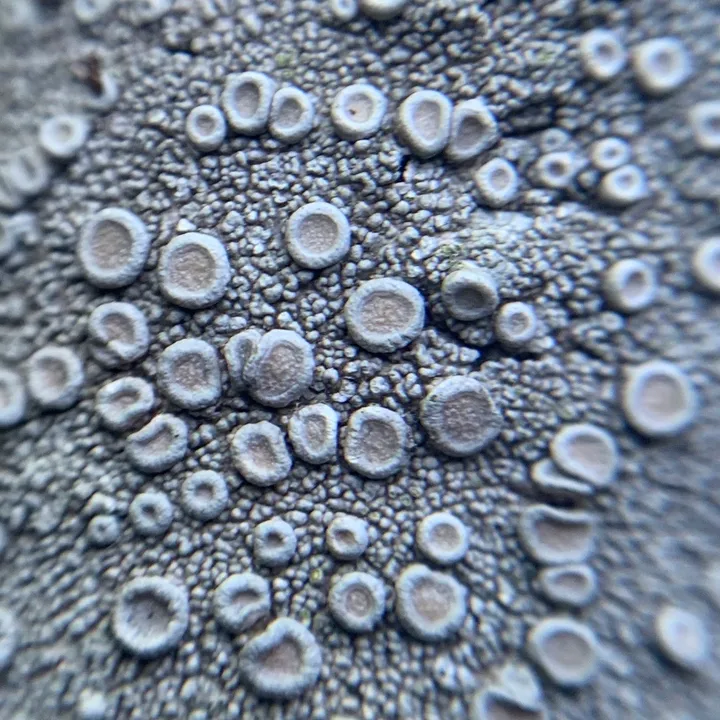
Foto yang diasosiasikan dengan Ochrolechia africana pada iNaturalist. Identifikasi mengikuti sumber; bukan penentuan spesimen independen.
Kredit dan penggunaan
(c) Neal Kelso, some rights reserved (CC BY), uploaded by Neal Kelso
Ukuran dan format gambar disesuaikan tanpa pemotongan, retus, atau penambahan skala. Lisensi sumber dipertahankan.
Sumber profil
- [1] Ochrolechia africana — Wikipedia (en)
- [2] Catalogue of Life Base2026-09-11 — Ochrolechia africana
- [3] Dokumentasi visual — Ochrolechia africana
- [4] Dokumentasi visual — Ochrolechia africana
- [5] Dokumentasi visual — Ochrolechia africana
Rujukan halaman ini
Fungi. Ochrolechia africana. Rilis data fungi-2026-10-12-expansion-2. https://fungi-atlas.mgadib.chatgpt.site/jamur/ochrolechia-africana/.
Status: impor sumber; pemeriksaan editorial per profil belum selesai. Untuk klaim biologis, gunakan rujukan pada bagian terkait dan periksa konteks sumber aslinya.