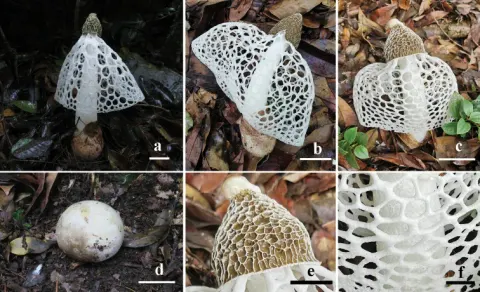
Ciri dan struktur
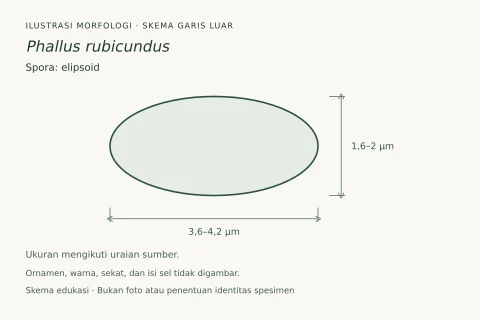
(designated here): BRAZIL. Pará: Belterra, Floresta Nacional do Tapajós, Jamaraqua Community (2.812667S, 55.033083W), 25 March 2014, Cabral TS (INPA-Fungos 264931). GenBank accessions: MG678500, MG678501, MG678502 (ITS); MG678463 (nuc-LSU); MG678550 (atp 6). Immature basidiomes not observed. Fresh expanded basidiome 120 mm high. Receptacle 25 × 25 mm, campanulate, with an apical pore, reticulated surface. Pseudostipe 67 × 12 mm, cylindrical, spongy, white (N 00 A 00 M 00); pseudoparenchymatous, composed of globose to elongate-ovoid cells, 29.5–56.8 × 17.2–44 µm, hyaline. Indusium in full development extending to the ground, white (N 00 A 00 M 00), 74 mm in length, attached to the apex of the pseudostipe; polygonal to rounded meshes up to 7 × 4 mm, composed of pseudoparenchymatous cells, 31–53.8 × 23.8–41 µm. Volva hypogeous, white (N 00 A 00 M 0), with pinkish pigments (N 00 M 10 C 00); outer layer papery, composed of filamentous hyphae, 3.22–6.5 µm, yellowish, septate, with clamp connections; crystal deposits in globose cells distributed amongst the hyphae, 11.5–13.8 × 19.6–22.7 μm. Rhizomorphs composed of filamentous thin-walled hyphae, with clamp connections. Gleba olive-brown (N 99 A 50 M 10), mucilaginous. Basidiospores elongated, smooth, 3.6–4.1 × 1.5–2.2 µm, hyaline in 5% KOH. BRAZIL. Pará: Belterra, Floresta Nacional do Tapajós, Jamaraqua Community (2.812667S, 55.033083W), 25 March 2014, Cabral TS (INPA-Fungos 264929, INPA-Fungos 264930); São Paulo, Parque Estadual das Fontes do Ipiranga (23.54S, 46.63W), January 2011, Oliveira, J.J.S. (SP416389); March 2011, Ventura, P.O. (SP416393); Capelari, M. (SP416087).
Habitat dan peran ekologis
found on sandy soil, in dense old-growth forest. It has a questionable circum-tropical distribution, with records for South and Central America, Mexico, Africa, Asia and Australia, but we believe that the distribution is restricted to South America.
- Habitat atau konteks temuan
- hutan
- Substrat
- Informasi belum tersedia pada sumber rilis ini.
- Peran atau konteks
- Belum dikategorikan pada rilis ini.
Reproduksi
(designated here): BRAZIL. Pará: Belterra, Floresta Nacional do Tapajós, Jamaraqua Community (2.812667S, 55.033083W), 25 March 2014, Cabral TS (INPA-Fungos 264931). GenBank accessions: MG678500, MG678501, MG678502 (ITS); MG678463 (nuc-LSU); MG678550 (atp 6). Immature basidiomes not observed. Fresh expanded basidiome 120 mm high. Receptacle 25 × 25 mm, campanulate, with an apical pore, reticulated surface. Pseudostipe 67 × 12 mm, cylindrical, spongy, white (N 00 A 00 M 00); pseudoparenchymatous, composed of globose to elongate-ovoid cells, 29.5–56.8 × 17.2–44 µm, hyaline. Indusium in full development extending to the ground, white (N 00 A 00 M 00), 74 mm in length, attached to the apex of the pseudostipe; polygonal to rounded meshes up to 7 × 4 mm, composed of pseudoparenchymatous cells, 31–53.8 × 23.8–41 µm.
Catatan identitas dan cakupan
- Nama diterima mengikuti Catalogue of Life Base2026-09-11; uraian mempertahankan konsep dan nama sumber aslinya.
- Preserve original treatment localities, hosts and substrate scope. Materials examined describe documented specimens, not the full global range.
- Impor dan terjemahan otomatis belum diperiksa editorial per profil. Struktur reproduktif yang disebutkan tidak membuktikan seluruh siklus hidup diketahui.
- Pengukuran pada uraian mengikuti spesimen, kultur, dan metode sumber; angka tidak diperluas ke semua populasi.
Catatan distribusi dalam narasi mengikuti sumbernya. Dokumentasi spesimen atau foto mengikuti catatan sumber. Bukti wilayah Indonesia dan penilaian konservasi tidak disimpulkan dari gambar.
Melihat dengan konteks
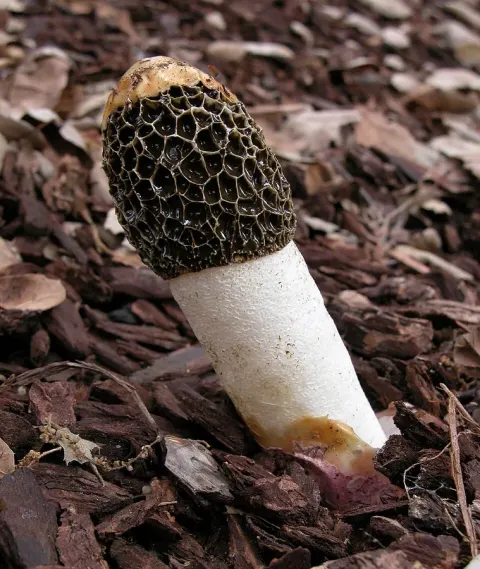
Dokumentasi Phallus indusiatus menurut asosiasi foto pada record takson iNaturalist. Kredit: Donald Hobern. Identitas mengikuti sumber; bukan penentuan spesimen independen.
- Jenis
- Fotografi
- Kredit
- (c) Donald Hobern, some rights reserved (CC BY)
- Lisensi
- CC BY 4.0
- Sumber media
- Buka entri sumber
Dokumentasi tambahan
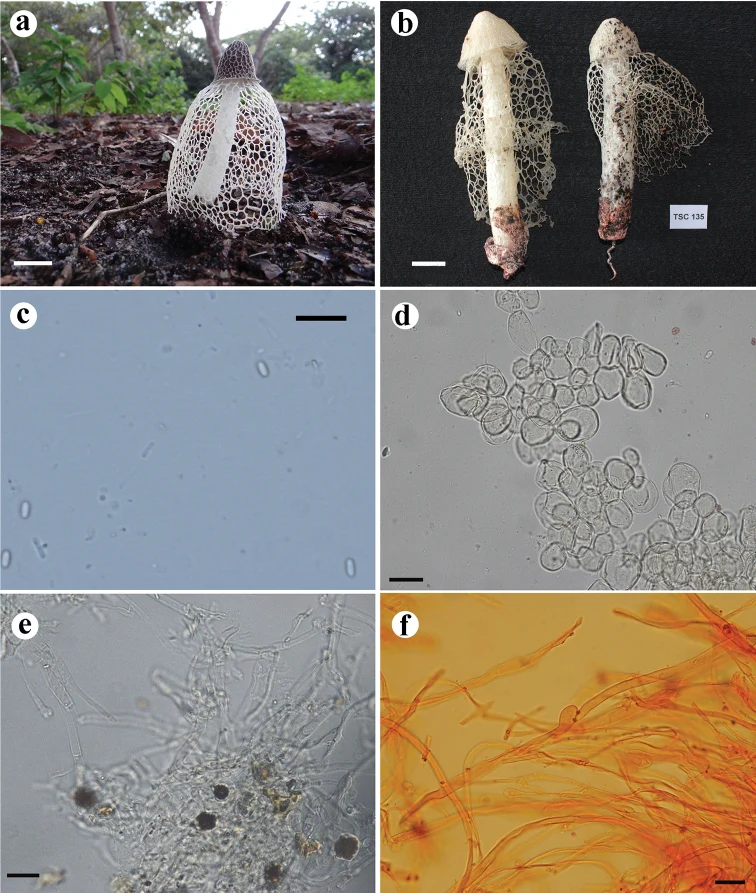
Phallus indusiatus. Fresh basidiome of A INPA-Fungos 264931 (neotype), and B INPA-Fungos 264929, showing the volva with pinkish pigments C spores D pseudoparenchymatous hyphae from pseudostipe E hyphae from volva and crystals deposits on globose cells F hyphae from rhizomorphs. Scale bars: 20 mm (A, B); 10 µm (C); 40 µm (D); 20 µm (E, F).
Kredit dan penggunaan
Tiara S. Cabral, Bianca DB. Silva, María P. Martín, Charles R. Clement, Kentaro Hosaka, Iuri G. Baseia
Ukuran dan format gambar disesuaikan tanpa pemotongan, retus, atau penambahan skala. Lisensi sumber dipertahankan.
Sumber profil
- [1] Behind the veil – exploring the diversity in Phallus indusiatus s.l. (Phallomycetidae, Basidiomycota) — Phallus indusiatus
- [2] Catalogue of Life Base2026-09-11 — Phallus indusiatus
- [3] Dokumentasi visual — Phallus indusiatus
- [4] Dokumentasi visual — Phallus indusiatus
Rujukan halaman ini
Fungi. Phallus indusiatus. Rilis data fungi-2026-10-12-expansion-2. https://fungi-atlas.mgadib.chatgpt.site/jamur/phallus-indusiatus/.
Status: impor sumber; pemeriksaan editorial per profil belum selesai. Untuk klaim biologis, gunakan rujukan pada bagian terkait dan periksa konteks sumber aslinya.