01 / Morfologi

Ciri dan struktur

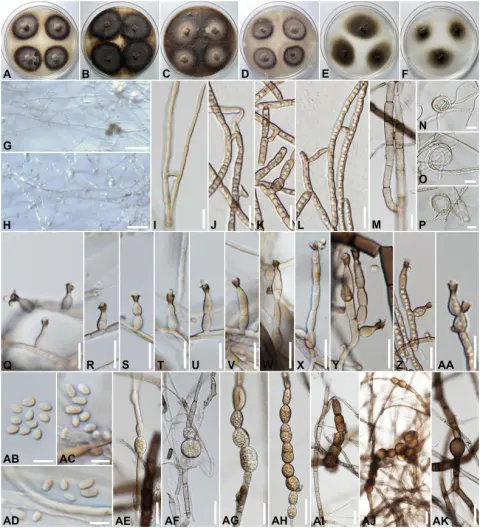
Phialophora verrucosa produces vase-shaped phialides with dark brown, cup-shaped collarettes. Each phialide is typically 3–4 μm wide and 4–7 μm long. Teardrop-shaped, smooth-walled conidia are formed at the apices of the collarettes and accumulate in clusters. Conidia are typically 2.5–4 μm by 1.5 3 μm in size. Hyphae are brown, cylindrical, and septate and are composed of thick-walled cells. The hyphae do not produce conidia.P. verrucosa grows well over a range of temperatures, 21-37 C with an optimal growth temperature of 30 C. Colonies grow slowly on oxalic acid and malt extract agar. Grown on Sabouraud's agar at 3 C, the colony attains a diameter of 3–4 cm after 2 weeks incubation.

Sebagian uraian ditampilkan dalam bahasa sumber; terjemahannya belum tersedia atau belum lolos pemeriksaan.

Rujukan: [1]

Pengukuran mengikuti objek, spesimen atau kultur, dan metode yang disebutkan sumber. Baca uraian asli untuk konteks lengkap.

02 / Kehidupan

Habitat dan peran ekologis

Although P. verrucosa was originally discovered in human tissue, it is known to occur naturally in soil, plant debris, wasp nests, and rotting wood. In a study where multiple strains of P. verrucosa were found growing in rotting wood, soil, and the bark and log of pine trees in Japan, it was found that these isolates from the natural environment had no distinct differences from P. verrucosa isolated from human tissue. P. verrucosa is widespread and can be found in Africa, Asia, Australia, North and South America, and Europe. Most strains of P. verrucosa available in culture collections are derived from human mycoses.

Sebagian uraian ditampilkan dalam bahasa sumber; terjemahannya belum tersedia atau belum lolos pemeriksaan.

Rujukan: [1]

Habitat atau konteks temuan
kultur yang didokumentasikan
Substrat
tanah
Peran atau konteks
Belum dikategorikan pada rilis ini.
Temukan hubungan serupa
03 / Siklus hidup

Reproduksi

Phialophora verrucosa produces vase-shaped phialides with dark brown, cup-shaped collarettes. Each phialide is typically 3–4 μm wide and 4–7 μm long. Teardrop-shaped, smooth-walled conidia are formed at the apices of the collarettes and accumulate in clusters. Conidia are typically 2.5–4 μm by 1.5 3 μm in size. Hyphae are brown, cylindrical, and septate and are composed of thick-walled cells. The hyphae do not produce conidia.P. verrucosa grows well over a range of temperatures, 21-37 C with an optimal growth temperature of 30 C. Colonies grow slowly on oxalic acid and malt extract agar. Grown on Sabouraud's agar at 3 C, the colony attains a diameter of 3–4 cm after 2 weeks incubation.

Sebagian uraian ditampilkan dalam bahasa sumber; terjemahannya belum tersedia atau belum lolos pemeriksaan.

Rujukan: [1]

Sinonim menurut acuan taksonomi rilis: Cadophora americana; Fonsecaea pedrosoi var. phialophora; Phialophora americana
04 / Batas informasi

Catatan identitas dan cakupan

  • Nama diterima mengikuti Catalogue of Life Base2026-09-11; uraian mempertahankan konsep dan nama sumber aslinya.
  • Original geographic, specimen and life-cycle scope retained; source import awaits individual editorial review.
  • Impor dan terjemahan otomatis belum diperiksa editorial per profil. Struktur reproduktif yang disebutkan tidak membuktikan seluruh siklus hidup diketahui.
  • Pengukuran pada uraian mengikuti spesimen, kultur, dan metode sumber; angka tidak diperluas ke semua populasi.

Catatan distribusi dalam narasi mengikuti sumbernya. Dokumentasi spesimen atau foto mengikuti catatan sumber. Bukti wilayah Indonesia dan penilaian konservasi tidak disimpulkan dari gambar.

05 / Dokumentasi

Melihat dengan konteks

Dokumentasi visual yang memenuhi pemeriksaan subjek dan hak penggunaan belum tersedia. Foto gejala, label, dan gambar yang meragukan tidak dihitung.

06 / Rujukan

Sumber profil

  1. [1] Phialophora verrucosa — Wikipedia (en)Bagian sumber: Frozen revision 1373766847
    Tanggal penghimpunan sumber: 2026-10-12
    Teks sumber: CC BY-SA4.0 · Wikipedia contributors
  2. [2] Catalogue of Life Base2026-09-11 — Phialophora verrucosaBagian sumber: ColDP NameUsage.tsv ID 4G475; accepted species; source 2073
    Tanggal penghimpunan sumber: 2026-10-12

Adaptasi teks: CC BY-SA 4.0. Wikipedia contributors — Phialophora verrucosa — Wikipedia (en)

Uraian asli dan riwayat sumber

Riwayat atau halaman sumber

Ringkasan sumber

Phialophora verrucosa is a pathogenic, dematiaceous fungus that is a common cause of chromoblastomycosis. It has also been reported to cause subcutaneous phaeohyphomycosis and mycetoma in very rare cases. In the natural environment, it can be found in rotting wood, soil, wasp nests, and plant debris. P. verrucosa is sometimes referred to as Phialophora americana, a closely related environmental species which, along with P. verrucosa, is also categorized in the P. carrionii clade.

Revisi sumber

Morfologi sumber

Phialophora verrucosa produces vase-shaped phialides with dark brown, cup-shaped collarettes. Each phialide is typically 3–4 μm wide and 4–7 μm long. Teardrop-shaped, smooth-walled conidia are formed at the apices of the collarettes and accumulate in clusters. Conidia are typically 2.5–4 μm by 1.5 3 μm in size. Hyphae are brown, cylindrical, and septate and are composed of thick-walled cells. The hyphae do not produce conidia.P. verrucosa grows well over a range of temperatures, 21-37 C with an optimal growth temperature of 30 C. Colonies grow slowly on oxalic acid and malt extract agar. Grown on Sabouraud's agar at 3 C, the colony attains a diameter of 3–4 cm after 2 weeks incubation.

Revisi sumber

Ekologi sumber

Although P. verrucosa was originally discovered in human tissue, it is known to occur naturally in soil, plant debris, wasp nests, and rotting wood. In a study where multiple strains of P. verrucosa were found growing in rotting wood, soil, and the bark and log of pine trees in Japan, it was found that these isolates from the natural environment had no distinct differences from P. verrucosa isolated from human tissue. P. verrucosa is widespread and can be found in Africa, Asia, Australia, North and South America, and Europe. Most strains of P. verrucosa available in culture collections are derived from human mycoses.

Revisi sumber

Struktur reproduksi sumber

Phialophora verrucosa produces vase-shaped phialides with dark brown, cup-shaped collarettes. Each phialide is typically 3–4 μm wide and 4–7 μm long. Teardrop-shaped, smooth-walled conidia are formed at the apices of the collarettes and accumulate in clusters. Conidia are typically 2.5–4 μm by 1.5 3 μm in size. Hyphae are brown, cylindrical, and septate and are composed of thick-walled cells. The hyphae do not produce conidia.P. verrucosa grows well over a range of temperatures, 21-37 C with an optimal growth temperature of 30 C. Colonies grow slowly on oxalic acid and malt extract agar. Grown on Sabouraud's agar at 3 C, the colony attains a diameter of 3–4 cm after 2 weeks incubation.

Revisi sumber

Rujukan halaman ini

Fungi. Phialophora verrucosa. Rilis data fungi-2026-10-12-expansion-2. https://fungi-atlas.mgadib.chatgpt.site/jamur/phialophora-verrucosa/.

Status: impor sumber; pemeriksaan editorial per profil belum selesai. Untuk klaim biologis, gunakan rujukan pada bagian terkait dan periksa konteks sumber aslinya.