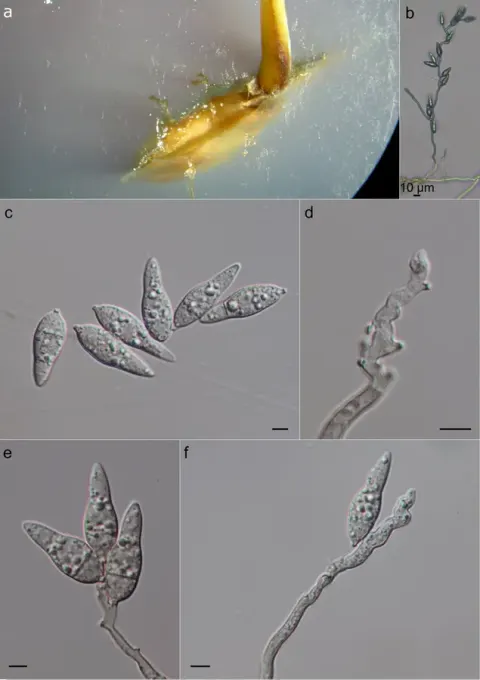
Ciri dan struktur
M. grisea is an ascomycete fungus. It is an extremely effective plant pathogen as it can reproduce both sexually and asexually to produce specialized infectious structures, appressoria, that infect aerial tissues and hyphae that can infect root tissues. The pathogen infects as a spore that produces lesions or spots on parts of the rice plant such as the leaf, leaf collar, panicle, culm and culm nodes. Using a structure called an appressorium, the pathogen penetrates the plant. The appressorium cell wall is chitinous and its inner side contains melanin. The pathogen is able to move between the plant cells using its invasive hyphae to enter through plasmodesmata. M. grisea then sporulates from the diseased rice tissue to be dispersed as conidiospores. After overwintering in sources such as rice straw and stubble, the cycle repeats. A single cycle can be completed in about a week under favorable conditions where one lesion can generate up to thousands of spores in a single night. Disease lesions, however, can appear in three to four days after infection. With the ability to continue to produce the spores for over 20 days, rice blast lesions can be devastating to susceptible rice crops. Rice blast is a significant problem in temperate regions and can be found in areas such as irrigated lowland and upland. Conditions conducive for rice blast include long periods of free moisture and/or high humidity, because leaf wetness is required for infection. Sporulation increases with high relative humidity and at 77 - 82 F, spore germination, lesion formation, and sporulation are at optimum levels.
Habitat dan peran ekologis
M. grisea adalah jamur askomycete. Ini adalah patogen tumbuhan yang sangat efektif karena dapat bereproduksi secara seksual dan asexual untuk menghasilkan struktur infeksi khusus, appressoria, yang menginfeksi jaringan udara dan hifa yang dapat menginfeksi jaringan akar. Rice blast has been observed on rice strains M-201, M-202, M-204, M-205, M-103, M-104, S-102, L-204, Calmochi-101, with M-201 being the most vulnerable. Initial symptoms adalah lesi putih hingga abu-abu atau bintik-bintik dengan batas yang lebih gelap yang dihasilkan di semua bagian tembakan, sementara lesi yang lebih tua adalah elips atau berbentuk spindle dan putih sampai abu-abu dengan batas nekrotik. Lesions may enlarge and coalesce to kill the entire leaf. Symptoms are diamati di semua bagian atas tanah dari tanaman. Lesions can terlihat pada kelengkeng daun, puncak, titik puncak, dan titik leher panik. Internodal infection puncak terjadi dalam pola terikat. Nodal infection menyebabkan puncak pecah pada node yang terinfeksi (kepalong busuk). Hal ini juga mempengaruhi reproduksi dengan menyebabkan inang menghasilkan lebih sedikit benih. Hal ini disebabkan oleh penyakit yang mencegah matangnya biji-bijian sebenarnya. Wheat blast was found in the 2017–2018 rainy season in Zambia, in the Mpika district of the Muchinga Province.
- Habitat atau konteks temuan
- Informasi belum tersedia pada sumber rilis ini.
- Substrat
- Informasi belum tersedia pada sumber rilis ini.
- Peran atau konteks
- Belum dikategorikan pada rilis ini.
Reproduksi
M. grisea is an ascomycete fungus. It is an extremely effective plant pathogen as it can reproduce both sexually and asexually to produce specialized infectious structures, appressoria, that infect aerial tissues and hyphae that can infect root tissues. Rice blast has been observed on rice strains M-201, M-202, M-204, M-205, M-103, M-104, S-102, L-204, Calmochi-101, with M-201 being the most vulnerable. Initial symptoms are white to gray-green lesions or spots with darker borders produced on all parts of the shoot, while older lesions are elliptical or spindle-shaped and whitish to gray with necrotic borders. Lesions may enlarge and coalesce to kill the entire leaf. Symptoms are observed on all above-ground parts of the plant.
Catatan identitas dan cakupan
- Nama diterima mengikuti Catalogue of Life Base2026-09-11; uraian mempertahankan konsep dan nama sumber aslinya.
- Original geographic, specimen and life-cycle scope retained; source import awaits individual editorial review.
- Impor dan terjemahan otomatis belum diperiksa editorial per profil. Struktur reproduktif yang disebutkan tidak membuktikan seluruh siklus hidup diketahui.
- Pengukuran pada uraian mengikuti spesimen, kultur, dan metode sumber; angka tidak diperluas ke semua populasi.
Catatan distribusi dalam narasi mengikuti sumbernya. Dokumentasi spesimen atau foto mengikuti catatan sumber. Bukti wilayah Indonesia dan penilaian konservasi tidak disimpulkan dari gambar.
Melihat dengan konteks
Dokumentasi visual yang memenuhi pemeriksaan subjek dan hak penggunaan belum tersedia. Foto gejala, label, dan gambar yang meragukan tidak dihitung.
Sumber profil
Rujukan halaman ini
Fungi. Pyricularia grisea. Rilis data fungi-2026-10-12-expansion-2. https://fungi-atlas.mgadib.chatgpt.site/jamur/pyricularia-grisea/.
Status: impor sumber; pemeriksaan editorial per profil belum selesai. Untuk klaim biologis, gunakan rujukan pada bagian terkait dan periksa konteks sumber aslinya.