01 / Morfologi

Ciri dan struktur

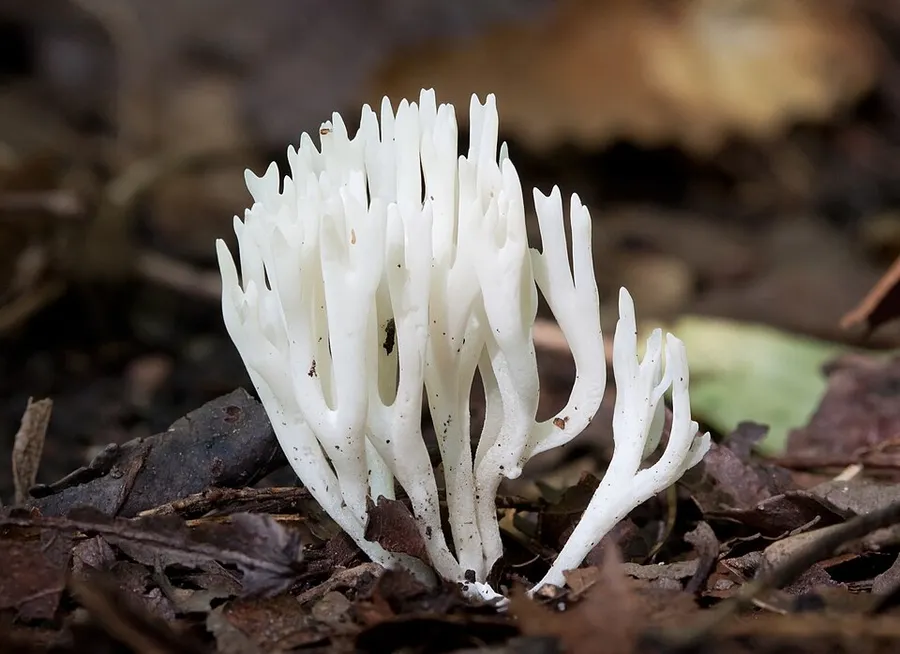
The fruit bodies are white to whitish-yellow in color, and are highly branched structures resembling coral; the dimensions are typically up to 8 cm tall and 6 cm wide. Older specimens may have a pinkish tinge. The tips of the branches are blunt, not crested as in some other species of coral fungi, like Clavulina cristata; branches are between 1 and 5 millimeters thick. The branch tips of mature specimens may be yellow. A stem, if present, may be up to 1 cm long and scurfy—covered with small flakes or scales. The texture of the flesh may range from pliable to brittle. The odor and taste are not distinctive. This mushroom does not change color upon bruising or injury, but a 10% solution of FeSO4 (a chemical test known as "iron salts") will turn it green. In deposit, the spores are white. Viewed with a light microscope, the spores are translucent and have an ellipsoid to roughly spherical shape with spines on the surface, and dimensions of 3–5.5 by 2.5–4.5 μm. Spores are non-amyloid, meaning that they do not absorb iodine when stained with Melzer's reagent. The spore-bearing cells, the basidia, are usually 25–45 μm long by 6–7 μm wide, and 4-spored. Clamp connections are present in the hyphae of this species.

Sebagian uraian ditampilkan dalam bahasa sumber; terjemahannya belum tersedia atau belum lolos pemeriksaan.

Rujukan: [1]

Pengukuran mengikuti objek, spesimen atau kultur, dan metode yang disebutkan sumber. Baca uraian asli untuk konteks lengkap.

02 / Kehidupan

Habitat dan peran ekologis

Spesies ini dianggap sebagai saprobik dan ditemukan tumbuh di tanah, di tanah, atau kurang sering di atas kayu yang sudah buruk. Fruit bodies dapat tumbuh secara individual, dalam kelompok, atau dikelompokkan bersama-sama. David Arora has noted a preference for growing under conifers, as well as a prevalence in redwood forests of North America. Sebaliknya, seorang penulis sebelumnya mengklaim spesies ini tumbuh "jarang di hutan konifer". Di Eropa, Ramariopsis kunzei telah dikumpulkan di Skotlandia (khususnya, di pulau Arran, Gigha and Kintyre peninsula), Belanda, Norwegia, bekas Ceko-Slovakia, Jerman, Polandia, dan Rusia (Gunung Zhiguli). Ia juga ditemukan di China, India, Iran, Kepulauan Solomon, dan Australia. Di Amerika Utara, distribusi ini membentang ke utara ke Kanada, dan mencakup Amerika Serikat (termasuk Hawaii and Puerto Rico).

Sebagian uraian ditampilkan dalam bahasa sumber; terjemahannya belum tersedia atau belum lolos pemeriksaan.

Rujukan: [1]

Habitat atau konteks temuan
hutan
Substrat
tanah
Peran atau konteks
Pengurai
Temukan hubungan serupa
03 / Siklus hidup

Reproduksi

In deposit, the spores are white. Viewed with a light microscope, the spores are translucent and have an ellipsoid to roughly spherical shape with spines on the surface, and dimensions of 3–5.5 by 2.5–4.5 μm. Spores are non-amyloid, meaning that they do not absorb iodine when stained with Melzer's reagent. The spore-bearing cells, the basidia, are usually 25–45 μm long by 6–7 μm wide, and 4-spored. Clamp connections are present in the hyphae of this species.

Sebagian uraian ditampilkan dalam bahasa sumber; terjemahannya belum tersedia atau belum lolos pemeriksaan.

Rujukan: [1]

Sinonim menurut acuan taksonomi rilis: Clavaria asperula; Clavaria asperulans; Clavaria chionea; Clavaria favreae; Clavaria krombholzii; Clavaria kunzei; Clavaria subcaespitosa; Clavaria subcorticalis; Clavaria velutina; Clavulina kunzei; Clavulinopsis kunzei; Lachnocladium subcorticale; Ramaria chionea; Ramaria favreae; Ramaria krombholzii; Ramaria kunzei; Ramariopsis kunzei var. deformis; Ramariopsis kunzei var. favreae; Ramariopsis kunzei var. megaspora; Ramariopsis kunzei var. subasperata; Ramariopsis kunzei var. sublaevispora
04 / Batas informasi

Catatan identitas dan cakupan

  • Nama diterima mengikuti Catalogue of Life Base2026-09-11; uraian mempertahankan konsep dan nama sumber aslinya.
  • Original geographic, specimen and life-cycle scope retained; source import awaits individual editorial review.
  • Impor dan terjemahan otomatis belum diperiksa editorial per profil. Struktur reproduktif yang disebutkan tidak membuktikan seluruh siklus hidup diketahui.
  • Pengukuran pada uraian mengikuti spesimen, kultur, dan metode sumber; angka tidak diperluas ke semua populasi.

Catatan distribusi dalam narasi mengikuti sumbernya. Dokumentasi spesimen atau foto mengikuti catatan sumber. Bukti wilayah Indonesia dan penilaian konservasi tidak disimpulkan dari gambar.

05 / Dokumentasi

Melihat dengan konteks

Dokumentasi Ramariopsis kunzei dari Wikimedia Commons. White coral fungi ( Ramariopsis kunzei ) at Great Smoky Mountains National Park. Focus stacked from two images. Identifikasi mengikuti record berkas sumber.

Jenis
Fotografi
Kredit
Ryan Kaldari
Sumber media
Buka entri sumber

Gambar menunjukkan objek menurut identifikasi sumber, bukan verifikasi independen spesimen oleh Fungi. Tidak ada skala baru yang ditambahkan.

06 / Rujukan

Sumber profil

  1. [1] Ramariopsis kunzei — Wikipedia (en)Bagian sumber: Frozen revision 1301187049
    Tanggal penghimpunan sumber: 2026-10-12
    Teks sumber: CC BY-SA4.0 · Wikipedia contributors
  2. [2] Catalogue of Life Base2026-09-11 — Ramariopsis kunzeiBagian sumber: ColDP NameUsage.tsv ID 4RBYJ; accepted species; source 2073
    Tanggal penghimpunan sumber: 2026-10-12
  3. [3] Dokumentasi visual — Ramariopsis kunzeiBagian sumber: Individual media record; identification follows the source, not independent determination
    Tanggal penghimpunan sumber: 2026-10-12
    Media sumber: Public domain · Ryan Kaldari

Adaptasi teks: CC BY-SA 4.0. Wikipedia contributors — Ramariopsis kunzei — Wikipedia (en)

Uraian asli dan riwayat sumber

Riwayat atau halaman sumber

Ringkasan sumber

The fruit bodies are white to whitish-yellow in color, and are highly branched structures resembling coral; the dimensions are typically up to 8 cm tall and 6 cm wide. Older specimens may have a pinkish tinge. The tips of the branches are blunt, not crested as in some other species of coral fungi, like Clavulina cristata; branches are between 1 and 5 millimeters thick. The branch tips of mature specimens may be yellow. A stem, if present, may be up to 1 cm long and scurfy—covered with small flakes or scales.

Revisi sumber

Morfologi sumber

The fruit bodies are white to whitish-yellow in color, and are highly branched structures resembling coral; the dimensions are typically up to 8 cm tall and 6 cm wide. Older specimens may have a pinkish tinge. The tips of the branches are blunt, not crested as in some other species of coral fungi, like Clavulina cristata; branches are between 1 and 5 millimeters thick. The branch tips of mature specimens may be yellow. A stem, if present, may be up to 1 cm long and scurfy—covered with small flakes or scales. The texture of the flesh may range from pliable to brittle. The odor and taste are not distinctive. This mushroom does not change color upon bruising or injury, but a 10% solution of FeSO4 (a chemical test known as "iron salts") will turn it green. In deposit, the spores are white. Viewed with a light microscope, the spores are translucent and have an ellipsoid to roughly spherical shape with spines on the surface, and dimensions of 3–5.5 by 2.5–4.5 μm. Spores are non-amyloid, meaning that they do not absorb iodine when stained with Melzer's reagent. The spore-bearing cells, the basidia, are usually 25–45 μm long by 6–7 μm wide, and 4-spored. Clamp connections are present in the hyphae of this species.

Revisi sumber

Ekologi sumber

The species is thought to be saprobic and is found growing on the ground, in duff, or less frequently on well-decayed wood. Fruit bodies may grow singly, in groups, or clustered together. David Arora has noted a preference for growing under conifers, as well as a prevalence in redwood forests of North America. In contrast, an earlier author claimed this species grows "rarely in coniferous woods." In Europe, Ramariopsis kunzei has been collected in Scotland (specifically, on the islands of Arran, Gigha and Kintyre peninsula), the Netherlands, Norway, former Czechoslovakia, Germany, Poland, and Russia (Zhiguli Mountains). It has also been found in China, India, Iran, the Solomon Islands, and Australia. In North America, the distribution extends north to Canada, and includes the United States (including Hawaii and Puerto Rico).

Revisi sumber

Struktur reproduksi sumber

In deposit, the spores are white. Viewed with a light microscope, the spores are translucent and have an ellipsoid to roughly spherical shape with spines on the surface, and dimensions of 3–5.5 by 2.5–4.5 μm. Spores are non-amyloid, meaning that they do not absorb iodine when stained with Melzer's reagent. The spore-bearing cells, the basidia, are usually 25–45 μm long by 6–7 μm wide, and 4-spored. Clamp connections are present in the hyphae of this species.

Revisi sumber

Rujukan halaman ini

Fungi. Ramariopsis kunzei. Rilis data fungi-2026-10-12-expansion-2. https://fungi-atlas.mgadib.chatgpt.site/jamur/ramariopsis-kunzei/.

Status: impor sumber; pemeriksaan editorial per profil belum selesai. Untuk klaim biologis, gunakan rujukan pada bagian terkait dan periksa konteks sumber aslinya.