01 / Morfologi

Ciri dan struktur

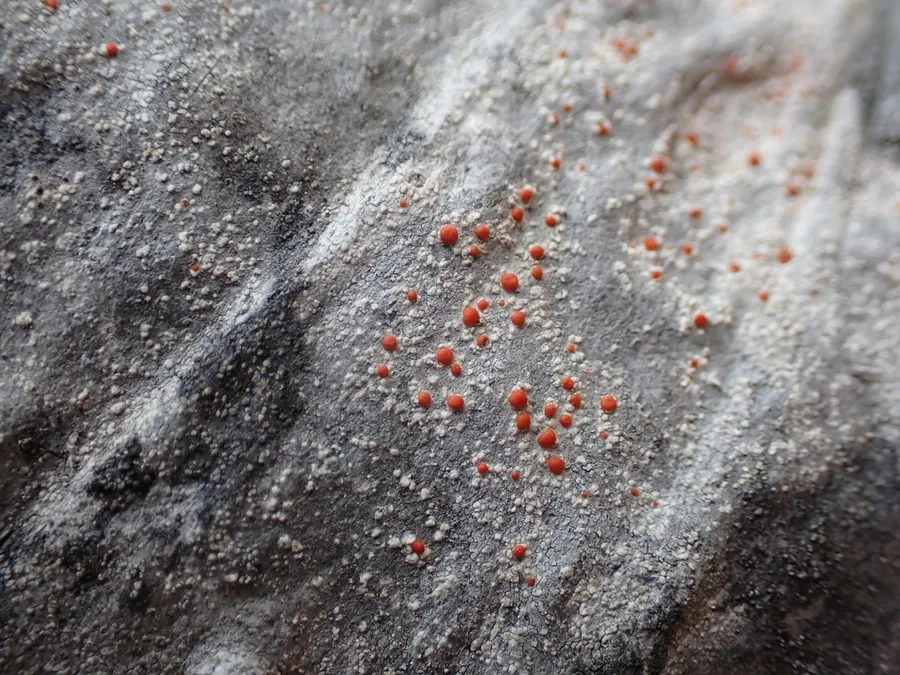
Ramboldia gowardiana has a crust-like thallus, which can range in color from grey and greyish olive to greenish-grey and whitish, particularly near the edges. The thallus is typically cracked and divided into small, irregular sections (-) and can be somewhat warty ( or ), though it is rarely smooth. The thallus lacks reproductive structures like soredia and isidia, which are common in many other lichens. Sometimes, a —a layer beneath the main body—can be seen, with a dark reddish-brown to blackish colour. The thickness of the thallus varies widely, ranging from 100 to 1,000 μm. The lichen contains a green algal partner () of the type, with cells that are typically spherical or slightly oval, measuring between 6 and 26 μm in diameter. Ramboldia gowardiana produces numerous apothecia, the fruiting bodies that produce spores. These apothecia are small, ranging from 0.2 to 2.5 mm in diameter, and can be found either individually or in clusters that merge to form small mounds. The apothecia are red to deep orange-red, with a surface that can be flat to strongly convex. They often have a constricted base and a surface that may be smooth or have irregular wrinkles and small bumps that sometimes radiate outward from the center. The internal structure of the apothecia includes a hymenium, which is the layer where spores develop. This layer is 40 to 60 μm tall, pale yellowish to colorless, and becomes orangish towards the top. The hymenium reacts strongly with Lugol's iodine (IKI+ dark blue) but does not react with potassium hydroxide (K−). The top layer of the hymenium, known as the epihymenium, is 8 to 16 μm tall and ranges from deep burnt-orange to orangish-yellow.

Sebagian uraian ditampilkan dalam bahasa sumber; terjemahannya belum tersedia atau belum lolos pemeriksaan.

Rujukan: [1]

Pengukuran mengikuti objek, spesimen atau kultur, dan metode yang disebutkan sumber. Baca uraian asli untuk konteks lengkap.

02 / Kehidupan

Habitat dan peran ekologis

Ramboldia gowardiana is found in dry, temperate forests, predominantly growing on the bark of twigs and branches of conifers at elevations ranging from 300 to 1,400 meters. This lichen species is commonly associated with trees like Pseudotsuga menziesii (Douglas-fir), Larix occidentalis (western larch), Pinus contorta (lodgepole pine), Pinus ponderosa (ponderosa pine), and Picea engelmannii (Engelmann spruce) in inland areas. In Oregon and California, it also occurs on Abies procera (noble fir) and Pinus attenuata (knobcone pine). In northwestern Montana, R. gowardiana can be particularly abundant on the bark of Larix occidentalis branches and fine twigs, though it also grows on other conifers such as Abies grandis (grand fir), Abies lasiocarpa (subalpine fir), and Pinus monticola (western white pine), and rarely on Acer glabrum (Rocky Mountain maple). The lichen typically thrives in dry woodlands with low snow cover, short snow seasons, and warm, low-precipitation summers. The branches it colonizes are often rich in other lichen species commonly found on Pinus and Larix branches, including Bryoria fuscescens, Hypogymnia imshaugii, Lecanora circumborealis, and Lecanora schizochromatica.

Sebagian uraian ditampilkan dalam bahasa sumber; terjemahannya belum tersedia atau belum lolos pemeriksaan.

Rujukan: [1]

Habitat atau konteks temuan
hutan
Substrat
Informasi belum tersedia pada sumber rilis ini.
Peran atau konteks
Pembentuk liken
Temukan hubungan serupa
03 / Siklus hidup

Reproduksi

Ramboldia gowardiana has a crust-like thallus, which can range in color from grey and greyish olive to greenish-grey and whitish, particularly near the edges. The thallus is typically cracked and divided into small, irregular sections (-) and can be somewhat warty ( or ), though it is rarely smooth. The thallus lacks reproductive structures like soredia and isidia, which are common in many other lichens. Sometimes, a —a layer beneath the main body—can be seen, with a dark reddish-brown to blackish colour. The thickness of the thallus varies widely, ranging from 100 to 1,000 μm. Ramboldia gowardiana produces numerous apothecia, the fruiting bodies that produce spores. These apothecia are small, ranging from 0.2 to 2.5 mm in diameter, and can be found either individually or in clusters that merge to form small mounds.

Sebagian uraian ditampilkan dalam bahasa sumber; terjemahannya belum tersedia atau belum lolos pemeriksaan.

Rujukan: [1]

Sinonim menurut acuan taksonomi rilis: Pyrrhospora gowardiana
04 / Batas informasi

Catatan identitas dan cakupan

  • Nama diterima mengikuti Catalogue of Life Base2026-09-11; uraian mempertahankan konsep dan nama sumber aslinya.
  • Original geographic, specimen and life-cycle scope retained; source import awaits individual editorial review.
  • Impor dan terjemahan otomatis belum diperiksa editorial per profil. Struktur reproduktif yang disebutkan tidak membuktikan seluruh siklus hidup diketahui.
  • Pengukuran pada uraian mengikuti spesimen, kultur, dan metode sumber; angka tidak diperluas ke semua populasi.

Catatan distribusi dalam narasi mengikuti sumbernya. Dokumentasi spesimen atau foto mengikuti catatan sumber. Bukti wilayah Indonesia dan penilaian konservasi tidak disimpulkan dari gambar.

05 / Dokumentasi

Melihat dengan konteks

Dokumentasi Ramboldia gowardiana menurut asosiasi foto pada record takson iNaturalist. Kredit: Fotografer tidak dicantumkan. Sumber observasi iNaturalist; pengunggah: Randal. Identitas mengikuti sumber; bukan penentuan spesimen independen.

Jenis
Fotografi
Kredit
Fotografer tidak dicantumkan. Sumber observasi iNaturalist; pengunggah: Randal
Lisensi
CC0 1.0
Sumber media
Buka entri sumber

Gambar menunjukkan objek menurut identifikasi sumber, bukan verifikasi independen spesimen oleh Fungi. Tidak ada skala baru yang ditambahkan.

06 / Rujukan

Sumber profil

  1. [1] Ramboldia gowardiana — Wikipedia (en)Bagian sumber: Frozen revision 1364423104
    Tanggal penghimpunan sumber: 2026-10-12
    Teks sumber: CC BY-SA4.0 · Wikipedia contributors
  2. [2] Catalogue of Life Base2026-09-11 — Ramboldia gowardianaBagian sumber: ColDP NameUsage.tsv ID 4RC2Z; accepted species; source 2073
    Tanggal penghimpunan sumber: 2026-10-12
  3. [3] Dokumentasi visual — Ramboldia gowardianaBagian sumber: Individual media record; identification follows the source, not independent determination
    Tanggal penghimpunan sumber: 2026-10-12
    Media sumber: CC0 1.0 · Fotografer tidak dicantumkan. Sumber observasi iNaturalist; pengunggah: Randal

Adaptasi teks: CC BY-SA 4.0. Wikipedia contributors — Ramboldia gowardiana — Wikipedia (en)

Uraian asli dan riwayat sumber

Riwayat atau halaman sumber

Ringkasan sumber

Ramboldia gowardiana is a species of corticolous (bark-dwelling), crustose lichen in the family Ramboldiaceae. First discovered in 2003 in Montana, United States, it typically appears as a grayish or greenish crust on tree bark, particularly on conifers like pines and firs. The lichen is characterised by its small, bright red to orange-red reproductive structures (apothecia) visible on its surface. R. gowardiana is found in dry, temperate forests from Alaska to California, often at elevations between 300 and 1,400 meters (about 980 to 4,600 feet).

Revisi sumber

Morfologi sumber

Ramboldia gowardiana has a crust-like thallus, which can range in color from grey and greyish olive to greenish-grey and whitish, particularly near the edges. The thallus is typically cracked and divided into small, irregular sections (-) and can be somewhat warty ( or ), though it is rarely smooth. The thallus lacks reproductive structures like soredia and isidia, which are common in many other lichens. Sometimes, a —a layer beneath the main body—can be seen, with a dark reddish-brown to blackish colour. The thickness of the thallus varies widely, ranging from 100 to 1,000 μm. The lichen contains a green algal partner () of the type, with cells that are typically spherical or slightly oval, measuring between 6 and 26 μm in diameter. Ramboldia gowardiana produces numerous apothecia, the fruiting bodies that produce spores. These apothecia are small, ranging from 0.2 to 2.5 mm in diameter, and can be found either individually or in clusters that merge to form small mounds. The apothecia are red to deep orange-red, with a surface that can be flat to strongly convex. They often have a constricted base and a surface that may be smooth or have irregular wrinkles and small bumps that sometimes radiate outward from the center. The internal structure of the apothecia includes a hymenium, which is the layer where spores develop. This layer is 40 to 60 μm tall, pale yellowish to colorless, and becomes orangish towards the top. The hymenium reacts strongly with Lugol's iodine (IKI+ dark blue) but does not react with potassium hydroxide (K−). The top layer of the hymenium, known as the epihymenium, is 8 to 16 μm tall and ranges from deep burnt-orange to orangish-yellow.

Revisi sumber

Ekologi sumber

Ramboldia gowardiana is found in dry, temperate forests, predominantly growing on the bark of twigs and branches of conifers at elevations ranging from 300 to 1,400 meters. This lichen species is commonly associated with trees like Pseudotsuga menziesii (Douglas-fir), Larix occidentalis (western larch), Pinus contorta (lodgepole pine), Pinus ponderosa (ponderosa pine), and Picea engelmannii (Engelmann spruce) in inland areas. In Oregon and California, it also occurs on Abies procera (noble fir) and Pinus attenuata (knobcone pine). In northwestern Montana, R. gowardiana can be particularly abundant on the bark of Larix occidentalis branches and fine twigs, though it also grows on other conifers such as Abies grandis (grand fir), Abies lasiocarpa (subalpine fir), and Pinus monticola (western white pine), and rarely on Acer glabrum (Rocky Mountain maple). The lichen typically thrives in dry woodlands with low snow cover, short snow seasons, and warm, low-precipitation summers. The branches it colonizes are often rich in other lichen species commonly found on Pinus and Larix branches, including Bryoria fuscescens, Hypogymnia imshaugii, Lecanora circumborealis, and Lecanora schizochromatica.

Revisi sumber

Struktur reproduksi sumber

Ramboldia gowardiana has a crust-like thallus, which can range in color from grey and greyish olive to greenish-grey and whitish, particularly near the edges. The thallus is typically cracked and divided into small, irregular sections (-) and can be somewhat warty ( or ), though it is rarely smooth. The thallus lacks reproductive structures like soredia and isidia, which are common in many other lichens. Sometimes, a —a layer beneath the main body—can be seen, with a dark reddish-brown to blackish colour. The thickness of the thallus varies widely, ranging from 100 to 1,000 μm. Ramboldia gowardiana produces numerous apothecia, the fruiting bodies that produce spores. These apothecia are small, ranging from 0.2 to 2.5 mm in diameter, and can be found either individually or in clusters that merge to form small mounds.

Revisi sumber

Rujukan halaman ini

Fungi. Ramboldia gowardiana. Rilis data fungi-2026-10-12-expansion-2. https://fungi-atlas.mgadib.chatgpt.site/jamur/ramboldia-gowardiana/.

Status: impor sumber; pemeriksaan editorial per profil belum selesai. Untuk klaim biologis, gunakan rujukan pada bagian terkait dan periksa konteks sumber aslinya.