Ciri dan struktur
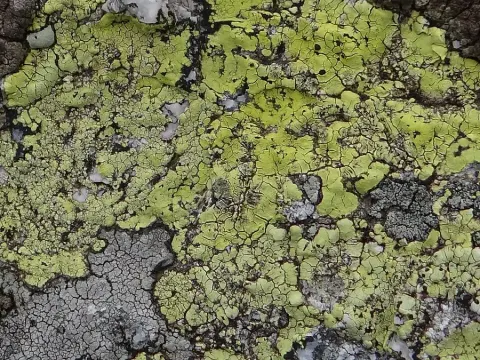
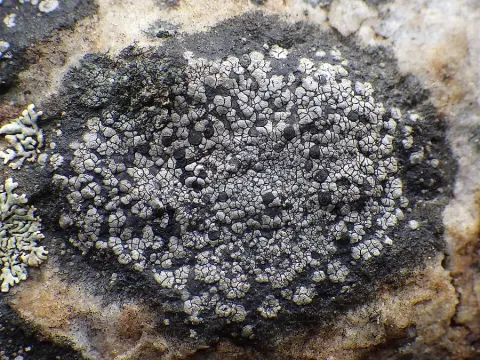
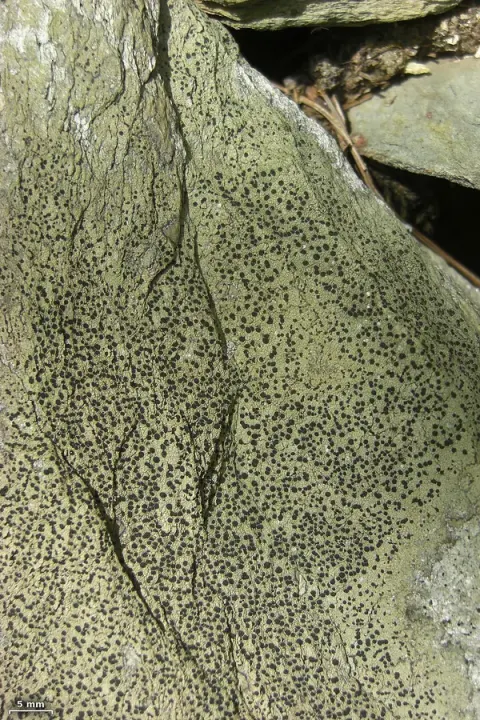
Rhizocarpon viridiatrum starts life on the surface of other crust-forming lichens, gradually replacing its host and sometimes etching a shallow pit where the first thallus erodes. Even when self-sustaining it remains compact, rarely spreading beyond 2 cm across. The thallus is broken into tiny platelets—or —up to about 1 mm wide. These areoles are green-yellow thanks to rhizocarpic acid, lie flush with the rock or rise into little domes, and fit together like pieces of cracked paint. A black —an advance fringe of fungal threads—is usually absent but may show as a thin dark line around the edge. The internal white layer (medulla) shows no blue staining reaction with iodine (I–), a quick test used to check for starch-like compounds. Scattered across the thallus are black fruit-bodies (apothecia) up to 1 mm in diameter. They begin flat but often swell into glossy mounds that sit slightly above the surrounding areoles. The protecting rim derived from the thallus (the ) soon wears away so that the apothecial appears rimless; in thin section its outer cells are brown-black, fading inward, and give a faint purple tint when touched with potassium hydroxide solution (K test). The cap of tissue over the spore layer () is similarly dark and reacts the same way. Beneath, the transparent hymenium produces eight large ascospores per ascus. These spores measure 17–32 × 10–16 μm and are —subdivided by several cross-walls that give a brick-like pattern; they turn a deep brown on maturity. Simple spot tests of the medulla are negative with bleach (C−), potassium hydroxide (K−), and para-phenylenediamine (Pd−), indicating only rhizocarpic and some unidentified fatty acids are present.
Habitat dan peran ekologis
Rhizocarpon viridiatrum occurs across Central Europe, with confirmed records from Austria, the Czech Republic, Germany, Hungary, and Poland. Within this range, the species is considered rare and is classified as vulnerable on Poland's Red List of lichens. Polish populations are documented from the Baltic Lakelands (Pojezierza Bałtyckie) and Western Carpathians (Karpaty Zachodnie), whilst historical collections from the Sudeten Mountains in southwestern Poland have not been confirmed in recent surveys. Rhizocarpon viridiatrum colonizes siliceous to moderately calcareous substrates such as basalt, beginning as a parasite on other crustose lichens, particularly Circinaria caesiocinerea. It typically inhabits exposed, well-lit locations that receive relatively warm conditions despite the rocky substrate. The species typically appears as dispersed fragments or small sections interspersed among other lichen communities.
- Habitat atau konteks temuan
- Informasi belum tersedia pada sumber rilis ini.
- Substrat
- Informasi belum tersedia pada sumber rilis ini.
- Peran atau konteks
- Pembentuk liken
Reproduksi
Scattered across the thallus are black fruit-bodies (apothecia) up to 1 mm in diameter. They begin flat but often swell into glossy mounds that sit slightly above the surrounding areoles. The protecting rim derived from the thallus (the ) soon wears away so that the apothecial appears rimless; in thin section its outer cells are brown-black, fading inward, and give a faint purple tint when touched with potassium hydroxide solution (K test). The cap of tissue over the spore layer () is similarly dark and reacts the same way. Beneath, the transparent hymenium produces eight large ascospores per ascus. These spores measure 17–32 × 10–16 μm and are —subdivided by several cross-walls that give a brick-like pattern; they turn a deep brown on maturity.
Catatan identitas dan cakupan
- Nama diterima mengikuti Catalogue of Life Base2026-09-11; uraian mempertahankan konsep dan nama sumber aslinya.
- Original geographic, specimen and life-cycle scope retained; source import awaits individual editorial review.
- Impor dan terjemahan otomatis belum diperiksa editorial per profil. Struktur reproduktif yang disebutkan tidak membuktikan seluruh siklus hidup diketahui.
- Pengukuran pada uraian mengikuti spesimen, kultur, dan metode sumber; angka tidak diperluas ke semua populasi.
Catatan distribusi dalam narasi mengikuti sumbernya. Dokumentasi spesimen atau foto mengikuti catatan sumber. Bukti wilayah Indonesia dan penilaian konservasi tidak disimpulkan dari gambar.
Melihat dengan konteks
Dokumentasi Rhizocarpon viridiatrum menurut asosiasi foto pada record takson iNaturalist. Kredit: Tony Rebelo. Identitas mengikuti sumber; bukan penentuan spesimen independen.
- Jenis
- Fotografi
- Kredit
- (c) Tony Rebelo, some rights reserved (CC BY-SA), uploaded by Tony Rebelo
- Lisensi
- CC BY-SA 4.0
- Sumber media
- Buka entri sumber
Sumber profil
- [1] Rhizocarpon viridiatrum — Wikipedia (en)
- [2] Catalogue of Life Base2026-09-11 — Rhizocarpon viridiatrum
- [3] Dokumentasi visual — Rhizocarpon viridiatrum
Rujukan halaman ini
Fungi. Rhizocarpon viridiatrum. Rilis data fungi-2026-10-12-expansion-2. https://fungi-atlas.mgadib.chatgpt.site/jamur/rhizocarpon-viridiatrum/.
Status: impor sumber; pemeriksaan editorial per profil belum selesai. Untuk klaim biologis, gunakan rujukan pada bagian terkait dan periksa konteks sumber aslinya.