Saprobic on daun mati dari Anthoxanthum odoratum, muncul sebagai hitam elipsoidal, titik-titik yang tinggi di permukaan tuan rumah. Morph seksual tidak ditentukan. Transformasi aseksual Coelomycetous. konidiomata 95–120 µm lebar, 80–95 µm tinggi, cokelat gelap hingga hitam, pycnidial, solitary hingga gregarious atau terpencar, semi-merendam hingga erumpent, globose, unilocular, glabrous. Pycnidial walls 10–20 µm lebar, di bagian atas dan lateral, terdiri dari kulit kulit cokelat gelap luar dan kulit cokelat terang dalam ke sel-sel hialin dari tekstura prismatica, di dasar, kulit cokelat pucat ke hialin sel-sel tekstura prismatica secara bertahap bergabung dengan jaringan inang.
Profil ini diimpor dari uraian spesies pada sumber berlisensi dan sebagian teks diterjemahkan otomatis. Pemeriksaan editorial per profil belum selesai. Bagian yang belum diterjemahkan atau belum lolos pemeriksaan terjemahan tetap ditampilkan dalam bahasa sumber. Angka dan nama ilmiah dipertahankan.
Saprobic on dead leaf of Anthoxanthum odoratum, appearing as black ellipsoidal, raised spots on the host surface. Sexual morph Undetermined. Asexual morph Coelomycetous. Conidiomata 95–120 µm wide, 80–95 µm high, dark brown to black, pycnidial, solitary to gregarious or scattered, semi-immersed to erumpent, globose, unilocular, glabrous. Pycnidial walls 10–20 µm wide, in the upper and lateral parts, composed of outer dark brown and inner light brown to hyaline cells of textura prismatica, at the base, pale brown to hyaline cells of textura prismatica gradually merging with host tissue. Conidiophores reduced to conidiogenous cells. Conidiogenous cells 2 × 3 µm, hyaline, phialidic, doliiform, discrete, determinate, smooth, arising from the inner layers of conidioma. Conidia 15.3–19.2 × 2.7–3.5 µm (\(\bar{x} \) = 17 × 3.2 μm, n = 30), hyaline when immature, becoming light brown to pale greenish-brown, oblong to subcylindrical, rounded at apex, slightly truncate at base, 1–3-septate at maturity, septa less conspicuous in immature spores, smooth-walled, greenish specks-like globules present in the cell matrix. Culture Characteristics: Colonies showing moderate growth, circular, reaching 40 mm diam. in 4 weeks at 18–20 °C on PDA, medium dense and woolly, dull surface, convex, margins entire, from above white at the centre, becoming grey at the margins, reverse gray.
Sebagian uraian ditampilkan dalam bahasa sumber; terjemahannya belum tersedia atau belum lolos pemeriksaan.
Pengukuran mengikuti objek, spesimen atau kultur, dan metode yang disebutkan sumber. Baca uraian asli untuk konteks lengkap.
02 / Kehidupan
Habitat dan peran ekologis
Saprobic on dead leaf of Anthoxanthum odoratum, appearing as black ellipsoidal, raised spots on the host surface. Sexual morph Undetermined. Asexual morph Coelomycetous. Conidiomata 95–120 µm wide, 80–95 µm high, dark brown to black, pycnidial, solitary to gregarious or scattered, semi-immersed to erumpent, globose, unilocular, glabrous. Pycnidial walls 10–20 µm wide, in the upper and lateral parts, composed of outer dark brown and inner light brown to hyaline cells of textura prismatica, at the base, pale brown to hyaline cells of textura prismatica gradually merging with host tissue. Conidiophores reduced to conidiogenous cells. Conidiogenous cells 2 × 3 µm, hyaline, phialidic, doliiform, discrete, determinate, smooth, arising from the inner layers of conidioma. Conidia 15.3–19.2 × 2.7–3.5 µm (\(\bar{x} \) = 17 × 3.2 μm, n = 30), hyaline when immature, becoming light brown to pale greenish-brown, oblong to subcylindrical, rounded at apex, slightly truncate at base, 1–3-septate at maturity, septa less conspicuous in immature spores, smooth-walled, greenish specks-like globules present in the cell matrix. Culture Characteristics: Colonies showing moderate growth, circular, reaching 40 mm diam. in 4 weeks at 18–20 °C on PDA, medium dense and woolly, dull surface, convex, margins entire, from above white at the centre, becoming grey at the margins, reverse gray.
Sebagian uraian ditampilkan dalam bahasa sumber; terjemahannya belum tersedia atau belum lolos pemeriksaan.
Saprobic on dead leaf of Anthoxanthum odoratum, appearing as black ellipsoidal, raised spots on the host surface. Sexual morph Undetermined. Asexual morph Coelomycetous. Conidiomata 95–120 µm wide, 80–95 µm high, dark brown to black, pycnidial, solitary to gregarious or scattered, semi-immersed to erumpent, globose, unilocular, glabrous. Pycnidial walls 10–20 µm wide, in the upper and lateral parts, composed of outer dark brown and inner light brown to hyaline cells of textura prismatica, at the base, pale brown to hyaline cells of textura prismatica gradually merging with host tissue. Conidiophores reduced to conidiogenous cells. Conidiogenous cells 2 × 3 µm, hyaline, phialidic, doliiform, discrete, determinate, smooth, arising from the inner layers of conidioma.
Sebagian uraian ditampilkan dalam bahasa sumber; terjemahannya belum tersedia atau belum lolos pemeriksaan.
Nama diterima mengikuti Catalogue of Life Base2026-09-11; uraian mempertahankan konsep dan nama sumber aslinya.
Preserve original monograph treatment localities, hosts and specimen/substrate scope. Materials examined document specimens, not the full global range.
Impor dan terjemahan otomatis belum diperiksa editorial per profil. Struktur reproduktif yang disebutkan tidak membuktikan seluruh siklus hidup diketahui.
Pengukuran pada uraian mengikuti spesimen, kultur, dan metode sumber; angka tidak diperluas ke semua populasi.
Catatan distribusi dalam narasi mengikuti sumbernya. Dokumentasi spesimen atau foto mengikuti catatan sumber. Bukti wilayah Indonesia dan penilaian konservasi tidak disimpulkan dari gambar.
05 / Dokumentasi
Melihat dengan konteks
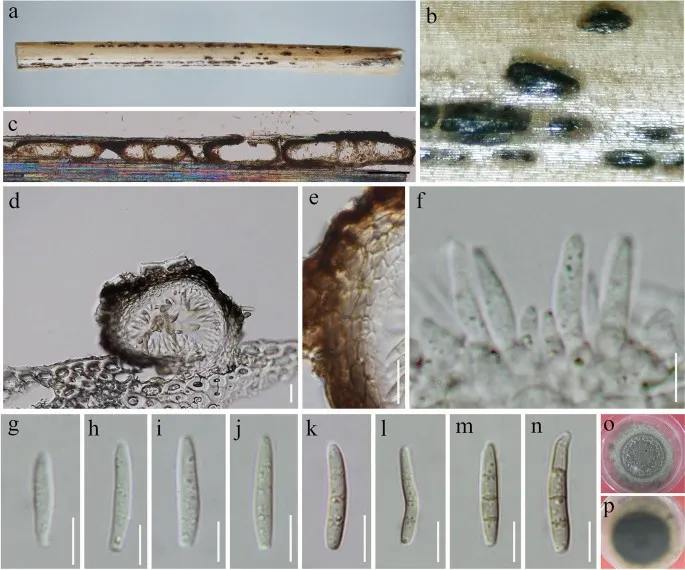
Septoriella camporesii (MFLU 15-1259, holotype). a Appearance of conidiomata on the host surface. b Close up of conidiomata. c, d Section through conidiomata. e Pycnidial wall. f Conidia arising from conidiogenous cells. g – n Conidia. o, p Colony characteristics from above (o) and below (p). Scale bars: c, f = 50 μm, d, e, g – o = 20 μm
Jenis
Pelat ilmiah
Kredit
Penulis dan sumber artikel: Hyde, Kevin D.; Dong, Yang; Phookamsak, Rungtiwa; Jeewon, Rajesh; Bhat, D. Jayarama; Jones, E. B. Gareth; Liu, Ning-Guo; Abeywickrama, Pranami D.; Mapook, Ausana; Wei, Deping; Perera, Rekhani H.; Manawasinghe, Ishara S.; Pem, Dhandevi; Bundhun, Digvijayini; Karunarathna, Anuruddha; Ekanayaka, Anusha H.; Bao, Dan-Feng; Li, Junfu; Samarakoon, Milan C.; Chaiwan, Napalai; Lin, Chuan-Gen; Phutthacharoen, Kunthida; Zhang, Sheng-Nan; Senanayake, Indunil C.; Goonasekara, Ishani D.; Thambugala, Kasun M.; Phukhamsakda, Chayanard; Tennakoon, Danushka S.; Jiang, Hong-Bo; Yang, Jing; Zeng, Ming; Huanraluek, Naruemon; Liu, Jian-Kui (Jack); Wijesinghe, Subodini N.; Tian, Qing; Tibpromma, Saowaluck; Brahmanage, Rashika S.; Boonmee, Saranyaphat; Huang, Shi-Ke; Thiyagaraja, Vinodhini; Lu, Yong-Zhong; Jayawardena, Ruvishika S.; Dong, Wei; Yang, Er-Fu; Singh, Sanjay K.; Singh, Shiv Mohan; Rana, Shiwali; Lad, Sneha S.; Anand, Garima; Devadatha, Bandarupalli; Niranjan, M.; Sarma, V. Venkateswara; Liimatainen, Kare; Aguirre-Hudson, Begoña; Niskanen, Tuula; Overall, Andy; Alvarenga, Renato Lúcio Mendes; Gibertoni, Tatiana Baptista; Pfliegler, Walter P.; Horváth, Enikő; Imre, Alexandra; Alves, Amanda Lucia; da Silva Santos, Ana Carla; Tiago, Patricia Vieira; Bulgakov, Timur S.; Wanasinghe, Dhanushaka N.; Bahkali, Ali H.; Doilom, Mingkwan; Elgorban, Abdallah M.; Maharachchikumbura, Sajeewa S. N.; Rajeshkumar, Kunhiraman C.; Haelewaters, Danny; Mortimer, Peter E.; Zhao, Qi; Lumyong, Saisamorn; Xu, Jianchu; Sheng, Jun
Saprobic on dead leaf of Anthoxanthum odoratum, appearing as black ellipsoidal, raised spots on the host surface.
Sexual morph Undetermined.
Asexual morph Coelomycetous.
Conidiomata 95–120 µm wide, 80–95 µm high, dark brown to black, pycnidial, solitary to gregarious or scattered, semi-immersed to erumpent, globose, unilocular, glabrous.
Pycnidial walls 10–20 µm wide, in the upper and lateral parts, composed of outer dark brown and inner light brown to hyaline cells of textura prismatica, at the base, pale brown to hyaline cells of textura prismatica gradually merging with host tissue.
Saprobic on dead leaf of Anthoxanthum odoratum, appearing as black ellipsoidal, raised spots on the host surface. Sexual morph Undetermined. Asexual morph Coelomycetous. Conidiomata 95–120 µm wide, 80–95 µm high, dark brown to black, pycnidial, solitary to gregarious or scattered, semi-immersed to erumpent, globose, unilocular, glabrous. Pycnidial walls 10–20 µm wide, in the upper and lateral parts, composed of outer dark brown and inner light brown to hyaline cells of textura prismatica, at the base, pale brown to hyaline cells of textura prismatica gradually merging with host tissue. Conidiophores reduced to conidiogenous cells. Conidiogenous cells 2 × 3 µm, hyaline, phialidic, doliiform, discrete, determinate, smooth, arising from the inner layers of conidioma. Conidia 15.3–19.2 × 2.7–3.5 µm (\(\bar{x} \) = 17 × 3.2 μm, n = 30), hyaline when immature, becoming light brown to pale greenish-brown, oblong to subcylindrical, rounded at apex, slightly truncate at base, 1–3-septate at maturity, septa less conspicuous in immature spores, smooth-walled, greenish specks-like globules present in the cell matrix.
Culture Characteristics: Colonies showing moderate growth, circular, reaching 40 mm diam. in 4 weeks at 18–20 °C on PDA, medium dense and woolly, dull surface, convex, margins entire, from above white at the centre, becoming grey at the margins, reverse gray.
Saprobic on dead leaf of Anthoxanthum odoratum, appearing as black ellipsoidal, raised spots on the host surface.
Sexual morph Undetermined.
Asexual morph Coelomycetous.
Conidiomata 95–120 µm wide, 80–95 µm high, dark brown to black, pycnidial, solitary to gregarious or scattered, semi-immersed to erumpent, globose, unilocular, glabrous.
Pycnidial walls 10–20 µm wide, in the upper and lateral parts, composed of outer dark brown and inner light brown to hyaline cells of textura prismatica, at the base, pale brown to hyaline cells of textura prismatica gradually merging with host tissue.
Conidiophores reduced to conidiogenous cells.
Conidiogenous cells 2 × 3 µm, hyaline, phialidic, doliiform, discrete, determinate, smooth, arising from the inner layers of conidioma.
Conidia 15.3–19.2 × 2.7–3.5 µm (\(\bar{x} \) = 17 × 3.2 μm, n = 30), hyaline when immature, becoming light brown to pale greenish-brown, oblong to subcylindrical, rounded at apex, slightly truncate at base, 1–3-septate at maturity, septa less conspicuous in immature spores, smooth-walled, greenish specks-like globules present in the cell matrix.
Culture Characteristics: Colonies showing moderate growth, circular, reaching 40 mm diam. in 4 weeks at 18–20 °C on PDA, medium dense and woolly, dull surface, convex, margins entire, from above white at the centre, becoming grey at the margins, reverse gray.
Saprobic on dead leaf of Anthoxanthum odoratum, appearing as black ellipsoidal, raised spots on the host surface.
Sexual morph Undetermined.
Asexual morph Coelomycetous.
Conidiomata 95–120 µm wide, 80–95 µm high, dark brown to black, pycnidial, solitary to gregarious or scattered, semi-immersed to erumpent, globose, unilocular, glabrous.
Pycnidial walls 10–20 µm wide, in the upper and lateral parts, composed of outer dark brown and inner light brown to hyaline cells of textura prismatica, at the base, pale brown to hyaline cells of textura prismatica gradually merging with host tissue.
Conidiophores reduced to conidiogenous cells.
Conidiogenous cells 2 × 3 µm, hyaline, phialidic, doliiform, discrete, determinate, smooth, arising from the inner layers of conidioma.
Status: impor sumber; pemeriksaan editorial per profil belum selesai. Untuk klaim biologis, gunakan rujukan pada bagian terkait dan periksa konteks sumber aslinya.
Saprobic on cabang kayu mati. Morph seksual Ascomata 270–290 µm tinggi × 390–415 µm diameter. (\(\bar{x} \) = 280.5 × 400 µm, n = 5), dangkal hingga semi-merendam, sepi atau beredar, karbon, sepi atau beredar, muncul sebagai cokelat gelap…