Ciri dan struktur
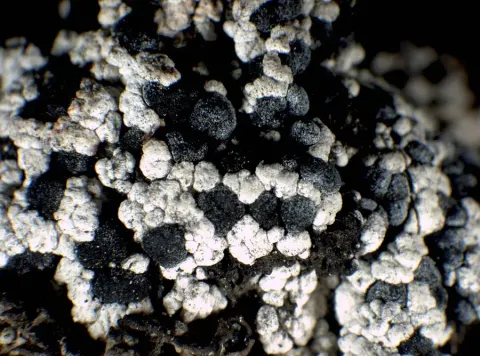
Tetramelas pulverulentus is an inconspicuous, lichen-dwelling fungus that lives within the white inner layer (medulla) of its host lichen rather than forming an obvious surface crust of its own. Even so, it develops a very thin outer skin () only 10–20 μm high, beneath which it houses its own microscopic green algal partner () and therefore functions as an independent lichen at this stage of its life cycle. The reproductive bodies are tiny, blackish (apothecia) 0.3–0.5 mm across—occasionally reaching 0.7 mm—that sit on the surface of the host. Each apothecium is ringed by a permanently dark-pigmented rim () made of rounded, thick-walled cells, while the uppermost layer () is brown. Beneath this lies the clear, spore-producing tissue (hymenium), 55–77 μm tall and lacking the oil droplets found in some related species. A darker supportive layer () underpins the hymenium. Thread-like hyphae called paraphyses, only about 2 μm wide but swelling to 5 μm at their tips, weave through the hymenium. Each club-shaped ascus typically contains eight brown ascospores measuring 16–21 μm long (occasionally 14.5–23 μm) and 6.5–8.5 μm wide; the spores are one- to three-celled and bear a fine, warty ornamentation. Asexual reproductive structures (pycnidia) are uncommon, but when present they release colourless, rod-shaped conidia about 5–6 μm long and 1 μm wide. Thin-layer chromatography has not detected any lichen products in this species.
Habitat dan peran ekologis
The reproductive bodies are tiny, blackish (apothecia) 0.3–0.5 mm across—occasionally reaching 0.7 mm—that sit on the surface of the host. Each apothecium is ringed by a permanently dark-pigmented rim () made of rounded, thick-walled cells, while the uppermost layer () is brown. Beneath this lies the clear, spore-producing tissue (hymenium), 55–77 μm tall and lacking the oil droplets found in some related species. A darker supportive layer () underpins the hymenium. Thread-like hyphae called paraphyses, only about 2 μm wide but swelling to 5 μm at their tips, weave through the hymenium. Each club-shaped ascus typically contains eight brown ascospores measuring 16–21 μm long (occasionally 14.5–23 μm) and 6.5–8.5 μm wide; the spores are one- to three-celled and bear a fine, warty ornamentation.
- Habitat atau konteks temuan
- Informasi belum tersedia pada sumber rilis ini.
- Substrat
- Informasi belum tersedia pada sumber rilis ini.
- Peran atau konteks
- Pembentuk liken
Reproduksi
The reproductive bodies are tiny, blackish (apothecia) 0.3–0.5 mm across—occasionally reaching 0.7 mm—that sit on the surface of the host. Each apothecium is ringed by a permanently dark-pigmented rim () made of rounded, thick-walled cells, while the uppermost layer () is brown. Beneath this lies the clear, spore-producing tissue (hymenium), 55–77 μm tall and lacking the oil droplets found in some related species. A darker supportive layer () underpins the hymenium. Thread-like hyphae called paraphyses, only about 2 μm wide but swelling to 5 μm at their tips, weave through the hymenium. Each club-shaped ascus typically contains eight brown ascospores measuring 16–21 μm long (occasionally 14.5–23 μm) and 6.5–8.5 μm wide; the spores are one- to three-celled and bear a fine, warty ornamentation.
Catatan identitas dan cakupan
- Nama diterima mengikuti Catalogue of Life Base2026-09-11; uraian mempertahankan konsep dan nama sumber aslinya.
- Original geographic, specimen and life-cycle scope retained; source import awaits individual editorial review.
- Impor dan terjemahan otomatis belum diperiksa editorial per profil. Struktur reproduktif yang disebutkan tidak membuktikan seluruh siklus hidup diketahui.
- Pengukuran pada uraian mengikuti spesimen, kultur, dan metode sumber; angka tidak diperluas ke semua populasi.
Catatan distribusi dalam narasi mengikuti sumbernya. Dokumentasi spesimen atau foto mengikuti catatan sumber. Bukti wilayah Indonesia dan penilaian konservasi tidak disimpulkan dari gambar.
Melihat dengan konteks
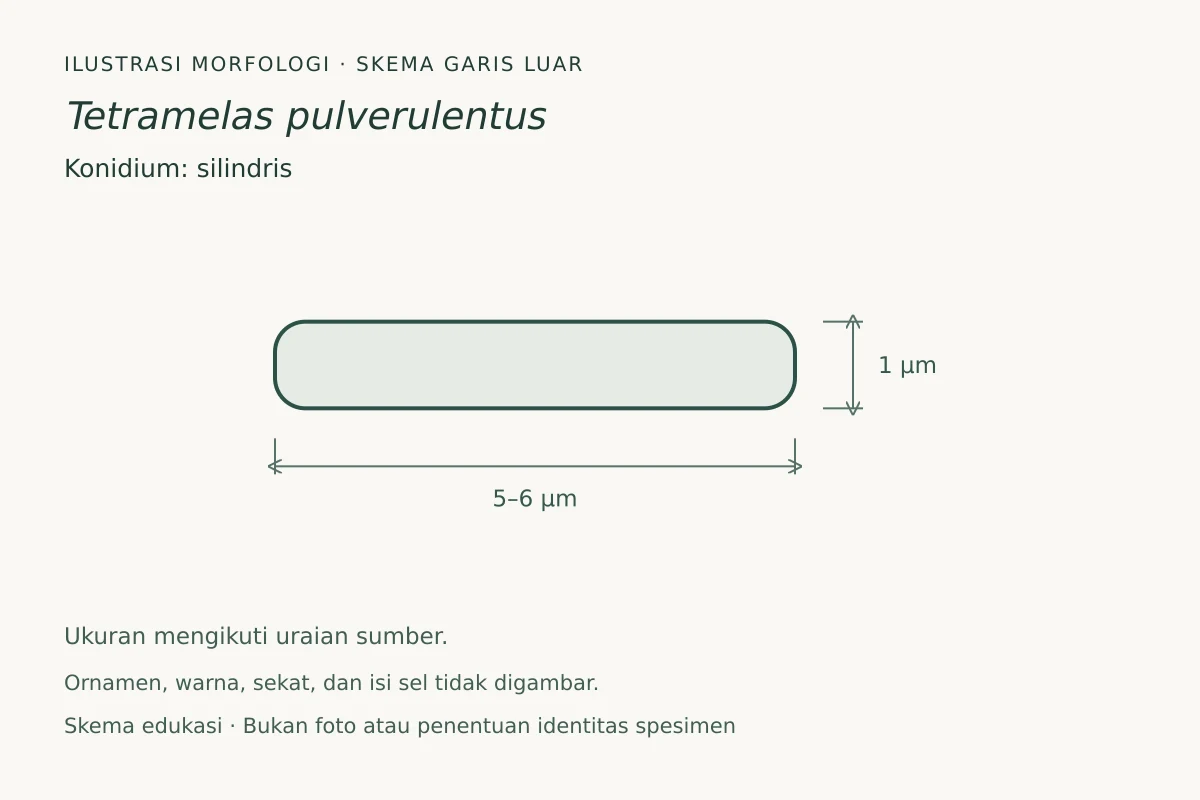
Ilustrasi skematis garis luar konidium Tetramelas pulverulentus, berdasarkan uraian sumber; ukuran yang dilaporkan 5–6 × 1 µm. Proporsi disederhanakan, bukan salinan satu spesimen. Ornamen permukaan, warna, sekat, dan isi sel tidak direkonstruksi. Sumber menyebut konidia berbentuk batang sekitar 5–6 × 1 µm. Skema hanya garis luar; warna dan isi sel tidak direkonstruksi.
- Jenis
- Ilustrasi skematis
- Kredit
- Fungi, ilustrasi orisinal (2026); fakta morfologi berdasarkan Wikipedia contributors
- Lisensi
- CC BY-SA 4.0
- Sumber media
- Buka entri sumber
Sumber profil
- [1] Tetramelas pulverulentus — Wikipedia (en)
- [2] Catalogue of Life Base2026-09-11 — Tetramelas pulverulentus
Rujukan halaman ini
Fungi. Tetramelas pulverulentus. Rilis data fungi-2026-10-12-expansion-2. https://fungi-atlas.mgadib.chatgpt.site/jamur/tetramelas-pulverulentus/.
Status: impor sumber; pemeriksaan editorial per profil belum selesai. Untuk klaim biologis, gunakan rujukan pada bagian terkait dan periksa konteks sumber aslinya.