Ciri dan struktur
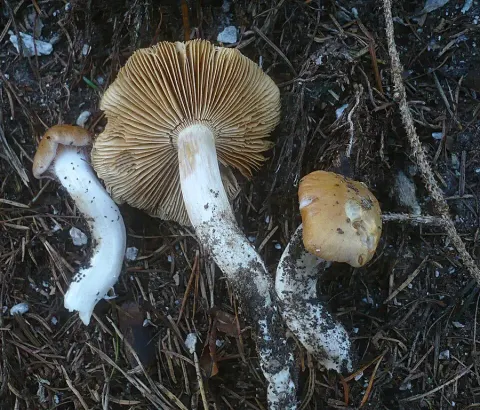
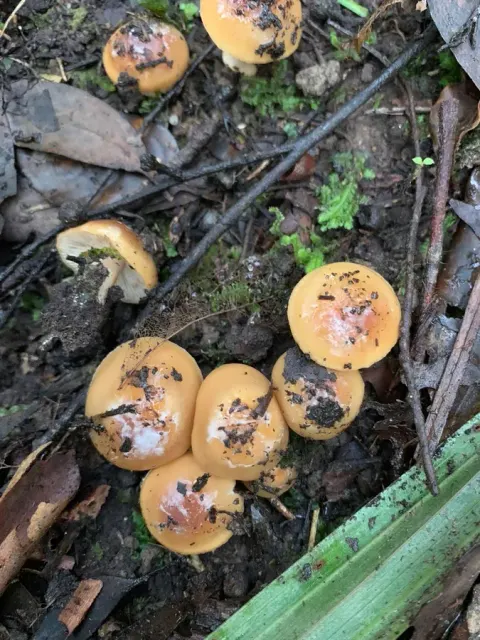
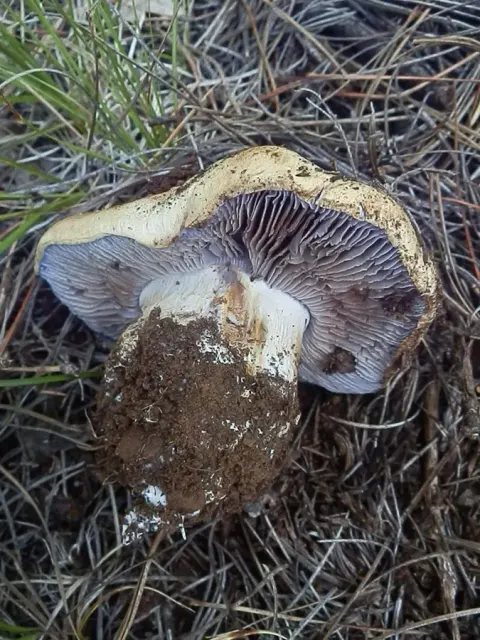
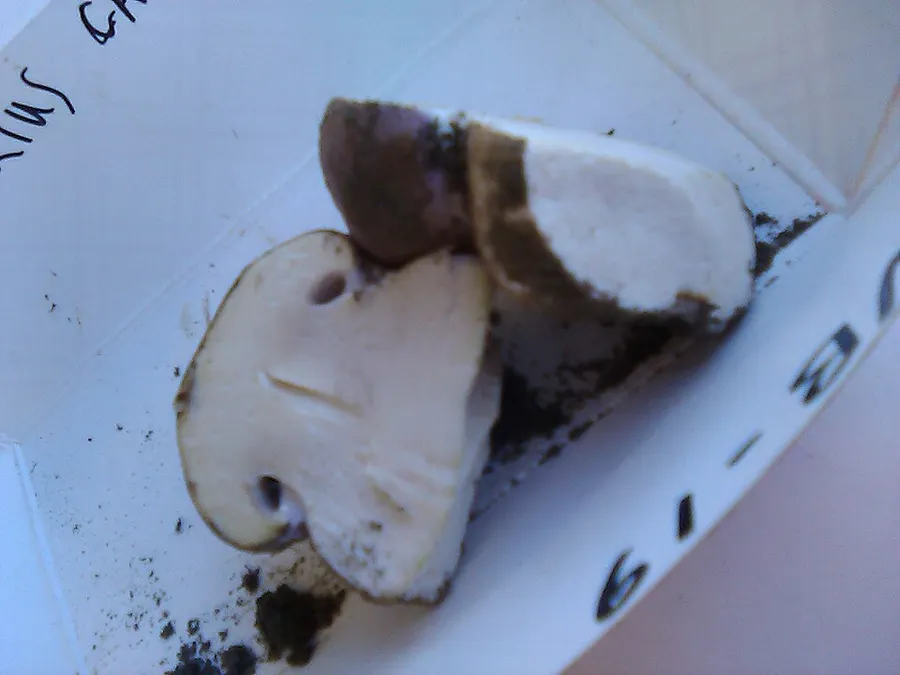
The cap (pileus) measures 4–8 cm across and ranges from hemispherical to flattening into a gentle dome. Its surface is sticky when moist and varies in colour from red-brown to ochraceous brown, occasionally with bluish-brown tones. As it ages, the cap often becomes paler ochraceous brown and may appear two-toned, with the outer, hygrophanous region drying to a darker grey-brown. Fine radial wrinkles (rugulose) sometimes develop toward the margin. The gills are notched where they meet the stipe, nearly crowded together, and initially pale grey with a bluish tint before turning pale brown. The stipe is 4–8 cm long and 0.7–1.7 cm thick near the apex, tapering slightly to a small bulb 1.5–2.5 cm wide at the base. It is covered in fine fibres (fibrillose) rather than appearing glossy, and its colour shifts from whitish—or faintly bluish at the top in young specimens—to pale brown with maturity. A sparse, white universal veil may cling to the bulb margin and become somewhat sticky. The flesh (context) is thin beneath the cap cuticle, white with a hint of brown just below the surface, and may show a bluish tint in the stipe when young. A gentle honey scent can be detected at the base of the stipe. In dried herbarium specimens (Latin: specimina exsiccata), the cap usually appears greyish to reddish brown, while the stipe remains very pale. Microscopically, the spores are ovoid to narrowly egg-shaped, measuring on average about 8.5–10 × 5.2–5.9 μm, based on several collections. Their surface bears moderate to pronounced wart-like spines that often fuse into low ridges and stain reddish-brown in iodine tests (dextrinoid).
Habitat dan peran ekologis
The mushroom is found in central and northern Europe, where it grows with spruce, and in Washington state (United States), where it additionally grows with pine. The lengthy fruiting season extends from June (in France) to November (in the United States). Thaxterogaster caesiolamellatus inhabits montane to mid-boreal mesci coniferous forests, favouring nutrient-rich or calcareous soils. In Europe it is almost exclusively found under spruce, often in low-herb or old-growth stands, whereas North American records come from pine woodlands on sandy substrates. Fruiting bodies appear over an extended season, with documented collections as early as June in France and as late as November in Washington state. Geographically, this species has a scattered but widespread presence across central and northern Europe—including Estonia, Finland, France, Germany, Norway and Sweden—and reaches into the Pacific Northwest of the United States. It is considered occasional throughout its range rather than common, with herbarium specimens reflecting its patchy occurrence beneath conifer canopies.
- Habitat atau konteks temuan
- hutan
- Substrat
- Informasi belum tersedia pada sumber rilis ini.
- Peran atau konteks
- Belum dikategorikan pada rilis ini.
Reproduksi
Microscopically, the spores are ovoid to narrowly egg-shaped, measuring on average about 8.5–10 × 5.2–5.9 μm, based on several collections. Their surface bears moderate to pronounced wart-like spines that often fuse into low ridges and stain reddish-brown in iodine tests (dextrinoid). The spore-bearing cells (basidia) are club-shaped, 25–34 × 7.5–9 μm, and each typically supports four spores. Many basidia and the underlying tissue contain yellowish, grainy or droplet-like contents. The cap cuticle (pileipellis) consists of a gelatinous layer of smooth, colourless hyphae about 2–3 μm wide, arranged in loose, erect tufts. Beneath this is a layer of thin-walled cells with pale brown pigment and occasional small brown spots; conspicuous yellow or brown patches are absent.
Catatan identitas dan cakupan
- Nama diterima mengikuti Catalogue of Life Base2026-09-11; uraian mempertahankan konsep dan nama sumber aslinya.
- Original geographic, specimen and life-cycle scope retained; source import awaits individual editorial review.
- Impor dan terjemahan otomatis belum diperiksa editorial per profil. Struktur reproduktif yang disebutkan tidak membuktikan seluruh siklus hidup diketahui.
- Pengukuran pada uraian mengikuti spesimen, kultur, dan metode sumber; angka tidak diperluas ke semua populasi.
Catatan distribusi dalam narasi mengikuti sumbernya. Dokumentasi spesimen atau foto mengikuti catatan sumber. Bukti wilayah Indonesia dan penilaian konservasi tidak disimpulkan dari gambar.
Melihat dengan konteks
Dokumentasi Thaxterogaster caesiolamellatus dari Wikimedia Commons. I believe this is Cortinarius caesiolamellatus. I found it growing with white pine in Upstate NY. Had cortina, lilac gills, parts of cap and upper stem were lilac, the rest buff. Stubby, abruptly marginate stem base. Matches description at http://www.alpental.com/psms/PNWMushrooms/PictorialKey/Cortinarius.htm Accessed Oct 2019 Identifikasi mengikuti record berkas sumber.
- Jenis
- Fotografi
- Kredit
- Nissimnanach
- Lisensi
- CC BY-SA 4.0
- Sumber media
- Buka entri sumber
Sumber profil
- [1] Thaxterogaster caesiolamellatus — Wikipedia (en)
- [2] Catalogue of Life Base2026-09-11 — Thaxterogaster caesiolamellatus
- [3] Dokumentasi visual — Thaxterogaster caesiolamellatus
Rujukan halaman ini
Fungi. Thaxterogaster caesiolamellatus. Rilis data fungi-2026-10-12-expansion-2. https://fungi-atlas.mgadib.chatgpt.site/jamur/thaxterogaster-caesiolamellatus/.
Status: impor sumber; pemeriksaan editorial per profil belum selesai. Untuk klaim biologis, gunakan rujukan pada bagian terkait dan periksa konteks sumber aslinya.