Ciri dan struktur
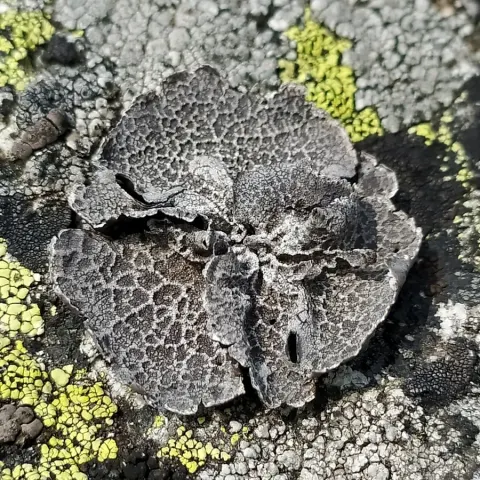
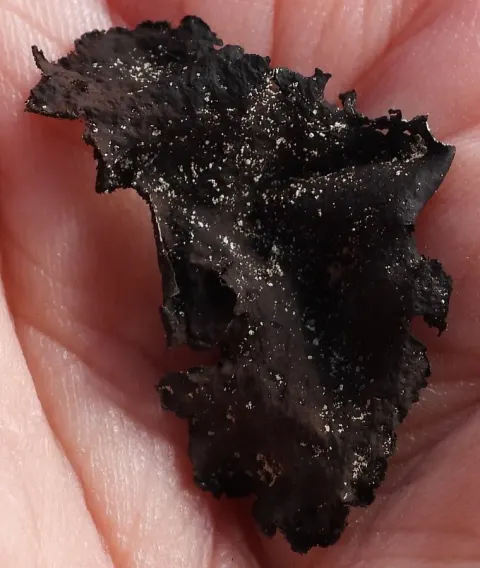
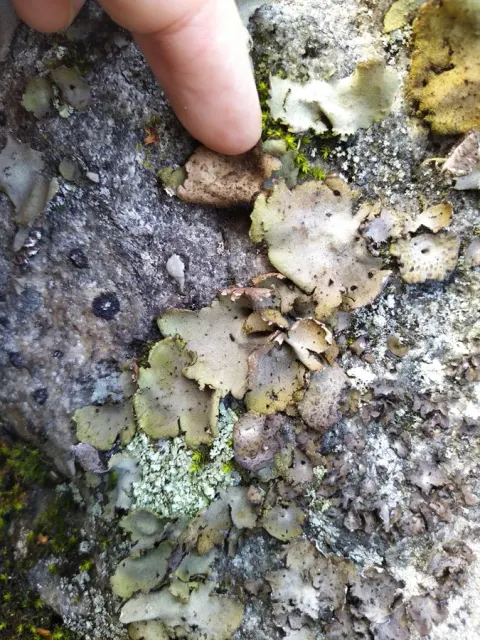
Umbilicaria cylindrica has a leaf-like thallus that reaches 2–10 cm in diameter, though most specimens are smaller than 4 cm across. One specimen, originally documented as the variety delisei, was recorded at a diameter of 26 cm. The thallus consists of multiple that may be either smoothly rounded or irregularly jagged, and sometimes contain small holes. The upper surface ranges in colour from dark brown to dark grey or black, and may be covered in places with a grey, powdery coating. Its texture can be smooth or slightly rough with tiny, map-like cracks. Inside, the thallus has a distinctive three-layered medulla: a loosely arranged, web-like () outer layer, a dense central core, and another web-like layer beneath. The internal structure of the thallus contains a distinctive three-layered medulla (inner tissue): an upper web-like layer beneath the , a dense central layer where fungal threads are tightly packed in parallel, and a lower web-like layer connecting to the bottom surface. This "decussata-type" medullary structure is characteristic of the species. This structure allows the thallus to store a moderate amount of water, with approximately 20% of its volume consisting of pore spaces. The reproductive structures (apothecia) are distinctive and numerous, appearing as black, slightly raised discs 0.5–2.0 (rarely up to 4.0) mm in diameter. These structures have a (maze-like) pattern on their surface and are elevated above the thallus on short stalks, with margins that are either smooth or slightly cracked. Early studies of this species' reproductive structures were conducted by Gustav Lindau in the late 19th century, who documented the development of apothecia near the centre of the thallus, a few millimetres inward from the marginal pycnidia.
Habitat dan peran ekologis
Umbilicaria cylindrica is an Arctic–alpine lichen found on exposed rocky surfaces in cold, mountainous regions. It prefers siliceous (acidic) rocks such as granite and basalt, and typically grows in the alpine vegetation zone above treeline. Thalli are usually located on windswept boulders and outcrops with only a brief seasonal snow cover, often near mountaintops. In the Alps, it occurs from subalpine elevations around 1000 m up to the nival zone, with records from as high as 4270 m on the Finsteraarhorn. This lichen tolerates extreme climatic conditions of high UV exposure, frequent freeze-thaw cycles, and desiccation typical of alpine and polar environments. In Greenland, the species shows an unusual altitudinal distribution pattern: while typically found at high elevations elsewhere, it is scarce in continental highlands and lower coastal areas due to the desiccating effects of frequent Foehn winds. However, it persists at higher coastal altitudes up to 1600 m where these warm, dry winds have less impact. Rather than acting as a pioneer species in these locations, it functions more as a specialist coloniser of protected ecological niches. Umbilicaria cylindrica has a circumpolar distribution across the Northern Hemisphere and is widespread in arctic and boreal-alpine regions.
- Habitat atau konteks temuan
- Informasi belum tersedia pada sumber rilis ini.
- Substrat
- Informasi belum tersedia pada sumber rilis ini.
- Peran atau konteks
- Pembentuk liken
Reproduksi
The reproductive structures (apothecia) are distinctive and numerous, appearing as black, slightly raised discs 0.5–2.0 (rarely up to 4.0) mm in diameter. These structures have a (maze-like) pattern on their surface and are elevated above the thallus on short stalks, with margins that are either smooth or slightly cracked. Early studies of this species' reproductive structures were conducted by Gustav Lindau in the late 19th century, who documented the development of apothecia near the centre of the thallus, a few millimetres inward from the marginal pycnidia. He observed that the initial stages of apothecial development occur below the algal layer, where densely packed hyphae form a coiled structure that later develops upward through the thallus layers.
Catatan identitas dan cakupan
- Nama diterima mengikuti Catalogue of Life Base2026-09-11; uraian mempertahankan konsep dan nama sumber aslinya.
- Original geographic, specimen and life-cycle scope retained; source import awaits individual editorial review.
- Impor dan terjemahan otomatis belum diperiksa editorial per profil. Struktur reproduktif yang disebutkan tidak membuktikan seluruh siklus hidup diketahui.
- Pengukuran pada uraian mengikuti spesimen, kultur, dan metode sumber; angka tidak diperluas ke semua populasi.
Catatan distribusi dalam narasi mengikuti sumbernya. Dokumentasi spesimen atau foto mengikuti catatan sumber. Bukti wilayah Indonesia dan penilaian konservasi tidak disimpulkan dari gambar.
Melihat dengan konteks
Dokumentasi Umbilicaria cylindrica menurut asosiasi foto pada record takson iNaturalist. Kredit: rainerburkard. Identitas mengikuti sumber; bukan penentuan spesimen independen.
- Jenis
- Fotografi
- Kredit
- (c) rainerburkard, some rights reserved (CC BY), uploaded by rainerburkard
- Lisensi
- CC BY 4.0
- Sumber media
- Buka entri sumber
Dokumentasi tambahan
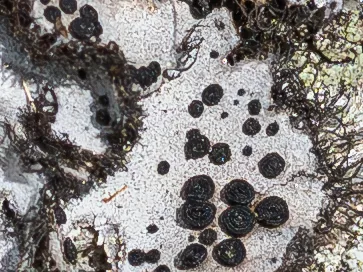
Foto yang diasosiasikan dengan Umbilicaria cylindrica pada iNaturalist. Identifikasi mengikuti sumber; bukan penentuan spesimen independen.
Kredit dan penggunaan
(c) rainerburkard, some rights reserved (CC BY), uploaded by rainerburkard
Ukuran dan format gambar disesuaikan tanpa pemotongan, retus, atau penambahan skala. Lisensi sumber dipertahankan.
Sumber profil
- [1] Umbilicaria cylindrica — Wikipedia (en)
- [2] Catalogue of Life Base2026-09-11 — Umbilicaria cylindrica
- [3] Dokumentasi visual — Umbilicaria cylindrica
- [4] Dokumentasi visual — Umbilicaria cylindrica
Rujukan halaman ini
Fungi. Umbilicaria cylindrica. Rilis data fungi-2026-10-12-expansion-2. https://fungi-atlas.mgadib.chatgpt.site/jamur/umbilicaria-cylindrica/.
Status: impor sumber; pemeriksaan editorial per profil belum selesai. Untuk klaim biologis, gunakan rujukan pada bagian terkait dan periksa konteks sumber aslinya.