01 / Morfologi

Ciri dan struktur

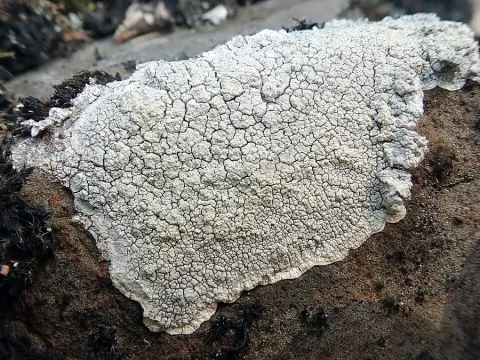
Varicellaria philippina is a crustose lichen with a somewhat thick, continuous thallus that is mostly smooth but can be slightly wrinkled, especially when young, where small wart-like beginnings of the fruiting bodies may appear. The thallus is whitish. In simple spot tests it reacts K− and C+ (red), the colour change being strong inside and faint on the surface. Soredia and isidia are absent. The medulla is I− (does not colour with iodine), and the is whitish and indistinct. The compound fruiting bodies () are crowded and nearly touching, measuring 0.7–1(–1.5) mm across. They are raised, at first slightly depressed and rounded, later becoming irregularly cylindrical with a slightly narrowed base. Each pseudostroma contains one, occasionally two, apothecia. As they mature, the disc opens to about 0.5 mm wide, forming a shallow, urn-shaped cavity that is pale and somewhat bare. The margin is prominent, fairly smooth to slightly -, and the same colour as the thallus. Both the pseudostromata and the disc are K− and C+ (red). The spores are two per ascus, colourless, oblong, and rounded to obtuse at the ends. They are non-gelatinous, with smooth walls about 6 μm thick, and measure 110–140 μm × 24–30 μm V. philippina is morphologically and chemically similar to V. velata, as noted by Vainio, but V. velata has single-spored asci.

Sebagian uraian ditampilkan dalam bahasa sumber; terjemahannya belum tersedia atau belum lolos pemeriksaan.

Rujukan: [1]

Pengukuran mengikuti objek, spesimen atau kultur, dan metode yang disebutkan sumber. Baca uraian asli untuk konteks lengkap.

02 / Kehidupan

Habitat dan peran ekologis

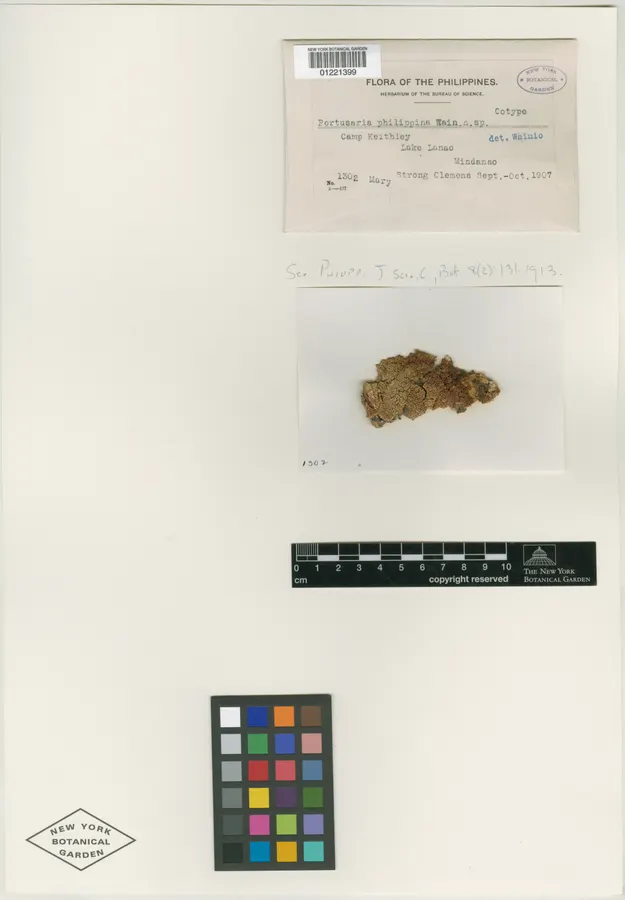
The species was described from Mindanao, Lanao District, Camp Keithley near Lake Lanao, based on a collection made by Mary Strong Clemens (no. 1302) from the trunk of a broad-leaved tree. It has also been collected from Papua New Guinea. Varicellaria philippina is one of three Varicellaria species that have been recorded from the Philippines.

Sebagian uraian ditampilkan dalam bahasa sumber; terjemahannya belum tersedia atau belum lolos pemeriksaan.

Rujukan: [1]

Habitat atau konteks temuan
Informasi belum tersedia pada sumber rilis ini.
Substrat
Informasi belum tersedia pada sumber rilis ini.
Peran atau konteks
Pembentuk liken
Temukan hubungan serupa
03 / Siklus hidup

Reproduksi

Varicellaria philippina is a crustose lichen with a somewhat thick, continuous thallus that is mostly smooth but can be slightly wrinkled, especially when young, where small wart-like beginnings of the fruiting bodies may appear. The thallus is whitish. In simple spot tests it reacts K− and C+ (red), the colour change being strong inside and faint on the surface. Soredia and isidia are absent. The medulla is I− (does not colour with iodine), and the is whitish and indistinct. The spores are two per ascus, colourless, oblong, and rounded to obtuse at the ends. They are non-gelatinous, with smooth walls about 6 μm thick, and measure 110–140 μm × 24–30 μm V. philippina is morphologically and chemically similar to V. velata, as noted by Vainio, but V. velata has single-spored asci.

Sebagian uraian ditampilkan dalam bahasa sumber; terjemahannya belum tersedia atau belum lolos pemeriksaan.

Rujukan: [1]

Sinonim menurut acuan taksonomi rilis: Pertusaria philippina
04 / Batas informasi

Catatan identitas dan cakupan

  • Nama diterima mengikuti Catalogue of Life Base2026-09-11; uraian mempertahankan konsep dan nama sumber aslinya.
  • Original geographic, specimen and life-cycle scope retained; source import awaits individual editorial review.
  • Impor dan terjemahan otomatis belum diperiksa editorial per profil. Struktur reproduktif yang disebutkan tidak membuktikan seluruh siklus hidup diketahui.
  • Pengukuran pada uraian mengikuti spesimen, kultur, dan metode sumber; angka tidak diperluas ke semua populasi.

Catatan distribusi dalam narasi mengikuti sumbernya. Dokumentasi spesimen atau foto mengikuti catatan sumber. Bukti wilayah Indonesia dan penilaian konservasi tidak disimpulkan dari gambar.

05 / Dokumentasi

Melihat dengan konteks

Voucher herbarium Pertusaria philippina (1221399), The New York Botanical Garden. Identifikasi mengikuti record spesimen sumber. Foto bahan, kemasan, atau label herbarium sebagaimana tersedia pada record institusi; bukan foto lapangan atau penentuan spesimen independen.

Jenis
Voucher herbarium
Kredit
The New York Botanical Garden
Lisensi
CC BY 4.0
Sumber media
Buka entri sumber

Gambar menunjukkan objek menurut identifikasi sumber, bukan verifikasi independen spesimen oleh Fungi. Tidak ada skala baru yang ditambahkan.

06 / Rujukan

Sumber profil

  1. [1] Varicellaria philippina — Wikipedia (en)Bagian sumber: Frozen revision 1327603386
    Tanggal penghimpunan sumber: 2026-10-12
    Teks sumber: CC BY-SA4.0 · Wikipedia contributors
  2. [2] Catalogue of Life Base2026-09-11 — Varicellaria philippinaBagian sumber: ColDP NameUsage.tsv ID 7FHW3; accepted species; source 2073
    Tanggal penghimpunan sumber: 2026-10-12
  3. [3] Dokumentasi visual — Pertusaria philippinaBagian sumber: Individual media record; identification follows the source, not independent determination
    Tanggal penghimpunan sumber: 2026-10-12
    Media sumber: CC BY 4.0 · The New York Botanical Garden

Adaptasi teks: CC BY-SA 4.0. Wikipedia contributors — Varicellaria philippina — Wikipedia (en)

Uraian asli dan riwayat sumber

Riwayat atau halaman sumber

Ringkasan sumber

Varicellaria philippina is a species of crustose lichen in the family Varicellariaceae. It was first described in 1913 in Mindanao, Philippines, and has since been found in Papua New Guinea as well. The lichen forms a whitish crust on tree bark and produces distinctive raised fruiting structures that contain large ascospores. Originally classified in the genus Pertusaria, it was transferred to Varicellaria in 2012 based on molecular and morphological evidence.

Revisi sumber

Morfologi sumber

Varicellaria philippina is a crustose lichen with a somewhat thick, continuous thallus that is mostly smooth but can be slightly wrinkled, especially when young, where small wart-like beginnings of the fruiting bodies may appear. The thallus is whitish. In simple spot tests it reacts K− and C+ (red), the colour change being strong inside and faint on the surface. Soredia and isidia are absent. The medulla is I− (does not colour with iodine), and the is whitish and indistinct. The compound fruiting bodies () are crowded and nearly touching, measuring 0.7–1(–1.5) mm across. They are raised, at first slightly depressed and rounded, later becoming irregularly cylindrical with a slightly narrowed base. Each pseudostroma contains one, occasionally two, apothecia. As they mature, the disc opens to about 0.5 mm wide, forming a shallow, urn-shaped cavity that is pale and somewhat bare. The margin is prominent, fairly smooth to slightly -, and the same colour as the thallus. Both the pseudostromata and the disc are K− and C+ (red). The spores are two per ascus, colourless, oblong, and rounded to obtuse at the ends. They are non-gelatinous, with smooth walls about 6 μm thick, and measure 110–140 μm × 24–30 μm V. philippina is morphologically and chemically similar to V. velata, as noted by Vainio, but V. velata has single-spored asci.

Revisi sumber

Ekologi sumber

The species was described from Mindanao, Lanao District, Camp Keithley near Lake Lanao, based on a collection made by Mary Strong Clemens (no. 1302) from the trunk of a broad-leaved tree. It has also been collected from Papua New Guinea. Varicellaria philippina is one of three Varicellaria species that have been recorded from the Philippines.

Revisi sumber

Struktur reproduksi sumber

Varicellaria philippina is a crustose lichen with a somewhat thick, continuous thallus that is mostly smooth but can be slightly wrinkled, especially when young, where small wart-like beginnings of the fruiting bodies may appear. The thallus is whitish. In simple spot tests it reacts K− and C+ (red), the colour change being strong inside and faint on the surface. Soredia and isidia are absent. The medulla is I− (does not colour with iodine), and the is whitish and indistinct. The spores are two per ascus, colourless, oblong, and rounded to obtuse at the ends. They are non-gelatinous, with smooth walls about 6 μm thick, and measure 110–140 μm × 24–30 μm V. philippina is morphologically and chemically similar to V. velata, as noted by Vainio, but V. velata has single-spored asci.

Revisi sumber

Rujukan halaman ini

Fungi. Varicellaria philippina. Rilis data fungi-2026-10-12-expansion-2. https://fungi-atlas.mgadib.chatgpt.site/jamur/varicellaria-philippina/.

Status: impor sumber; pemeriksaan editorial per profil belum selesai. Untuk klaim biologis, gunakan rujukan pada bagian terkait dan periksa konteks sumber aslinya.