Ciri dan struktur
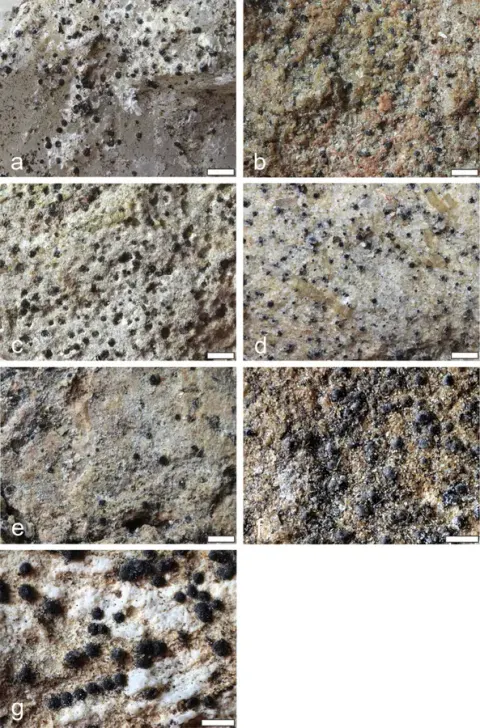
Verrucaria nigrescens is a crustose lichen that forms a superficial, dark brown layer varying in thickness from thin to thick (100–500 μm). The thallus (main body) is characteristically divided into small polygonal sections called , which measure 200–800 μm in diameter. These areoles typically have smooth surfaces that range from flat to slightly convex, with occasional (bud-like) margins. The sides of these areoles appear brown to blackish in colour. The lichen generally lacks a (an initial growth stage visible at the edges), or if present, it is inconspicuous or slightly darker than the main thallus, sometimes visible in the spaces between areoles. Internally, the lichen has a thin upper (protective outer layer) measuring 10–20 μm thick, with a brownish uppermost portion. Beneath this lies the (30–120 μm thick), where the photosynthetic cells are arranged in approximately vertical columns. The medulla (inner layer) features a distinctive black basal layer comprising half to two-thirds of the thallus thickness. The reproductive structures, called perithecia, are partially in the thallus (half to three-quarters embedded), with typically one perithecium per areole. The apex (top) of each perithecium ranges from flat to hemispherical in shape. The (a protective covering around the perithecium) measures 200–400 μm in diameter and can be hemispherical or extend to the base level of the perithecium. In cross-section, perithecia measure 150–250 μm in diameter, with a dark brown (inner wall of the fruiting body). The (spores produced in specialised cells called asci) are ellipsoidal in shape, typically measuring 19–27 by 8–14 μm.
Habitat dan peran ekologis
Verrucaria nigrescens is a widely distributed species in the Northern Hemisphere. It is typically found growing on sun-exposed limestone, in habitats that are somewhat eutrophic. Verrucaria nigrescens is among several calcicolous lichen species grazed by terrestrial snails. Laboratory studies have shown that three snail species—Balea perversa, Helicigona lapicida, and Clausilia bidentata—intensively graze on V. nigrescens, whereas the snail species Chondrina clienta tends to avoid it. The selective grazing is likely influenced by physical characteristics of the lichen, such as the tissues, since V. nigrescens does not produce chemical defence metabolites common in other lichens. Snail herbivory has implications for the survival and colonisation strategies of lichens, potentially affecting their population dynamics and ecological interactions on calcareous substrates. Several species of lichenicolous (lichen-dwelling) fungi have been recorded inhabiting Verrucaria nigrescens populations in Ukraine. These include Endococcus rugulosus, Muellerella lichenicola, Opegrapha opaca, Polycoccum marmoratum, Zwackhiomyces calcisedus, and Zwackhiomyces lithoiceae.
- Habitat atau konteks temuan
- Informasi belum tersedia pada sumber rilis ini.
- Substrat
- Informasi belum tersedia pada sumber rilis ini.
- Peran atau konteks
- Pembentuk liken
Reproduksi
The reproductive structures, called perithecia, are partially in the thallus (half to three-quarters embedded), with typically one perithecium per areole. The apex (top) of each perithecium ranges from flat to hemispherical in shape. The (a protective covering around the perithecium) measures 200–400 μm in diameter and can be hemispherical or extend to the base level of the perithecium. In cross-section, perithecia measure 150–250 μm in diameter, with a dark brown (inner wall of the fruiting body). The (spores produced in specialised cells called asci) are ellipsoidal in shape, typically measuring 19–27 by 8–14 μm. Conidiomata (asexual reproductive structures) have not been observed in this species.
Catatan identitas dan cakupan
- Nama diterima mengikuti Catalogue of Life Base2026-09-11; uraian mempertahankan konsep dan nama sumber aslinya.
- Original geographic, specimen and life-cycle scope retained; source import awaits individual editorial review.
- Impor dan terjemahan otomatis belum diperiksa editorial per profil. Struktur reproduktif yang disebutkan tidak membuktikan seluruh siklus hidup diketahui.
- Pengukuran pada uraian mengikuti spesimen, kultur, dan metode sumber; angka tidak diperluas ke semua populasi.
Catatan distribusi dalam narasi mengikuti sumbernya. Dokumentasi spesimen atau foto mengikuti catatan sumber. Bukti wilayah Indonesia dan penilaian konservasi tidak disimpulkan dari gambar.
Melihat dengan konteks
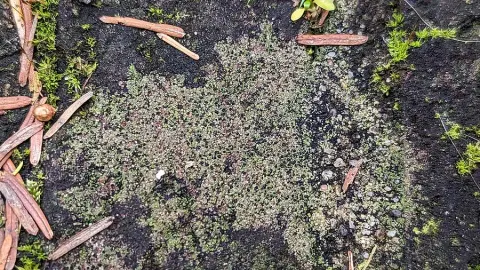
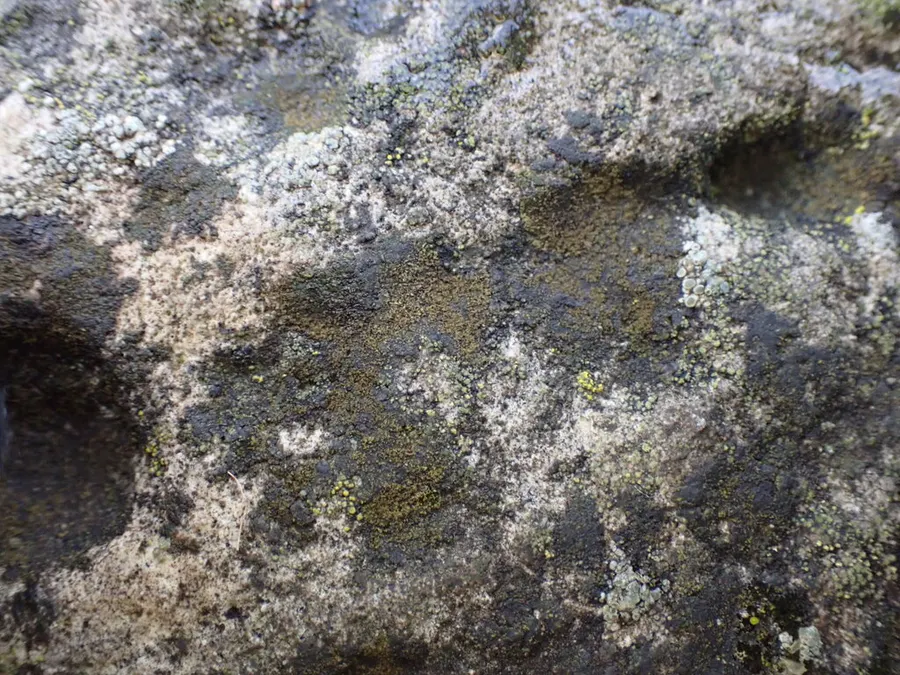
Dokumentasi Verrucaria tectorum menurut asosiasi foto pada record takson iNaturalist. Kredit: Sam Buckton. Identitas mengikuti sumber; bukan penentuan spesimen independen.
- Jenis
- Fotografi
- Kredit
- no rights reserved, uploaded by Sam Buckton
- Lisensi
- CC0 1.0
- Sumber media
- Buka entri sumber
Sumber profil
- [1] Verrucaria nigrescens — Wikipedia (en)
- [2] Catalogue of Life Base2026-09-11 — Verrucaria nigrescens
- [3] Dokumentasi visual — Verrucaria tectorum
Rujukan halaman ini
Fungi. Verrucaria nigrescens. Rilis data fungi-2026-10-12-expansion-2. https://fungi-atlas.mgadib.chatgpt.site/jamur/verrucaria-nigrescens/.
Status: impor sumber; pemeriksaan editorial per profil belum selesai. Untuk klaim biologis, gunakan rujukan pada bagian terkait dan periksa konteks sumber aslinya.