01 / Morfologi

Ciri dan struktur

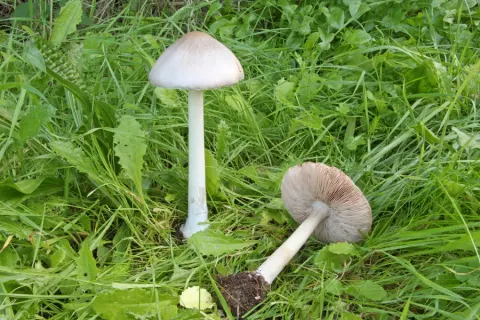
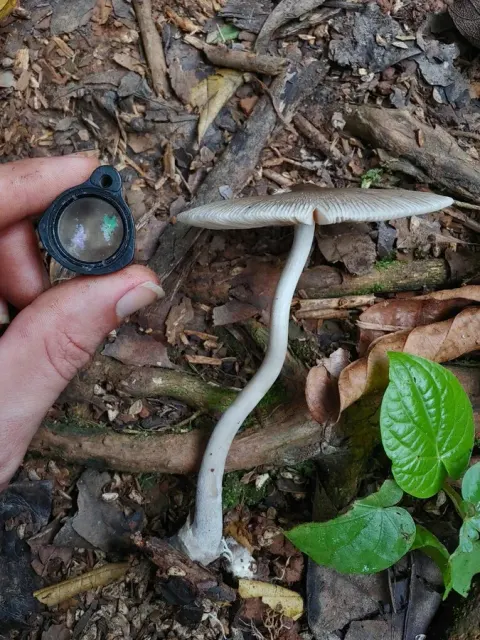
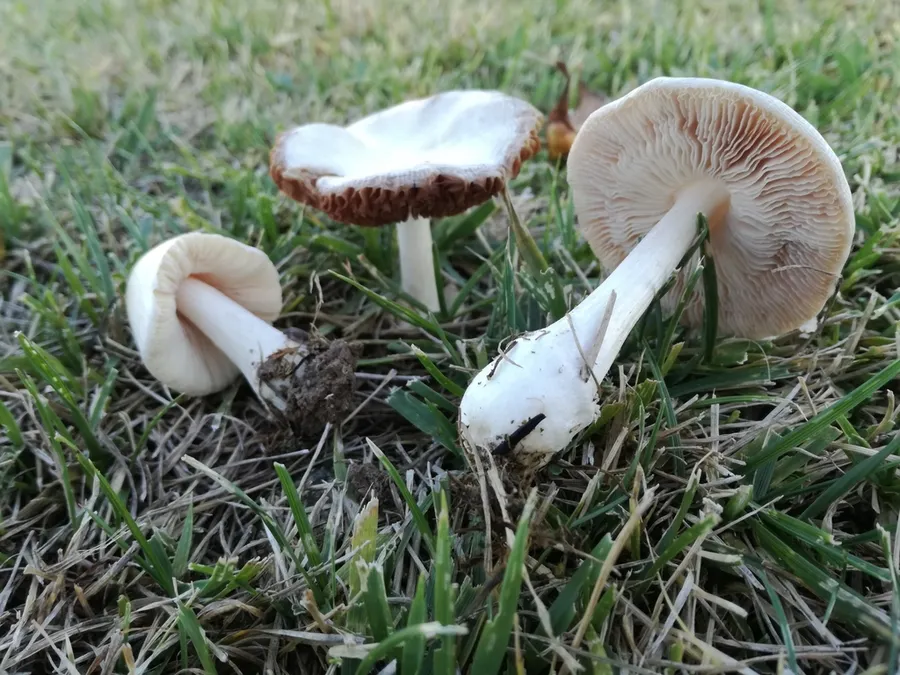
The cap of Volvopluteus earlei is between 25 and 50 mm in diameter, more or less ovate or hemispherical when young, then expanding to convex or flat. It can have a low, broad umbo in the center in old specimens; the surface is markedly viscid in fresh fruit bodies; the cap is pure white, but sometimes develops pale brown tinges with age. The gills are crowded together, free from attachment to the stipe, ventricose, and up to 6 mm broad; they are white when young but turn pink with age as the spores mature. The cylindrical stipe is 30 – 50 mm long and 2 – 10 mm wide, and broadening towards the base. Its surface is white, smooth or slightly pruinose (as if covered with a fine white powder). The sac-like volva is up to 20 mm high, white and has a smooth surface. The context is white in the stipe and cap and it does not change color when bruised or exposed to air. The smell and taste of the flesh are described as indistinct or herbaceous. The spore print is pinkish-brown. The spores are ellipsoid and measure 11–16 by 8–11 μm. Basidia are 20–40 by 8–16 μm; they are usually four-spored but sometimes two-spored, and, more rarely, one-spored forms can occur. Pleurocystidia (cystidia on the gill face) are absent in most collections; if present they are scarce and similar to the cheilocystidia. Cheilocystidia (cystidia on the gill edge) measure 30–70 by 10–35 μm, and are club-, spindle-, or flask-shaped, and usually each one has an apical outgrowth up to 40 μm long. The cheilocystidia completely cover the gill edge. In the form acystidiatus (N.C.Pathak) Vizzini & Contu, both pleurocystidia and cheilocystidia are completely absent.

Sebagian uraian ditampilkan dalam bahasa sumber; terjemahannya belum tersedia atau belum lolos pemeriksaan.

Rujukan: [1]

Pengukuran mengikuti objek, spesimen atau kultur, dan metode yang disebutkan sumber. Baca uraian asli untuk konteks lengkap.

02 / Kehidupan

Habitat dan peran ekologis

Volvopluteus earlei is a saprotrophic mushroom that grows in gardens and grassy fields. It was originally found in banana fields in Cuba. In Africa, Spain and Italy it has been reported mostly in urban or anthropogenic garden areas. It usually fruits in groups of several mushrooms but it can also be found growing solitary. This species has been reported from Cuba, North Carolina, Mexico, Spain and Italy. Molecular data have so far corroborated that the European and African collections correspond to the same species.

Sebagian uraian ditampilkan dalam bahasa sumber; terjemahannya belum tersedia atau belum lolos pemeriksaan.

Rujukan: [1]

Habitat atau konteks temuan
Informasi belum tersedia pada sumber rilis ini.
Substrat
Informasi belum tersedia pada sumber rilis ini.
Peran atau konteks
Pengurai
Temukan hubungan serupa
03 / Siklus hidup

Reproduksi

The cap of Volvopluteus earlei is between 25 and 50 mm in diameter, more or less ovate or hemispherical when young, then expanding to convex or flat. It can have a low, broad umbo in the center in old specimens; the surface is markedly viscid in fresh fruit bodies; the cap is pure white, but sometimes develops pale brown tinges with age. The gills are crowded together, free from attachment to the stipe, ventricose, and up to 6 mm broad; they are white when young but turn pink with age as the spores mature. The cylindrical stipe is 30 – 50 mm long and 2 – 10 mm wide, and broadening towards the base. Its surface is white, smooth or slightly pruinose (as if covered with a fine white powder). The sac-like volva is up to 20 mm high, white and has a smooth surface.

Sebagian uraian ditampilkan dalam bahasa sumber; terjemahannya belum tersedia atau belum lolos pemeriksaan.

Rujukan: [1]

Sinonim menurut acuan taksonomi rilis: Volvaria earlei; Volvariella acystidiata; Volvariella earlei; Volvariopsis earlei; Volvopluteus earlei f. acystidiatus
04 / Batas informasi

Catatan identitas dan cakupan

  • Nama diterima mengikuti Catalogue of Life Base2026-09-11; uraian mempertahankan konsep dan nama sumber aslinya.
  • Original geographic, specimen and life-cycle scope retained; source import awaits individual editorial review.
  • Impor dan terjemahan otomatis belum diperiksa editorial per profil. Struktur reproduktif yang disebutkan tidak membuktikan seluruh siklus hidup diketahui.
  • Pengukuran pada uraian mengikuti spesimen, kultur, dan metode sumber; angka tidak diperluas ke semua populasi.

Catatan distribusi dalam narasi mengikuti sumbernya. Dokumentasi spesimen atau foto mengikuti catatan sumber. Bukti wilayah Indonesia dan penilaian konservasi tidak disimpulkan dari gambar.

05 / Dokumentasi

Melihat dengan konteks

Dokumentasi Volvopluteus earlei menurut asosiasi foto pada record takson iNaturalist. Kredit: Davide Puddu. Identitas mengikuti sumber; bukan penentuan spesimen independen.

Jenis
Fotografi
Kredit
(c) Davide Puddu, some rights reserved (CC BY), uploaded by Davide Puddu
Lisensi
CC BY 4.0
Sumber media
Buka entri sumber

Gambar menunjukkan objek menurut identifikasi sumber, bukan verifikasi independen spesimen oleh Fungi. Tidak ada skala baru yang ditambahkan.

06 / Rujukan

Sumber profil

  1. [1] Volvopluteus earlei — Wikipedia (en)Bagian sumber: Frozen revision 1342492245
    Tanggal penghimpunan sumber: 2026-10-12
    Teks sumber: CC BY-SA4.0 · Wikipedia contributors
  2. [2] Catalogue of Life Base2026-09-11 — Volvopluteus earleiBagian sumber: ColDP NameUsage.tsv ID 5BQRD; accepted species; source 2073
    Tanggal penghimpunan sumber: 2026-10-12
  3. [3] Dokumentasi visual — Volvopluteus earleiBagian sumber: Individual media record; identification follows the source, not independent determination
    Tanggal penghimpunan sumber: 2026-10-12
    Media sumber: CC BY 4.0 · (c) Davide Puddu, some rights reserved (CC BY), uploaded by Davide Puddu

Adaptasi teks: CC BY-SA 4.0. Wikipedia contributors — Volvopluteus earlei — Wikipedia (en)

Uraian asli dan riwayat sumber

Riwayat atau halaman sumber

Ringkasan sumber

Volvopluteus earlei is a species of mushroom in the family Pluteaceae. It was originally described in 1911 by American mycologist William Alphonso Murrill as Volvariopsis earlei, based on collections made in a Cuban banana field. The fungus was later shuffled to the genera Volvaria and Volvariella before molecular studies placed it in Volvopluteus, a genus newly described in 2011. The cap of Volvopluteus earlei is typically between 2.5 – 5 cm in diameter, white, and is markedly viscid when fresh.

Revisi sumber

Morfologi sumber

The cap of Volvopluteus earlei is between 25 and 50 mm in diameter, more or less ovate or hemispherical when young, then expanding to convex or flat. It can have a low, broad umbo in the center in old specimens; the surface is markedly viscid in fresh fruit bodies; the cap is pure white, but sometimes develops pale brown tinges with age. The gills are crowded together, free from attachment to the stipe, ventricose, and up to 6 mm broad; they are white when young but turn pink with age as the spores mature. The cylindrical stipe is 30 – 50 mm long and 2 – 10 mm wide, and broadening towards the base. Its surface is white, smooth or slightly pruinose (as if covered with a fine white powder). The sac-like volva is up to 20 mm high, white and has a smooth surface. The context is white in the stipe and cap and it does not change color when bruised or exposed to air. The smell and taste of the flesh are described as indistinct or herbaceous. The spore print is pinkish-brown. The spores are ellipsoid and measure 11–16 by 8–11 μm. Basidia are 20–40 by 8–16 μm; they are usually four-spored but sometimes two-spored, and, more rarely, one-spored forms can occur. Pleurocystidia (cystidia on the gill face) are absent in most collections; if present they are scarce and similar to the cheilocystidia. Cheilocystidia (cystidia on the gill edge) measure 30–70 by 10–35 μm, and are club-, spindle-, or flask-shaped, and usually each one has an apical outgrowth up to 40 μm long. The cheilocystidia completely cover the gill edge. In the form acystidiatus (N.C.Pathak) Vizzini & Contu, both pleurocystidia and cheilocystidia are completely absent.

Revisi sumber

Ekologi sumber

Volvopluteus earlei is a saprotrophic mushroom that grows in gardens and grassy fields. It was originally found in banana fields in Cuba. In Africa, Spain and Italy it has been reported mostly in urban or anthropogenic garden areas. It usually fruits in groups of several mushrooms but it can also be found growing solitary. This species has been reported from Cuba, North Carolina, Mexico, Spain and Italy. Molecular data have so far corroborated that the European and African collections correspond to the same species.

Revisi sumber

Struktur reproduksi sumber

The cap of Volvopluteus earlei is between 25 and 50 mm in diameter, more or less ovate or hemispherical when young, then expanding to convex or flat. It can have a low, broad umbo in the center in old specimens; the surface is markedly viscid in fresh fruit bodies; the cap is pure white, but sometimes develops pale brown tinges with age. The gills are crowded together, free from attachment to the stipe, ventricose, and up to 6 mm broad; they are white when young but turn pink with age as the spores mature. The cylindrical stipe is 30 – 50 mm long and 2 – 10 mm wide, and broadening towards the base. Its surface is white, smooth or slightly pruinose (as if covered with a fine white powder). The sac-like volva is up to 20 mm high, white and has a smooth surface.

Revisi sumber

Rujukan halaman ini

Fungi. Volvopluteus earlei. Rilis data fungi-2026-10-12-expansion-2. https://fungi-atlas.mgadib.chatgpt.site/jamur/volvopluteus-earlei/.

Status: impor sumber; pemeriksaan editorial per profil belum selesai. Untuk klaim biologis, gunakan rujukan pada bagian terkait dan periksa konteks sumber aslinya.