Ciri dan struktur
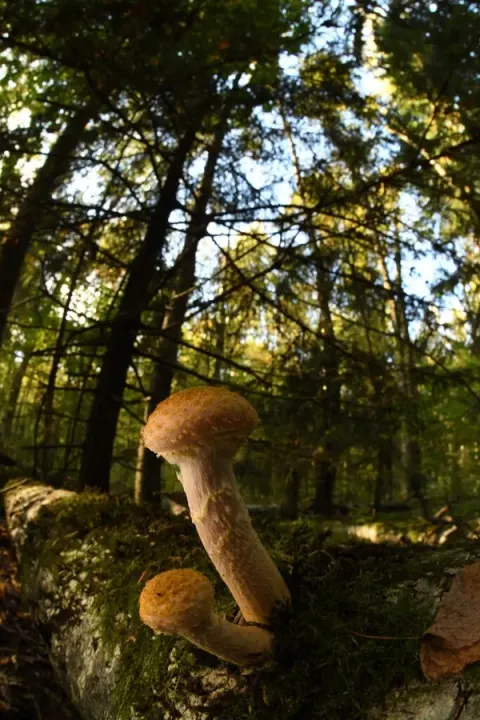
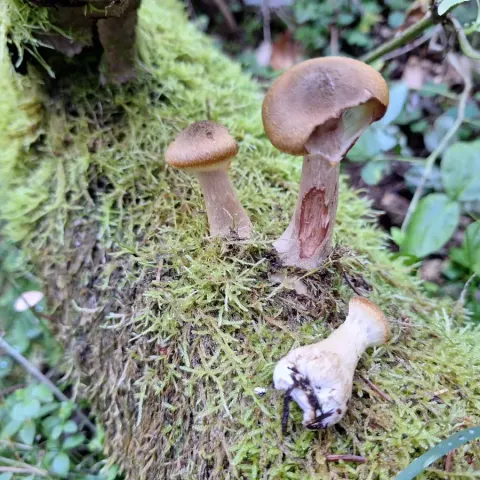
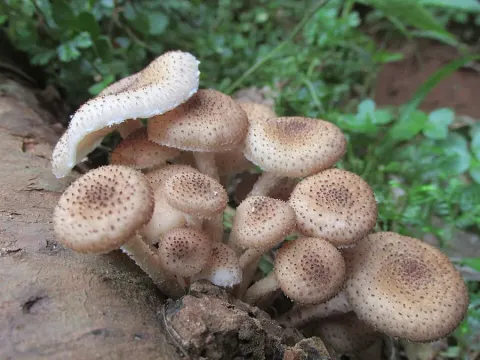
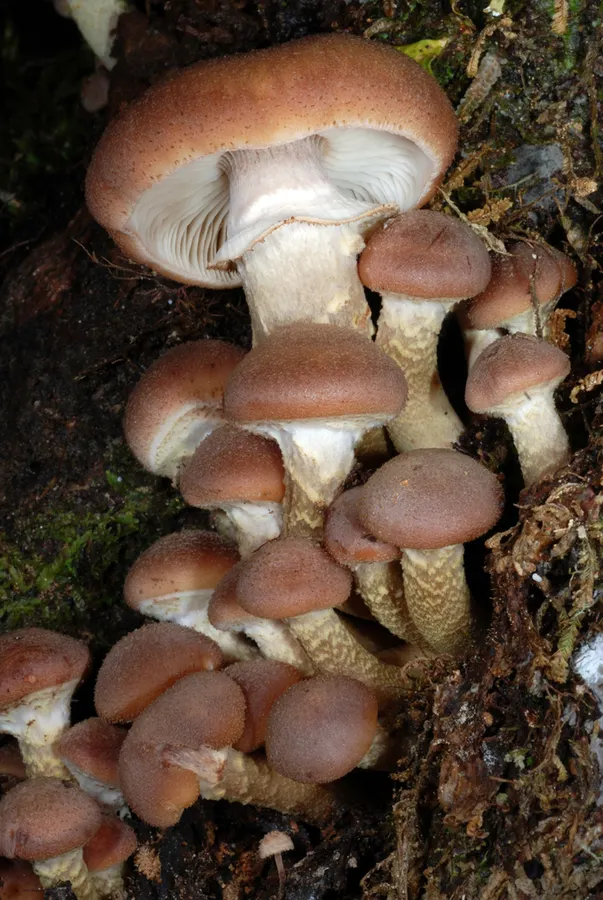
Armillaria aotearoa produces fruiting bodies (basidiomata) that grow in clusters (caespitose), with centrally positioned stalks supporting the caps. The cap, or pileus, measures between 35 and 60 mm across and is pinkish-brown to brown. The surface is dry and moderately smooth, scattered with small, dark granular scales that are more concentrated toward the centre. Initially convex, the cap flattens over time but retains a distinctive broad zone at the edges that darkens when it absorbs moisture (hygrophanous) but does not become sticky. The flesh of the cap is off-white to pale pink. The gills are attached near the top of the stalk (adnexed), moderately packed, and pale pink in colour. The stalk, or stipe, ranges from 35 to 90 mm in length, with a bulbous base and pale pinkish-brown colour that may show faint green or yellowish tones. It is dry, with tiny, scattered fibrils, and eventually hollows out as it matures. The flesh of the stipe is also off-white to pale pink. A partial veil forms a ring (annulus) around the stalk, with the underside matching the colour of the stipe and featuring concentrically arranged darker flecks. Armillaria aotearoa has rhizomorphs—root-like structures typical of the genus—that are black and show uneven branching. Microscopic examination reveals that the tissue within the gills (gill trama) is composed of thick-walled, inflated hyphae arranged in layers, with no clamp connections observed. The basidia (spore-producing cells) are club-shaped, bearing four spores each, and measure 31–49 by 5–9.5 μm. The spores are smooth, thin- to moderately thick-walled, ellipsoid to ovoid, and range from 7.5 to 10.5 μm in length and 5 to 7.5 μm in width; they are non-amyloid, meaning they do not stain with iodine, and appear transparent (hyaline) under a microscope.
Habitat dan peran ekologis
The species is known from the Taupo region of the North Island and Mid-Canterbury region of the South Island of Aotearoa New Zealand. Armillaria aotearoa is found in southern beech (Nothofagaceae) forests, on woody debris of Fuscospora fusca (Nothofagus fusca), Lophozonia menziesii (Nothofagus menziesii) and Fuscospora cliffortioides (Nothofagus solandri var. cliffortioides). Fruiting occurs between late April and mid-June.
- Habitat atau konteks temuan
- hutan
- Substrat
- Informasi belum tersedia pada sumber rilis ini.
- Peran atau konteks
- Belum dikategorikan pada rilis ini.
Reproduksi
Armillaria aotearoa produces fruiting bodies (basidiomata) that grow in clusters (caespitose), with centrally positioned stalks supporting the caps. The cap, or pileus, measures between 35 and 60 mm across and is pinkish-brown to brown. The surface is dry and moderately smooth, scattered with small, dark granular scales that are more concentrated toward the centre. Initially convex, the cap flattens over time but retains a distinctive broad zone at the edges that darkens when it absorbs moisture (hygrophanous) but does not become sticky. The flesh of the cap is off-white to pale pink. Armillaria aotearoa has rhizomorphs—root-like structures typical of the genus—that are black and show uneven branching.
Catatan identitas dan cakupan
- Nama diterima mengikuti Catalogue of Life Base2026-09-11; uraian mempertahankan konsep dan nama sumber aslinya.
- Original geographic, specimen and life-cycle scope retained; source import awaits individual editorial review.
- Impor dan terjemahan otomatis belum diperiksa editorial per profil. Struktur reproduktif yang disebutkan tidak membuktikan seluruh siklus hidup diketahui.
- Pengukuran pada uraian mengikuti spesimen, kultur, dan metode sumber; angka tidak diperluas ke semua populasi.
Catatan distribusi dalam narasi mengikuti sumbernya. Dokumentasi spesimen atau foto mengikuti catatan sumber. Bukti wilayah Indonesia dan penilaian konservasi tidak disimpulkan dari gambar.
Melihat dengan konteks
Dokumentasi Armillaria aotearoa menurut asosiasi foto pada record takson iNaturalist. Kredit: Jerry Cooper. Identitas mengikuti sumber; bukan penentuan spesimen independen.
- Jenis
- Fotografi
- Kredit
- (c) Jerry Cooper, some rights reserved (CC BY), uploaded by Jerry Cooper
- Lisensi
- CC BY 4.0
- Sumber media
- Buka entri sumber
Sumber profil
- [1] Armillaria aotearoa — Wikipedia (en)
- [2] Catalogue of Life Base2026-09-11 — Armillaria aotearoa
- [3] Dokumentasi visual — Armillaria aotearoa
Rujukan halaman ini
Fungi. Armillaria aotearoa. Rilis data fungi-2026-10-12-expansion-2. https://fungi-atlas.mgadib.chatgpt.site/jamur/armillaria-aotearoa/.
Status: impor sumber; pemeriksaan editorial per profil belum selesai. Untuk klaim biologis, gunakan rujukan pada bagian terkait dan periksa konteks sumber aslinya.